Melitopol
Grey BeesMelitopol appears as a waypoint on Sergeyich’s return journey: a stretch of road where exhaustion, the presence of military traffic, and the cultivated landscape bring his passage through a country at war into the same frame as his wish to get home.
The road and its weariness
The road to Melitopol runs smoothly between fields, but the ease of the route does not ease Sergeyich’s journey. Sunlight strikes his eyes while wind blows in his face; he wants to close his eyes, yet keeps driving, squinting and yawning. His hands are tired from turning the wheel, and his fingers are going numb. The accumulated strain has a specific history: a nearly sleepless night, an early start, anxious waiting at the Russian border, and the running between buses and the train station in Novooleksiyivka. Together, these demands weigh on him like ten tons of coal.
A glance toward the back seat turns the pause in his attention into a small reminder of care. Seeing the bag, Sergeyich realizes that Vitalina left without eating. The thought interrupts the forward movement of the journey with concern for someone absent, while his physical fatigue continues to press on him.
War beside the way home
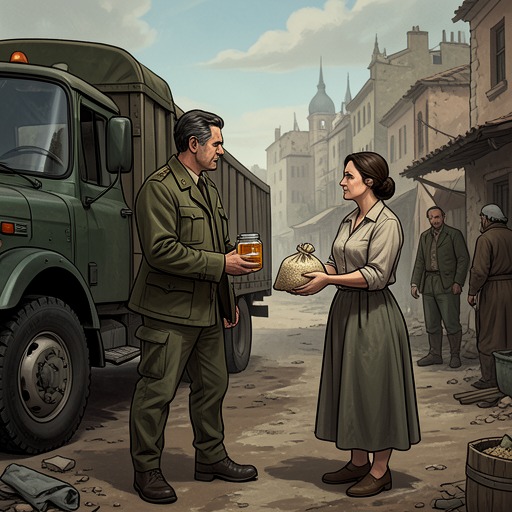
As evening catches up with him beyond Melitopol, Sergeyich meets a short convoy returning from the war: two armoured personnel carriers, one towing a tank on a trailer, followed by two Ural 6x6 trucks and a green U.A.Z. jeep. He reads the drivers’ faces as evidence that they are coming back from combat, but distinguishes their direction from his own: he is not heading to war; he is going home.
That distinction is immediately unsettled by the condition of home itself. Little Starhorodivka lies in the middle of the war, yet Sergeyich sees it as taking no part in the fighting: no one fires at the enemy from his yard, windows, or fence, and so, he reasons, his home has no enemies. He connects this absence of combat activity with the fact that the house remains standing, untouched by the mines and shells that have fallen on the village over the previous three years. Melitopol’s road therefore marks not an escape from war but a passage toward a home situated within it.
Landscape and the return
After the convoy, the road opens ahead between passing apricot trees. Beyond them, watermelons fill the fields on the right and beans those on the left. This worked, abundant landscape stands beside the military vehicles without erasing their presence; the journey holds fields and war traffic together as neighboring realities.
Thinking of the checkpoints still ahead, Sergeyich decides that he should stock up on necessities before reaching them. The practical calculation extends the journey’s tension beyond Melitopol: the road remains open, but the return is not complete, and its next stage is shaped by checkpoint passage as well as distance. Melitopol’s significance lies in this transition, where bodily exhaustion, routine preparation, and the visible machinery of war accompany Sergeyich toward home.