Mikhalych
Grey BeesMikhalych is a history teacher and former teacher of Valik who tries to restrain him during a drunken confrontation with Sergey Sergeyich. His intervention begins as an attempt to prevent a fight, then becomes an uneasy act of protection: he holds Sergeyich back while Valik wrecks the beekeeper’s car, pleading that Valik is shell-shocked and cannot be stopped. In this brief encounter, Mikhalych’s practical knowledge of a former pupil’s violence protects one person from an immediate assault while leaving another exposed to damage.
Identity and Introduction
Mikhalych arrives with Valik as an uninvited visitor to Sergeyich’s tent. When Valik staggers forward and tries to punch the beekeeper, Mikhalych pulls him back. He is described as older than Valik, but younger than Sergeyich by perhaps five or seven years. The account identifies him as a history teacher: Valik later contrasts his own experience in the trenches with Mikhalych’s work telling stories to children at school.
That contrast gives Mikhalych a distinct position in the confrontation. He is not presented as a combatant, and he does not claim to have shared Valik’s experience of shelling or concussion. Instead, his authority comes from knowing Valik before the encounter and recognizing what the young man may do next. His attempt to stop the violence is neither an abstract appeal to calm nor confidence that Valik will listen; it is the intervention of someone who knows the person he is trying to restrain.
Intervening in the Confrontation
Valik accuses Sergeyich of being responsible for Sashka’s death and directs his anger at him. Mikhalych repeatedly tries to de-escalate the encounter, first demanding that Valik calm down and then physically pulling him away when he lunges. Valik answers by invoking his own wartime experience: he says that he lay in trenches under shellfire and suffered a concussion, while Mikhalych was busy teaching children. The accusation makes their difference in experience part of the conflict, even as Mikhalych continues trying to control its consequences.
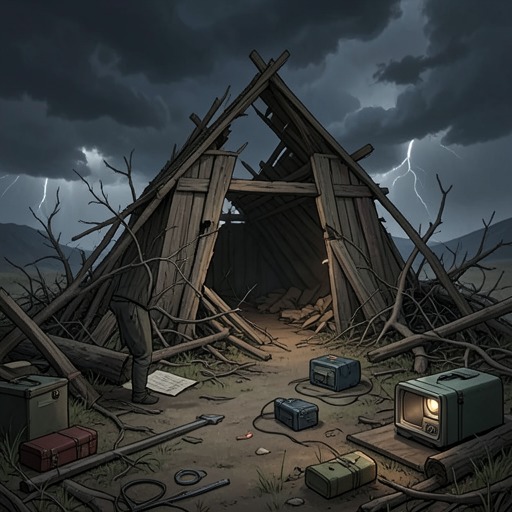
When Sergeyich invites the visitors into the tent, Mikhalych enters and looks at the candle and icon. His expression softens. He is the one listening when Sergeyich says he commemorated the fallen and lit a candle; Valik, by contrast, is staring at the axe outside. The moment briefly shifts the encounter away from accusation toward the ritual of remembrance. Mikhalych’s attention to the candle and icon suggests that he can receive the beekeeper’s account, but it does not settle the conflict or persuade Valik to join them.
Teacher, Former Pupil, and Protector
Inside the tent, Sergeyich proposes commemorating the fallen. Mikhalych agrees, and Sergeyich pours him a glass. Their shared observance offers a brief, tentative pause between the older men while Valik remains outside. When Sergeyich asks whether Valik is coming in, Mikhalych says that he is probably having a smoke and adds that Valik used to be all right, recalling that he taught him history. The remark connects the violent young man at the door with a former pupil and implies a past that is not reducible to this outburst.
Mikhalych’s knowledge of Valik also shapes his warning when Sergeyich hears him attacking the car. The beekeeper tries to get past the teacher, but Mikhalych grabs him by the shoulders and pushes him back onto the sleeping bag. He explains that Valik is shell-shocked and completely out of control, and that Sergeyich will not stop him now. His plea is urgent rather than commanding: he asks Sergeyich to stay put because, in his judgment, intervention would only escalate the danger.
The Cost of Containment
Sergeyich is not willing to accept the damage passively. He fears Valik may go after his bees and insists that he is not afraid of him. He nearly gets out of the tent, but Mikhalych catches his left hand and pulls with all his strength, sending him back onto the sleeping bag. The action makes Mikhalych’s protective strategy physical: to keep Sergeyich safe from a confrontation, he must restrain him against his will.
That restraint has a visible cost. While Mikhalych keeps Sergeyich inside, Valik is wrecking the beekeeper’s car. The scene does not show Mikhalych stopping the attack or preventing the loss; instead, he asks Sergeyich to wait about ten minutes while Valik smokes and calms down, promising that he will then go out and take him home. His knowledge of Valik may make this a considered attempt to limit further violence, but for Sergeyich the immediate consequence is helplessness and distrust. Mikhalych looks into that distrust, cannot bear the beekeeper’s gaze, and turns away with his eyes lowered.
Narrative Role
Mikhalych occupies the uneasy space between explanation and accountability. He knows Valik as a former student and recognizes his shell shock, yet that understanding cannot undo the destruction unfolding outside the tent. His intervention prevents the confrontation from becoming a direct fight between Valik and Sergeyich, but it also prevents Sergeyich from defending his property. By making the act of restraint both caring and costly, the episode refuses an easy distinction between protection and complicity: Mikhalych is trying to keep the situation from worsening, while the beekeeper watches his car being destroyed.
The encounter also sets two forms of remembrance against each other. Sergeyich has lit a candle for the fallen, and Mikhalych responds to the candle and icon with softened eyes; Valik, unable to accept the ceremony as sufficient, directs his grief and wartime anger toward Sergeyich. Mikhalych can listen to the ritual and understand something of the young man’s condition, but he cannot reconcile those competing responses. His final lowered gaze leaves that failure of mediation unresolved.