Muslim memorial days for the deceased
Grey BeesMuslim memorial days for the deceased are presented as a sequence of observances on the third, seventh, fortieth, and fifty-first days after a death. In the story, Aisylu names these occasions while arranging for Sergeyich to attend the next day’s wake for Akhtem. The calendar gives grief a communal form, while Sergeyich’s questions expose how much of that form remains unfamiliar to him.
The calendar of remembrance
After Akhtem’s body has been buried, Sergeyich tells Aisylu that someone he had spoken with called her a widow. She replies that a woman cannot be called a widow before her husband has been buried, adding that she is a widow now and inviting Sergeyich to the wake. Her distinction joins the status of the bereaved to a completed rite: the disappearance and death that preceded burial had left the loss unresolved in a different way.
Sergeyich asks whether nine days have passed. Aisylu corrects him: it is the sixth day, and the next day will be the seventh. When he asks whether the gathering is held on the seventh, she explains that observances occur on the third, seventh, fortieth, and fifty-first days. Her answer supplies a precise pattern of repeated remembrance rather than treating mourning as a single event at the funeral.
The exchange is practical as well as explanatory. Aisylu turns to her son, Bekir, and asks whether he will pick Sergeyich up the following day; Bekir nods. The memorial calendar therefore organizes not only remembrance but also the family’s immediate arrangements and the visitor’s participation.
Burial and the limits of an outsider’s understanding
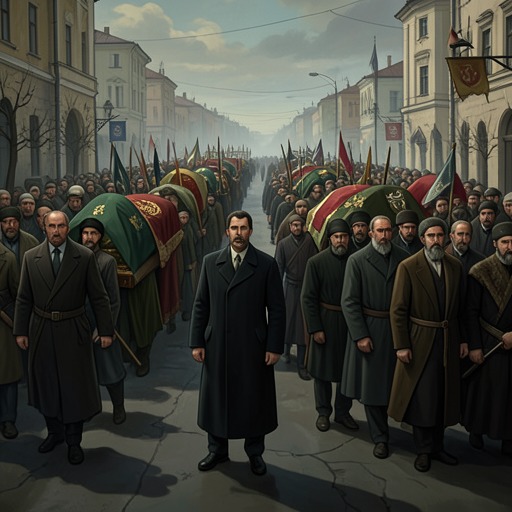
The seventh-day observance follows a funeral at which Sergeyich has already experienced himself as a bee in an unfamiliar hive. Men gather around Akhtem’s body, wrapped in a green pall embroidered with golden Arabic script, and the imam leads prayers in a language Sergeyich does not understand. At the cemetery, he remains near enough to accompany the procession but apart from those closest to the deceased. The funeral makes visible the communal setting in which the later memorial days belong, while his position on its edge underscores his partial understanding.
That distance is not indifference. Sergeyich has sought Akhtem and learned from Aisylu that armed men took him, along with two others, after they had travelled to the mosque in Bakhchysarai. The family had been left with an empty car, a child’s account of men being forced into a minibus, and no news of where the captives were taken. The interval before Akhtem’s body is buried is thus part of the family’s experience of loss; Aisylu’s distinction between a missing husband and a buried one gives that interval a personal and social consequence.
A candle and a boundary of practice
At the household gathering, an imam points to a burning candle and explains something to those present. Aisha promptly goes to the dresser and blows out its flame, and the imam gives her an approving look. The scene presents a specific religious boundary within the domestic setting: the candle Sergeyich has brought into his own habits of mourning is not simply carried over into the family’s observance.
The candle episode and Aisylu’s account of the memorial dates show different ways that grief is shaped by religious practice: one through a sequence of days, another through an action that is stopped. The story does not make Sergeyich an interpreter of either custom. Instead, he asks questions, watches, and adjusts his conduct. At the end of his short conversation with Aisylu and Bekir, neither has touched their tea, so he decides not to finish his own.
Remembrance as repeated communal care
Aisylu’s list of four memorial days gives bereavement a rhythm extending beyond burial. The dates distinguish successive occasions for gathering, while the seventh-day wake brings Sergeyich back into the household after he has attended the funeral as a newcomer. His uncertainty about whether the count has reached nine days contrasts with the exactness of Aisylu’s correction: mourning has its own local measure, and she is the person who names it.
The practice is consequently shown through concrete acts rather than abstract exposition: Aisylu identifies the day, invites a visitor, and asks Bekir to bring him; the family gathers, and the candle is extinguished after the imam’s explanation. These moments connect remembrance to social presence and religious boundaries. For Sergeyich, attending does not erase his outsider status, but it gives that status a place within a shared response to Akhtem’s death.