Pashka Khmelenko
Grey BeesPashka Khmelenko is Sergey Sergeyich’s neighbor, almost exactly his age, and the only other boy in their school class. For decades Sergeyich has called him an enemy, though the Ukrainian word vrazhenyatko, or “frenemy,” better captures their small-scale antagonism. In a village where military positions face one another across abandoned fields, Pashka remains both a source of suspicion and the closest thing Sergeyich has to a companion: their relationship turns on the uneasy coexistence of old quarrels, practical familiarity, and wartime uncertainty.
Identity and Background
Pashka lives on Shevchenko Street, one of the village’s two proper streets; Sergey Sergeyich lives on Lenin Street. The two men retired early and have shared a neighborhood for years, but closeness of age and place has never meant ease. Their school class contained seven girls and just the two boys, leaving Sergeyich without another male friend. He remembers Pashka fighting dirty, tattling to teachers, and refusing to let him copy answers during exams. The grievance has outlasted the incidents themselves: after forty years, Sergey Sergeyich thinks he might forgive but cannot forget.
The novel gives their feud a deliberately modest scale. Sergey Sergeyich’s opening response to Pashka’s visit is a grunt, and he still regards him as a harmless little enemy, “the kind no-one fears.” The word vrazhenyatko softens the idea of enmity without erasing it. Pashka is not a distant adversary but a person whose habits, history, and house are familiar enough to provoke both suspicion and teasing irritation.
Life in a Divided Village
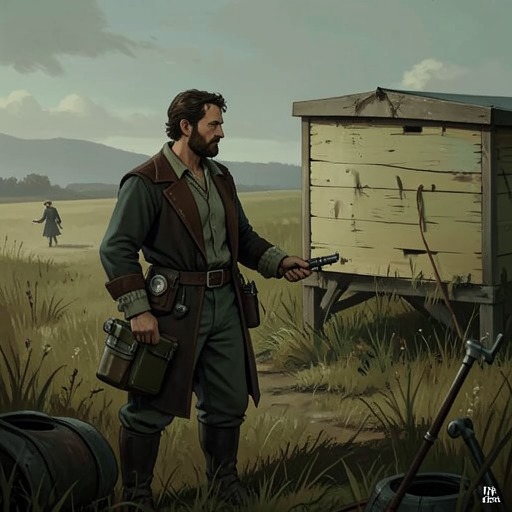
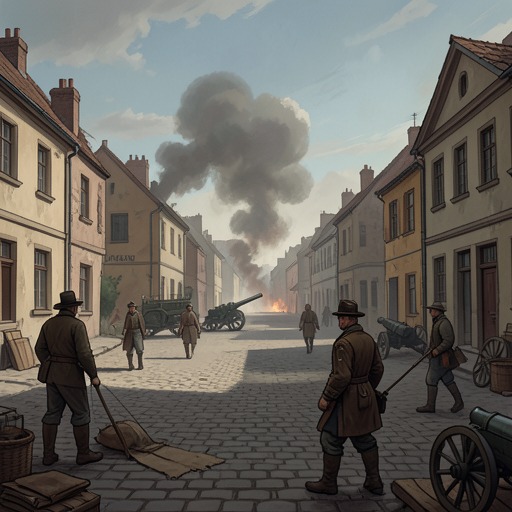
Pashka’s street and garden occupy a particular position in the village’s wartime geography. His garden faces Horlivka, making him one street closer to Donetsk than Sergey Sergeyich. Beyond his plot lie the remnants of an apricot grove planted in the Soviet era and a field emptied of its workers by war. Local men and Russian military personnel have dug in beyond that stretch, while Ukrainian army positions lie across the fields visible from Sergey Sergeyich’s side. The opposing lines are not abstract fronts: they press close to the neighbors’ gardens and shape what each man can hear, see, and fear.
When Sergey Sergeyich hears a car nearby, he works out that it must be on Shevchenko Street, where Pashka is the only person left. The small population makes the neighbor’s movements legible, but it also magnifies their exposure. During one encounter, Pashka identifies armed men as “our boys” on reconnaissance and says they are looking for “dirty Ukes.” His explanation places him on the side of the local forces in the language of the scene, while revealing the hostile terms through which the conflict enters ordinary conversation. The front line runs through not only fields and dugouts but also the way people name those across it.
Suspicion and Familiarity
Sergey Sergeyich’s caution toward Pashka is real, even when it is comic. Before opening his door to the uninvited visitor, he moves a broom in front of the safety axe he keeps by the entrance. Pashka might, he imagines, be carrying a pistol or a Kalashnikov for self-defence; the axe is all Sergey Sergeyich has to protect himself. He keeps it under his bed at night, where its presence sometimes lets him sleep more calmly. In this exchange, the men’s old rivalry is reframed by the conditions of war: an ordinary visit can bring the possibility of a weapon across the threshold.
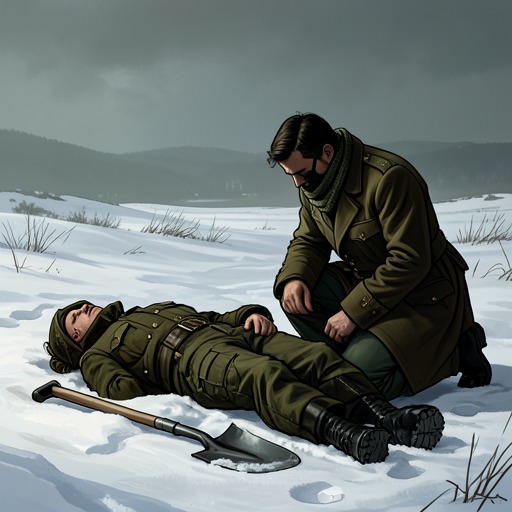
That same familiarity makes it possible for the two men to read one another through gestures and history. Pashka glances at the broom, apparently considering whether to brush snow from his boots with it. Sergey Sergeyich interprets even a greeting through decades of resentment, while Pashka later treats Sergey Sergeyich’s concern as evidence of friendship. Neither account cancels the other. Their relationship is sustained by a shared past that allows Pashka to tease and Sergey Sergeyich to grumble, even as danger gives those ordinary gestures a sharper edge.
A Neighbor’s Gratitude
After Sergey Sergeyich has gone looking for him, Pashka visits and calls himself Sergey Sergeyich’s friend. He says he is not angry and thanks him for the trouble, including the lost sleep. Sergey Sergeyich stares at him in bewilderment: the source of Pashka’s gratitude is not immediately clear to him. Pashka explains that “Lenin Street” is a gift, because he has had enough of Shevchenko Street. The renaming has transformed an old grievance with a street into a new reason to thank his neighbor.
The moment does not settle their history or turn their teasing friendship into uncomplicated affection. Instead, Pashka’s response gives their local quarrel a surprising civic dimension: a change in the street’s name matters to him personally, and he reads Sergey Sergeyich’s actions as a favor. His joke about being forgiven also reverses the established pattern. The man Sergey Sergeyich has long imagined as the keeper of old slights says he has never been angry, and assumes Sergey Sergeyich is not the type to hold a grudge.
Narrative Role
Pashka’s importance lies partly in the contrast he creates between intimate familiarity and political division. He is introduced as the rival Sergey Sergeyich cannot forget, yet he is also the neighbor whose street, garden, and movements help locate the village within the war’s geography. His account of reconnaissance exposes the conflict’s partisan vocabulary; his visits return the narrative to the domestic scale of coal, a stove, snow on boots, and an axe beside a door.
The changing street name gives their relationship a compact reversal: an emblem of Soviet-era public language becomes, for Pashka, a welcome alternative to the name that had irritated him. The novel does not erase the men’s antagonism, but makes its limits visible. In a village emptied and divided by war, the old school enemy can still arrive as an unwanted guest, call himself a friend, and expect his neighbor to understand why a street sign matters.