Pashka’s binoculars
Grey BeesPashka’s binoculars are a massive, old pair that Sergey Sergeyich borrows to identify a body lying in the snow beyond Little Starhorodivka. Their practical use becomes inseparable from the story’s central difficulty: they bring an abandoned soldier close enough to see, but cannot resolve who he was or what the living should risk doing for him. In passing between the two men, the binoculars make observation a shared responsibility, then return to Pashka carrying the weight of what neither man has managed to settle.
Appearance and First Use
At first, Sergeyich can make out only a dark shape on the field. He wonders whether it might be a person and thinks that binoculars would let him see more clearly; the thought sends him to Pashka, his childhood foe, without even a greeting. He asks to borrow the pair because there may be a corpse on his side of the field. Pashka agrees, curious enough to accompany him.
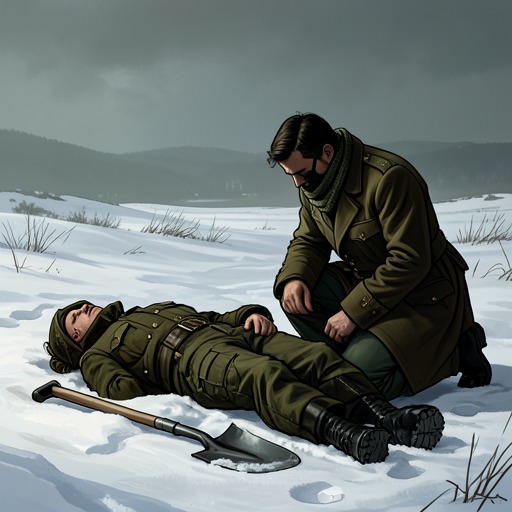
The binoculars are described as massive and old, hanging from a brown leather strap against Pashka’s bulging, sheepskin-clad chest. Their weight and conspicuous scale contrast with the precision Sergeyich needs: at the garden’s edge, Pashka raises them and locates the shape on the slope. What had seemed dark from afar resolves as green. The man is dead, lying on his right side with his back toward Little Starhorodivka and his face toward the Ukrainian trenches. The instrument clarifies the body’s color, posture, and orientation, but not the soldier’s identity.
A Shared View, Different Conclusions
Pashka hands the binoculars to Sergeyich, suggesting the beekeeper’s eyes may be sharper. That exchange briefly makes the device a means of looking together: one man finds the casualty, the other examines him. Yet the clearer view does not produce a single shared interpretation. Later, Pashka uses the binoculars to reason about which direction the soldier may have been crawling. If the man was moving away from the opposing side, Pashka says, he might have been Ukrainian; if toward it, he might have belonged to their side. The body’s sideways position frustrates this inference, leaving its allegiance uncertain.
The binoculars thus disclose limits along with detail. They can reveal where the body lies and how it is positioned, but cannot recover its movements or establish which force should retrieve it. Pashka proposes that, if they knew the soldier was one of theirs, they could alert the men in Karuselino to collect him at night. He refuses Sergeyich’s suggestion that the two of them crawl out and drag the body toward the trees. The device helps Pashka assess the danger and speculate about responsibility; it does not remove the risk or resolve the disagreement.
Loan, Return, and Moral Afterimage
After their first viewing, Sergeyich asks to keep the binoculars for a couple of days. Pashka agrees, and the two walk back through the garden, orchard, and yard in silence, without looking at one another. The loan gives Sergeyich the means to check the field for himself. When the binoculars on his windowsill remind him of the dead man, he looks again: the soldier remains in the same position, his back turned toward the village—and toward Sergeyich.
That renewed sight prompts a decisive change in Sergeyich’s intention. He writes Pashka a note saying he has gone out to deal with the corpse, asks him to come if he is killed, and leaves instructions to bury him beside his parents. Then he takes a sapper shovel and crosses the exposed, snow-covered field, crouching as he goes. The binoculars do not accompany him into that approach, but they have helped turn an indistinct shape into a persistent obligation. Their use has not made the crossing safe; Sergeyich knows he is visible to snipers, as the dead man was.
When distress sends Sergeyich hurrying home, he pauses at the junction where one path leads home and another toward Pashka’s house. He decides he cannot arrive empty-handed and will bring the binoculars back because he no longer needs them. At Pashka’s, he returns them without answering the question about the latest news. The instrument passes back to its owner, but the body it enabled them to see remains unresolved in Sergeyich’s mind. Its movement between the men traces a brief cooperation under pressure: they share sight, not conclusions, and the returned object cannot return either man to ignorance.