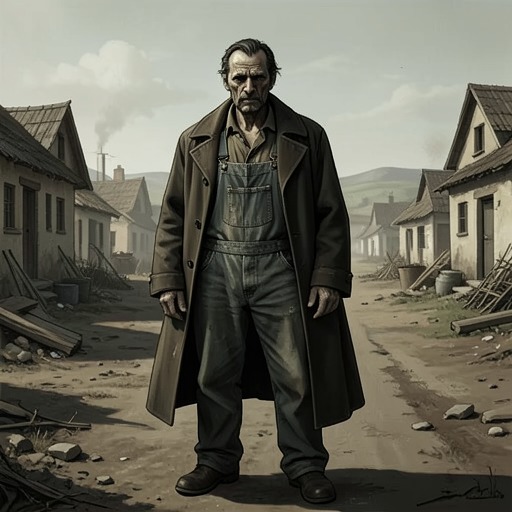
Pashka’s isolation
Grey BeesPashka’s isolation is not simply a matter of being alone: it is the wartime loss of dependable company, movement, and contact, even as a friend remains reachable by telephone. As Sergey Sergeyich prepares to leave the village with his bees, Pashka reveals that his closest friend was killed there, that other acquaintances alternate between treating him as a brother and rejecting him, and that he is afraid to visit the armed men in Karuselino. Their later call makes the distance between them explicit: Sergey Sergeyich can remain where the bees are comfortable and honey sells, while Pashka asks him not to stay away too long.
Friendship at the Point of Departure
When Sergey Sergeyich tells Pashka that he expects to leave with the bees for several months, silence follows. Pashka’s first response is to ask where he will go; then he asks whether he will be left all alone. Sergey Sergeyich points out that Pashka has friends in Karuselino, but Pashka corrects that reassuring picture: his one close friend, Vovka, was killed in their own village, and the others are inconsistent, welcoming him as a brother at one moment and telling him to go away at another. He suggests drinking to Vovka, also known as Vladlen. Sergey Sergeyich sets out honey vodka, and Pashka raises a glass to the dead friend.
The exchange gives Pashka’s isolation a specific shape. The friend he names is gone; the people who remain offer no reliable belonging. Sergey Sergeyich’s departure therefore lands not as an ordinary trip but as the possible removal of one of the few dependable connections Pashka has left.
Isolation Under Shelling
A later phone call shows that Pashka’s circumstances have not eased. When Sergey Sergeyich reacts with excitement to the possibility that electricity has returned, Pashka clarifies that he was joking: there is still no power, and there has only been more shelling. The two sides fire at one another at night, and sometimes the projectiles pass low enough to be seen. War narrows the conditions of daily life while making the village’s isolation more acute.
Pashka also describes the limits on his movement. He has run out of supplies, and the armed men in Karuselino have a new commander, a tough man from Kuban. They no longer visit, and Pashka is afraid to go there himself. His fear is not an abstract unease: it leaves him without access to the people and resources on which he had relied. Sergey Sergeyich offers him ginger vodka from behind the documents in his sideboard, a small, practical gesture of care across the distance.
A Call That Cannot Close the Distance
Asked when he will return, Sergey Sergeyich says he is comfortable where he is: his bees are doing well, and honey is easy to sell. He immediately feels guilty at having said so. His relative security and productive work stand in contrast to Pashka’s depleted supplies, isolation, and exposure to shelling. Sergey Sergeyich promises to bring him something when he comes home, but Pashka’s answer is less about a gift than about the length of the absence: he asks his friend not to stay away too long.
After the call, Sergey Sergeyich thinks that Pashka may be angry with him. He had expected either news or happiness that he had taken the trouble to call, but hears neither. He understands that Pashka is having a hard time alone, with shells overhead and no one to talk to. He then considers calling Vitalina, but leaves the mobile phone in his pocket. The scene ends not with reconciliation or a new plan, but with another unmade call: attention turns toward a second relationship while the one just heard remains unresolved.
The Wider Pattern of Absence
Pashka’s isolation belongs to a wider landscape of missing people and interrupted ties. When Sergey Sergeyich reaches Akhtem Mustafayev’s household, Akhtem’s wife, Aisylu, tells him that Akhtem has been gone for twenty months and was taken. She later explains that armed men took three people who had travelled together to the mosque in Bakhchysarai; the car was found empty, and a child had seen them pushed into a minibus. Their last known journey and the absence of reliable news give another form to the separation that governs lives in the story.
Sergey Sergeyich later hears an official tell him to tell Akhtem’s widow to speak to the police. The word widow shocks him; the official immediately retracts it, explaining that the case remains open. When Akhtem’s body is eventually found buried in the woods, the discovery confirms that the prolonged absence had concealed a death. Aisylu thanks Sergey Sergeyich for going to Simferopol, saying that without his intervention Akhtem would not have been returned. These events are not Pashka’s own story, but they deepen the context of his loneliness: in a landscape where war kills friends, separates families, and leaves others waiting for news, a call and a promise to return carry unusual weight.