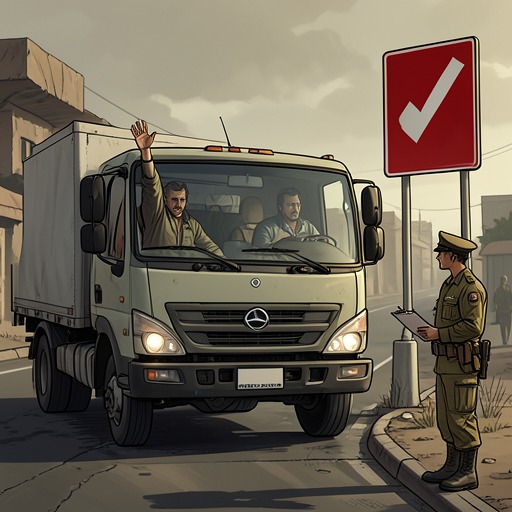
Pass and document checks at frontline checkpoints
Grey BeesPass and document checks at frontline checkpoints are the practical machinery by which the novel’s divided territory controls movement. A pass, a passport stamp, a walkie-talkie query, and even a folded slip of paper determine whether Sergeyich can travel with his bees, while encounters with officials expose how uncertain and unequal that permission remains.
The pass as a condition of movement
Before setting out, Sergeyich asks whether he will be allowed through Karuselino by the armed men Pashka calls his brothers. Pashka is less concerned about that crossing than the Ukrainian checkpoint: Sergeyich may need a pass, or may have to reach an agreement with the officials. His advice is practical and contradictory, telling Sergeyich to stand up for his rights but, if a soldier reaches for his rifle, to stop arguing and apologize, blaming the shelling for frayed nerves. The exchange makes clear that a traveler must read not only rules but also the immediate danger posed by the people enforcing them.
Sergeyich freezes at the word pass. The checkpoint requirement is not an abstract inconvenience: he is trying to drive through a contested landscape with his bees, and he does not know whether his identity or address will suffice. Pashka suggests that officials might accept his passport or residence address instead, leaving permission contingent on negotiation as well as paperwork. The route itself is therefore governed by multiple authorities and uncertain standards, rather than by one predictable system.
Documents examined against territory
At a checkpoint, a soldier asks Sergeyich to show his pass. His attempt to explain his disability and Category II silicosis does not replace the requested document. When his coughing fit subsides, he identifies himself as being from the grey zone, from Little Starhorodivka near Karuselino. The soldier checks the passport’s residence stamp, while his colleague uses a walkie-talkie to ask whether Little Starhorodivka is in the D.P.R. The question of where Sergeyich belongs becomes an operational test of which authority claims the place and whether his route is considered legitimate.
The soldiers ask why he is entering through the O.R.D.L.O. Sergeyich answers that Petro advised him to take that route because it was safer; the first soldier agrees that it is safer. Yet the questioning does not end with that explanation. One soldier takes Sergeyich’s passport and mobile phone away from him, while the other orders him to pull onto a shoulder blocked with concrete so that the next car can pass. The pause leaves him waiting beside his bees as the checkpoint queue extends into the dark.
The papers and phone are eventually returned, together with a piece of paper the soldier tells him to show at the next checkpoint. Sergeyich folds the slip carefully and puts it with his passport and mobile. The small document is both permission and a fragile object to protect: the journey can continue, but only because an official has supplied a token whose value depends on another official accepting it.
Border crossings and unequal scrutiny
Further along the route, Sergeyich crosses a bridge and sees the canopy marked “RUSSIA. DZHANKOY CHECKPOINT.” The sign gives the crossing a stark official name, while a memory of a message painted on a transformer box near Chonhar—“18 KM TO THE RUSSIAN OCCUPIERS.”—makes the same short distance register as a passage into occupation. At the Russian post, an officer directs him where to park and approaches his Lada with an expression that shifts from indifference to perplexity. The scene sets the ordinary choreography of a border inspection against the displacement and fear carried into it.
When Sergeyich later goes to the F.S.B., a guard studies the insert documenting his entry into the Russian Federation and warns that asylum will not be granted: foreigners may stay for ninety days. Sergeyich says he has come for something else. The exchange establishes that entry documents do not simply record travel; they also delimit what he may ask for and how long he may remain. The guard’s warning frames his presence as legally provisional before the purpose of his visit is even established.
The same coercive logic appears in the detective’s explanation of Bekir Mustafayev’s predicament. The detective says that Bekir had driven his father’s car for two years without official permission, because the father had never formally authorized his son to use it. Sergeyich protests that the car belonged to Bekir’s father, who had been killed, but the detective treats the absence of written authorization as a violation of Russian law. He then reminds Sergeyich that he is a foreigner and threatens that, if he does not leave Russia within eleven days, he will be brought back—not to an office but to a cell. In this system, a family relationship and an evident circumstance do not outweigh the official status of a document.
Paperwork at departure
When Sergeyich accompanies Aisha toward the Ukrainian border, she continues on foot with her green suitcase while he parks beneath the border-post canopy and presents his own documents at a window. A guard reproaches him for crumpling his insert and unfolds the paper found in his passport. The scene returns to the material vulnerability of his travel papers: a document has to survive not only inspection but also the handling and scrutiny of successive officials.
After being told not to stop in the buffer zone, Sergeyich drives slowly through it, overtaking people on foot and searching the stream for Aisha. He cannot know whether she is still on the road or has already reached the Ukrainian border. The checkpoint system separates their passage into different routes—his by car, hers on foot—and leaves him watching for her without control over the pace of her crossing. The rules thus regulate more than entry and exit: they shape who can travel together, how long a separation lasts, and what a traveler can know about another person’s progress.
A border made by procedure
Across these encounters, permission is repeatedly provisional. Sergeyich’s address must be checked against territorial claims; his passport is taken and returned; a handwritten-scale scrap of paper is passed forward to the next checkpoint; and the insert documenting entry becomes the basis for a limit on his stay. Officials interpret the same person through different jurisdictions, while each crossing introduces fresh questions and risks.
The novel presents the border not as a single line but as a chain of stops, documents, roads, queues, and discretionary decisions. Its rules are concrete—show the pass, produce the passport, keep the paper intact, leave before the deadline—but their application depends on armed officials and unstable political boundaries. For Sergeyich, mobility is never simply the distance between two places. It is an uncertain privilege renewed at each checkpoint, with his bees, his relationships, and his own safety exposed to the outcome.