Red Poppy sweets
Grey BeesRed Poppy sweets are the candies Sergey Sergeyich finds in the backpack of a dead man, and their importance changes as he learns whom they were meant for. First evidence of the stranger’s interrupted journey, they become an uneasy possession when Sergeyich realizes he has eaten one of the children’s promised gifts. His decision to return the remaining sweets makes the familiar candy a modest instrument of care: a gift carried across a winter night from the dead man’s unfinished errand to the children who were waiting.
Discovery in the backpack
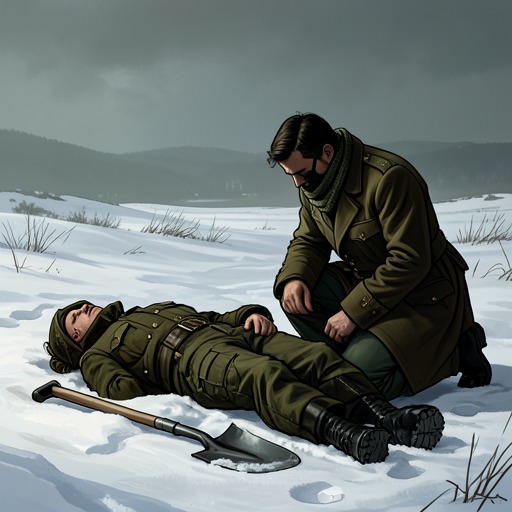
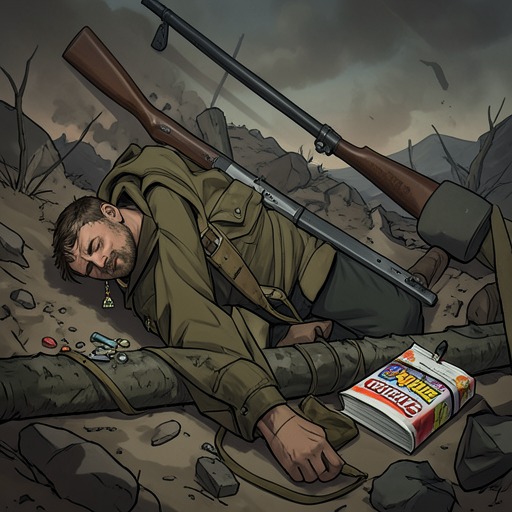
Sergeyich encounters the sweets while searching the snow-covered body of a man in camouflage. The man’s clothing yields no documents or mobile phone; a small gold earring and the blue backpack beside his rifle provide the few recognizable details. The bag weighs about five or six kilograms. Inside, beneath the snow, Sergeyich finds bags of sweets and recognizes the Red Poppy wrappers from the local shop.
The wrappers connect the unfamiliar dead man to an ordinary local world. The man is not introduced through a name or an account of his past, but through things carried with him: a rifle, an earring, and candies recognizable from the village shop. The sweets are both evidence of a journey and a piece of everyday life that has crossed into the setting of death.
The children’s account
Later, children in Svitle describe the young Santa Claus who had returned in December. A girl recalls his promise to bring toys and sweets for New Year. A boy identifies him by a rifle and an earring, details that make Sergeyich recognize the dead man and his backpack. The children say that Santa wore a uniform because there was a war, and that he had two children of his own but had promised them gifts from himself and his children.
The discovery changes the sweets’ meaning. Sergeyich remembers the backpack and the dead man; what had been a cache of recognizable candy is now a delivery that did not reach its recipients. He reassures the children that Santa may still bring their presents, perhaps delayed at a checkpoint. The explanation lets him respond to their disappointment without telling them that the man they remember is dead.
Eating and recognizing what is owed
That evening, while drinking tea, Sergeyich returns in thought to the children and their absent visitor. He takes a handful of sweets from the backpack, unwraps a Red Poppy, and eats it with his tea. Its taste and wrapper have remained unchanged throughout his life, a continuity he finds comforting. But the familiar taste sharpens the recognition that these particular sweets were meant for the two boys and a girl he has just met.
Sergeyich’s discomfort follows from the shift between the candy as an ordinary treat and as someone else’s intended gift. He understands that the dead man had been on his way to deliver the sweets and had not made it; by eating one, Sergeyich has begun to enjoy what belonged in the children’s hands. The backpack, left in the corner of the room, keeps that unfinished delivery present. He becomes unable to rest and resolves to return to Svitle.
The return as a gift
Sergeyich walks back through the dark with the backpack, telling the hostess that he forgot to give something to the children next door and asking where they live. When he reaches their home, he hands the bag to their mother and presents the sweets as gifts from Santa Claus, late but still delivered. The girl asks whether they are from the Santa with the earring; Sergeyich confirms the connection and says Santa is sorry he could not come himself because he is unwell.
The children thank Sergeyich and ask him to thank Santa. He replies that he will do so when he sees him. The exchange preserves the children’s image of their visitor while allowing the sweets to reach their intended recipients. Sergeyich does not claim the gifts as his own; he carries them onward as the bearer of an interrupted promise.
Reciprocity and significance
The mother, Valya, responds to Sergeyich’s return with a gift of her own. Although he is walking back to Little Starhorodivka, where there is no shop or post office, she runs into the yard and returns with his backpack filled with a three-litre jar of lard. Sergeyich is surprised by this kindness from a stranger. The sweets’ delivery thus leads not to a simple transaction but to an exchange in which an act of responsibility is met with practical hospitality.
The candies carry the story between separate lives without erasing the circumstances that divide them. The dead man’s intended kindness survives his failed journey, while Sergeyich’s return turns recognition into action. Their familiar wrapper and unchanged taste offer a small continuity in wartime, but the sweets are not merely a sign of comfort: once their intended recipients become clear, keeping and eating them acquire a moral weight. Their final passage from backpack to children makes a private discovery into a shared, if incomplete, act of care.