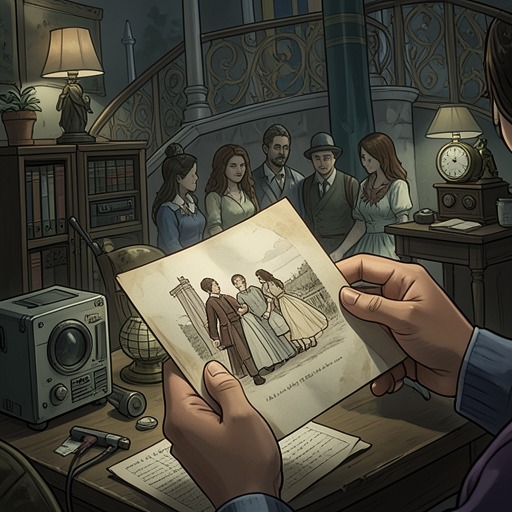
Sergeyich and Angelica’s father–daughter relationship
Grey BeesSergey Sergeyich and Angelica’s father–daughter relationship is defined by an early rupture and a silence that Sergeyich helps maintain. Angelica was only four when her mother left with her, and Sergeyich’s recollections move between the daughter he lost and the possibility of contacting her that he repeatedly refuses. His account of her name—first Svetlana, then Angelica—makes the separation tangible: even the name he chose did not remain his to give.
Separation and the lost household
Sergeyich’s family life ended when his wife took their daughter away while he was at the wholesale produce market in Horlivka. He remembers the departure as a wound, but the loss has two different contours. His wife remains readily present in his thoughts; Angelica, he admits, does not enter his memories as naturally. She had been so young that she and her father may never have formed a strong bond. The absence is therefore not simply the loss of a child he remembers well, but the recognition that their closeness may never have had time to take root.
The family’s separation predates the war that empties Little Starhorodivka. When Sergeyich later imagines what might have happened had he not exploded after Angelica’s birth, he cannot picture a straightforward reunion: he would not have moved to live with his wife’s parents in Vinnytsia, and he believes his wife would not have stayed in the village. His counterfactual does not undo the breakup. Instead, it holds together regret and a belief that the couple’s different lives would have pulled them apart in any case.
The name Angelica
In a conversation with Petro, Sergeyich explains that he and his wife could not agree on a name for their daughter. He registered her as Svetlana; after leaving him and taking the child, his wife changed the name to Angelica. The detail compresses the family rupture into a small domestic decision: Sergeyich’s initial choice survives only as a name he can recount, while the daughter’s present name belongs to the life established after the departure.
Petro remarks that such a bright name seems conspicuous against the village’s grey surroundings. Sergeyich takes exception to the premise that grey means dull, insisting that he can distinguish twenty shades of it and pointing to the green Lada in his garage. The exchange does not restore contact with Angelica, but it shows that speaking about her can bring the absent family into an ordinary conversation. The daughter’s name prompts a disagreement about how to see the world, while Sergeyich’s sharp defense of grey reveals how much feeling can gather around a seemingly simple description.
Regret and imagined responsibility
When Sergeyich thinks of his wife, a boarded-up house marked with the words “THE OWNERS ARE ALIVE” brings him a moment of pleasure. The affirmation also turns his attention toward his own family. He wonders why his wife is easier to remember than his daughter, and considers whether Angelica’s young age at the time of the separation left little opportunity for father and child to bond. He then turns from circumstance to self-accusation: perhaps he should have smiled more, and perhaps he should not have twisted his lips at the sight of his wife’s clothes.
His reflections do not settle into a single explanation. Sergeyich speculates that he might have preserved the marriage by reacting differently after their daughter’s birth, but immediately confronts the practical impossibility of the life he imagines. This wavering between personal blame and the conviction that the couple would not have stayed together makes his regret unresolved. He can name possible failures in his own conduct, but he cannot convert them into a credible path back to the family he lost.
Refused contact
The prospect of communication becomes concrete when Pashka offers Sergeyich a charged mobile phone and suggests calling Vitalina. Sergeyich rejects the idea, saying she has not been his for six years. Pashka then asks about his daughter, but Sergeyich cuts the conversation short and insists that there is no one for him to call. The exchange makes the gap between remembering and reaching out unmistakable: even with a working phone offered to him, he will not attempt to cross it.
That refusal sits alongside the tenderness and sociability of Sergeyich’s later life. After his wife and daughter left, he continued to host customers who came to sleep on his bees, kept the modest price for the bee-bed, and offered tea with honey to the nicer visitors. Their conversations filled some of the quiet at home, but did not replace the family he had lost. His relationship with Angelica thus remains present less through shared scenes than through separation, the memory of her changed name, and his guarded response when someone offers him a chance to call.