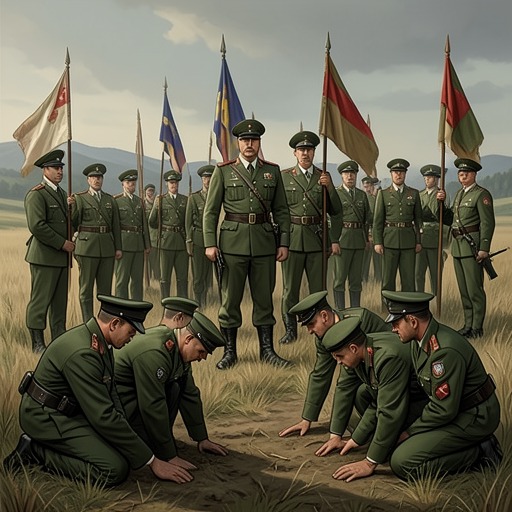
Sergeyich attends the welcoming ceremony for a fallen soldier
Grey BeesSergeyich attends a roadside ceremony for Vitya Samoylenko, a soldier killed in Donbas, but his participation becomes a crisis of belonging rather than an uncomplicated act of communal mourning. He kneels when Galya urges him to join the villagers, yet the gesture makes him feel stripped of strength and identity; shortly afterward he refuses to go on to the funeral and walks back alone toward his bees.
The call to greet the fallen
On a rainy morning, the familiar rumble of Galya’s scooter brings Sergeyich out of his tent. He expects her to have brought breakfast and is already thinking that the weather will force them to eat inside. Instead, Galya arrives empty-handed and announces that they must be there by nine: Vitya Samoylenko has been killed in Donbas, and the village is going to greet him. Sergeyich is confused by the word “greet,” since Vitya is dead. Galya explains that people have seen Western Ukrainians line the road and kneel as the dead are brought home, and asks whether their village is any worse. She says the whole village is going.
The ceremony is therefore presented not as a private farewell but as a collective practice the village has chosen to adopt. Galya’s urgency carries Sergeyich from his solitary morning routine toward a gathering whose customs and relationships are already familiar to everyone else. When the villagers begin folding their umbrellas, their attention shifts to the road. Groups leave the trees and assemble at the roadside; Galya tugs Sergeyich’s sleeve and whispers for him to come. Those near the village turn are already lowering themselves to their knees, gradually rather than all at once.
A stranger among the mourners
The approaching procession makes the scale of Sergeyich’s estrangement apparent. Hundreds of people are gathered, and they know one another as well as the dead man who is returning to be honoured and buried in his native soil. Sergeyich feels he has no part in their shared grief and worries that his presence might intrude upon it. Three years of near-isolation in an abandoned village with Pashka have accustomed him to having very few people around; he has come to regard solitude as a condition in which a person can better understand his life. Here, surrounded by a community bound by long companionship, he cannot see what use he is to anyone.
The procession itself is starkly ordinary: a dark-green old minivan approaches slowly, followed by khaki-coloured jeeps. As it nears the turn, Sergeyich remains standing. Galya nervously tugs at his trouser leg, but he hesitates over the meaning of kneeling. He remembers having been made to kneel as a boy when his father punished him for fighting at school, and recalls kneeling in church, though he disliked it there too. To Sergeyich, the posture is associated with weakness: it makes sense in church, where people are weak before God, but not as an act he readily accepts among other people.
Kneeling and its cost
Galya calls to him from below, and Sergeyich finally sinks down beside her. He becomes aware of people watching him, including a boy on the opposite side of the road. Their hostile attention ends when the minivan arrives: the villagers lower their heads and look at the tarmac, and Sergeyich bows his head with them. The outward act is brief, but its inward consequence is severe. He feels strength leave him, as though he has been pushed down, reduced to nobody, and deprived of his name and pride.
The moment recalls a slogan written years earlier on a bus stop in Karuselino: “No-one can bring Donbas to its knees!” As Sergeyich kneels at a ceremony for a fallen soldier, that defiant declaration returns with a painful reversal. He privately thinks that those who made the slogan have finally done it, then shakes his head, frightened by the thought and by how alien and dangerous it seems. The scene does not resolve the contradiction between shared mourning and personal dignity. Sergeyich has joined the ritual, but experiences his participation through the language of defeat.
Leaving the procession
After the minivan passes, the gathering loosens. People rise, recover their bicycles, scooters, mopeds, and cars, and begin following the vehicle toward the village. The rain has stopped, though the clouds remain. Sergeyich helps Galya to her feet. She looks at him with compassion but says nothing. He offers her an overripe apricot he has found beneath an apricot tree; she declines, and he eats it himself. The small exchange offers no explanation or reconciliation, and the two leave the roadside with different intentions.
“I’m not going,” Sergeyich says firmly after swallowing the fruit. Galya nods and, about five minutes later, rides away as cars begin to depart. Her decision to continue with the others and his refusal mark a separation within their shared morning: she goes with the village toward the funeral, while he turns away from the collective occasion.
The road back to the bees
Sergeyich walks along the highway toward Vesele. A bus and then two lorries pass, their noise pressing on him; the surroundings become quieter only when he turns onto the track leading to his bees and his little forest. He describes this as a road that goes nowhere but to the fields, a route to his temporary shelter and to the shelter of the bees. Its isolation is not merely an escape from the crowd but a place he can claim as his own, where there is no one else and, in his view, that is how it should be.
Even as he walks away, he imagines the mourners continuing along the tarmac toward the cemetery and church, with Galya among them and her head lowered. Their procession remains present in his mind as a source of pain: he pictures each person stepping on him as though he were lying on the road beneath their feet. The ceremony thus ends for Sergeyich not with arrival at the grave but with retreat to the bees. His choice exposes the cost of belonging to a community whose grief he can recognize but whose public gesture leaves him feeling diminished and out of place.