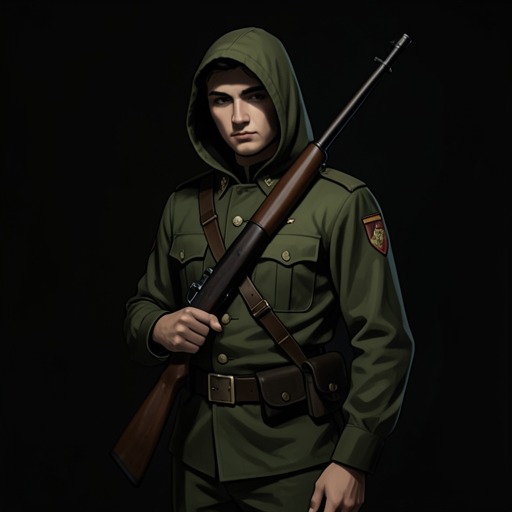
Sergeyich helps Ukrainian soldier Petro
Grey BeesSergeyich helps Ukrainian soldier Petro by turning an unexpected encounter with an armed observer into a relationship of reciprocal practical care. Petro first arrives at night in camouflage with a rifle, explains that he has watched the village through binoculars, and says he wanted to make Sergeyich’s acquaintance. Their exchanges move from tea and a gift of a grenade to food, a charged mobile phone, and a warning about a sniper’s position. The episode’s quiet acts of trust sit within a war in which even the words used to describe the opposing forces are contested.
First Meeting and the Observer
Sergeyich expects Pashka when he opens the door, but instead finds a young stranger in the evening darkness, wearing camouflage and carrying a rifle. The visitor speaks apologetically and asks to come in. Sergeyich reads the apology as a sign that the young man is unlikely to be there to rob or kill him; bringing the candle closer, he sees that the stranger is perhaps twenty-two or twenty-three. The initial encounter is therefore shaped by both the rifle and the stranger’s polite manner: suspicion is present, but it does not prevent an invitation indoors.
The soldier gives his name as Petro and says he is from Khmelnytskyi. When Sergeyich asks what prompted the visit, Petro explains that he has seen him for more than a year through binoculars, because his assignment is to observe the village. He had delayed making contact because daytime was dangerous, although coming after dark was not officially permitted either; it was simply less risky. The explanation recasts the stranger at the door as someone who has long watched Sergeyich from a distance, while also clarifying the danger and limits surrounding his presence.
Gifts, Food, and a Way to Call for Help
When Petro prepares to leave, he takes an R.G.D.-5 grenade from his jacket and places it beside his teacup as a gift. The gesture brings the war into the room in a particularly direct form: an ordinary visit and a shared drink coexist with an explosive weapon on the table. Before leaving, Petro gives Sergeyich a practical way to summon him, instructing him to tie a white rag to a tree branch in the orchard where Petro can see it.
On a later visit, Sergeyich welcomes Petro again and offers to fry him noodles with an egg. Sergeyich explains that he had been hungry two days earlier, but had gone to Svitle the previous day and exchanged honey for eggs; what he will have the next day remains uncertain. Petro, meanwhile, has brought food for Sergeyich. Their hospitality runs in both directions rather than settling into a simple pattern of soldier rescuing civilian or civilian feeding soldier.
The two drink tea with honey, and Sergeyich asks whether Petro still has the mobile phone and charger he had given him. Petro returns both, now charged, and adds a piece of paper with his number. Sergeyich no longer needs to hang a rag in the orchard: he can send a text or call if the matter is urgent. Sergeyich thanks him for keeping his word, a quality he says matters greatly in the area, then offers him honey vodka for the road. Practical help has become a modest system of contact, sustained by the returned phone and Petro’s written number.
The Sniper’s Position and Mutual Trust
As Petro is leaving after that visit, Sergeyich remembers a sniper’s bed he has found near the Krupins’ place. He calls Petro back and leads him along the edge of the gardens to show him the position, explaining that he noticed it a couple of days earlier and wanted to warn him. Petro responds seriously, thanks him, and shakes his hand.
The departure gives the warning its weight: Petro walks away from the sniper’s position and across the field without stooping or lowering his head. Sergeyich watches until the soldier disappears into the night. The exchange does not remove the danger around them, but it changes what each man knows and can do for the other: Petro has offered a means of calling for help, while Sergeyich has passed on information that may matter to the soldier’s safety. After Petro leaves, Sergeyich puts the cereals and canned goods from the soldier’s backpack on the windowsill, beyond the mice, adds coal to the stove, and goes to bed in a quietly joyful mood.
War on Television and in the Interview
The relationship unfolds amid competing accounts of the conflict. At Nastasya’s, Sergeyich watches television coverage in which commentators blame American and European support for holding Ukraine together, and a green-faced woman identifies herself as a member of the Verkhovna Rada and asserts her right to an opinion. The broadcast offers a public, argumentative version of events alongside the danger Sergeyich and Petro navigate in their own village.
That contest over language becomes explicit later, when a crew interviews Sergeyich at the border about why he has come from Donbas. He tries to explain that he is from the grey zone and that there is a war, with Ukrainians on one side and Russians on the other. A young crew member interrupts and tells him to repeat the answer without saying Russians. Sergeyich revises it, naming separatists from Karuselino instead. Asked about his damaged car, he says one shell-shocked man attacked it after getting drunk at a wake for a soldier killed by Russians; the crew member stops the live interview and directs the crew to record the bees and the axe mark on a damaged hive instead. The encounter makes a contrast with Petro’s private visits: Sergeyich can speak plainly at home, but the public account of his experience is edited as it is being recorded.