Sergeyich shelters a fallen soldier and returns his candy
Grey BeesSergeyich shelters a fallen soldier and returns his candy in a two-part act of wartime care: first he covers the body when the frozen ground will not let him bury it, then he carries the dead man’s sweets to the children for whom they were intended. What begins as an anxious attempt to protect the corpse from exposure becomes a reckoning with the soldier’s interrupted purpose, and a small exchange of gifts across the line between the living and the dead.
Encounter with the Fallen Soldier
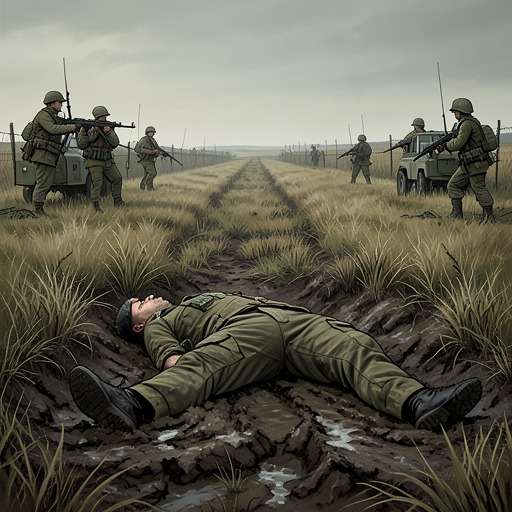
The dead man lies in a snowy field, his back turned toward Little Starhorodivka. When the binoculars on Sergeyich’s windowsill bring the body back into his thoughts, he decides to go out and deal with it. Before leaving, he writes Pashka a note explaining where he is going and what to do if he is killed, even asking to be buried beside his parents. The note makes the errand feel dangerous and uncertain: Sergeyich sets off not as a soldier, but as a civilian who has decided that leaving the body exposed is no longer acceptable.
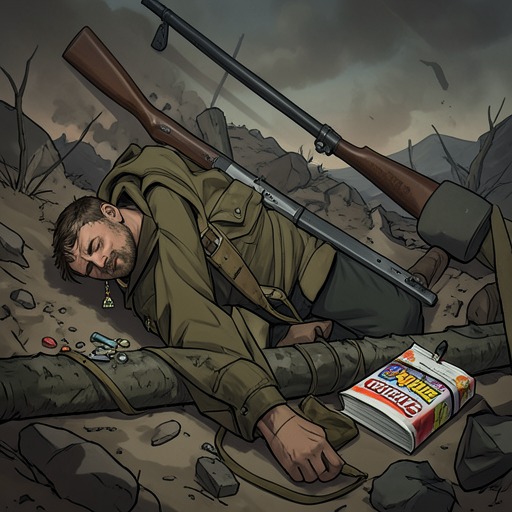
He carries a sapper shovel across the field, first crouching and then crawling as the darkening snow makes him fear that his clothes will make him visible to snipers. Beside the body, he searches the frozen camouflage for identification or a mobile phone but finds neither. He notices a small gold earring and a hand still gripping the rifle; most of the weapon is hidden under the snow. Nearby, he uncovers a blue backpack weighing five or six kilograms. Its contents are bags of sweets, including Red Poppy sweets recognizable from the local shop.
Sergeyich cannot bury the soldier. The snow crust resists his shovel, and below it lies frozen earth. Instead, he cuts out squares of crust and lays them over the body, steadily making a covering from the hard ground itself. He cuts roughly fifteen square metres before deciding that the work will do. The crust’s weight conceals the soldier from strangers and protects him from ravens. The return is physically difficult: Sergeyich crawls back with the shovel and backpack, his trousers soaked and his legs numb, coughing and short of breath.
The Sweets Reveal the Soldier’s Purpose
The backpack changes meaning after Sergeyich visits old Nastasya’s home in Svitle. There, children have come looking for Santa Claus, who had promised to bring them sweets. Their description unsettles Sergeyich: Santa wore a uniform, carried a rifle, and said that he had two children of his own but would bring them a present from himself and his children. Sergeyich remembers the dead man, the gold earring, and the backpack. He reassures the children that Santa may still come, perhaps delayed at a checkpoint, but he now understands that the soldier in the field was the person they were waiting for.
Back home, Sergeyich takes a Red Poppy sweet from the backpack and recognizes that its taste and wrapper have remained unchanged throughout his life. The familiar candy briefly offers continuity amid wartime disruption, but eating it makes his position harder to ignore: these sweets were not abandoned provisions. The dead man had been carrying them to the children, and Sergeyich has taken their gift for himself. The body is now covered and no longer keeps him awake, yet the backpack in the corner gives the soldier’s interrupted journey a presence in the house. Sergeyich’s guilt arises not simply from possessing the sweets, but from knowing whose purpose they were meant to serve.
Returning the Gift
A trembling and a stubborn resolve lead Sergeyich to set out for Svitle again that night. He follows his own recent footprints and carries the backpack back to Nastasya’s house. When she opens the door, he explains that he forgot to give the sweets to the children and asks where they live. He cannot easily explain why he has come back in the dark; he says only that the place is pleasant, with lights in the windows.
At the neighbouring home, Sergeyich presents the sweets as a late gift from Santa Claus. The children run to see what he has brought and ask whether the gift really comes from Santa with the earring. Their thanks recognize the gift without requiring them to know that its bearer has died. Sergeyich answers that he will thank Santa when he sees him. The remark preserves the children’s understanding while marking Sergeyich’s own knowledge of what happened. The sweets have reached their destination, but the return is not a recovery of the soldier’s life or a simple happy ending: it is the completion of one small intention he could no longer carry out himself.
Reciprocal Kindness and Significance
The return also creates an exchange between Sergeyich and strangers. He had earlier offered honey to Petro, who declined at first and then accepted some to have with tea; in Svitle, Sergeyich gives the sweets to children, and their mother responds by putting a three-litre jar of lard in the backpack for his walk home. He is surprised by this kindness. The gift is practical as well as generous, acknowledging the hardship of his isolated home, where there is no shop or post office. The backpack that carried the dead soldier’s intended present thus comes back to Sergeyich filled with food.
The episode’s central movement is from taking to returning. Sergeyich initially brings the backpack home with the corpse’s other unclaimed belongings, and the children’s story makes him see that the sweets have a destination and a human promise attached to them. Returning them cannot repair the violence that killed the soldier, but it prevents that violence from being the last fact of the man’s journey. The careful covering of the body and the delivery of the candy are distinct acts of care: one protects the dead from exposure; the other restores a connection between the dead man and the living children who were waiting for him.