Sergeyich’s wartime displacement
Grey BeesSergeyich’s wartime displacement is a series of journeys undertaken to keep his bees alive as fighting, insecurity, and personal loss make staying impossible. His departure from the grey zone begins as a temporary relocation for the summer, but the road carries him farther than planned; later, after violence destroys his car, he loads the hives again and heads toward Crimea. The movement binds practical beekeeping to the larger question of what home means when the familiar world can no longer protect its inhabitants.
Leaving the grey zone
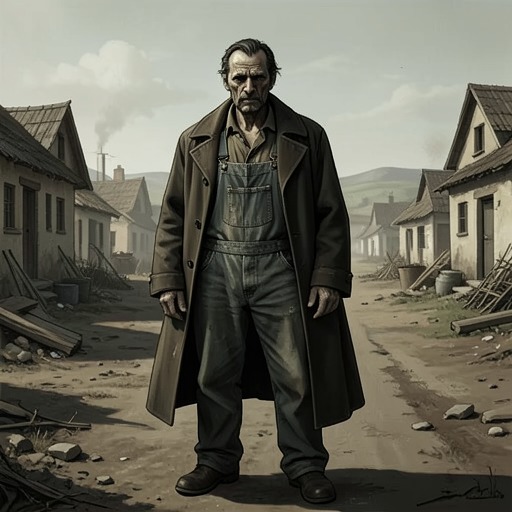
Sergeyich first tells Pashka that he will leave with the bees the next day or the day after, probably until August. The announcement falls into silence. It is not a carefree seasonal outing: the conflict has made the village and its surroundings an unsafe place to keep a living apiary, and the bees cannot simply be left behind. Sergeyich checks that Petro is alive by sending him a one-word text, receives the same word back without a question mark, and then begins to gather his belongings.
The departure turns on the difference between an ordinary trip and a wartime one. Sergeyich is practiced at packing, but the journey requires more than clothes and supplies. He starts the green Lada after a long period of inactivity and siphons petrol into three canisters. Rain begins as he drives out of his yard; its drops seem salty to him, like tears from a sky that cannot know whether he will return. Looking at the walls, trees, fences, gates, doors, and windows of his home, he understands that they have protected him like a fortress. He had thought himself their protector; only as he leaves does he recognize that the shelter ran in the other direction as well.
The hives must be made roadworthy with the same care as the rest of the load. Sergeyich plans to close their entrances so the bees will not scatter, carry the hives onto a flatbed trailer, cover them with a tarpaulin against the rain, and strap them down. He also packs jars of honey: it retains its value more reliably than sausages or clothing, he thinks, and is nearly as dependable as a dollar. Weather is part of the calculation. Cool, rainy conditions reduce the danger that jolts and agitation will overheat the hives, a risk that would make night driving necessary in warmer weather. This is displacement measured in degrees as well as miles.
Pashka insists on seeing him off, first offering tea and a stronger drink, which Sergeyich refuses, then asking to ride with him to the end of the street before the turn toward Karuselino. The small farewell does not remove the loneliness of the departure: Sergeyich leaves behind his neighbour in a village already shaped by war, while Pashka is left there without him.
A road beyond the intended destination
At the checkpoints, Sergeyich passes with his passport and the paper he has been issued. He drives through a landscape marked by military control and bombardment, leaving behind both the Ukrainian army and the separatist forces he calls the Dee-pee-aria. He understands that his sudden feeling of youth and freedom is false reassurance, yet takes comfort from it all the same. He had not chosen to participate in the war; he had simply found himself living inside it, a resident of war. The bees, however, cannot make the same shift between peace and war that people do. They must be able to collect and spread pollen, their natural task, in a place quiet enough for flowering herbs and trees.
That distinction gives the journey its ethical and practical direction. Sergeyich says that without the bees he would not have left, and might have stayed out of pity for Pashka. Their needs compel him to seek quiet beyond the fighting, even as the road draws him away from the neighbour and home he is reluctant to abandon. Crossing into Zaporizhzhia brings tears and a sense of weight lifting from his shoulders, but it does not resolve whether he will return or what he will find if he does.
Later, a second flight begins after Sergeyich’s battered Lada has been attacked and left without its windows. Galya advises him to get away for a while, warning that the authorities might arrest him and promising to call with news. He fears the attention his damaged car will attract—from other drivers, traffic police, or passers-by—and plans to leave before dawn, when the roads are quieter. The immediate cause is now not only the bees’ need for safety but the threat surrounding Sergeyich himself.
He and Galya prepare the apiary in the dark. At the hives, they close all six entrances, load the boxes wall to wall onto the trailer, and secure them with straps; his other possessions go into the Lada’s boot. Sergeyich asks Galya to look around later and keep safe anything he has missed, adding that he will be back. She reassures him that he will return. Their embrace, brief and difficult to end, makes the departure personal as well as logistical: he does not want to let her go, but eventually gets behind the wheel and drives away.
Crimea, found rather than planned
The empty road calms Sergeyich, and he continues past junctions where he could have stopped and established a quiet camp. Instead, the road’s desertedness seems to carry him onward, as if farther must mean better. At a fork, Donetsk lies straight ahead and Melitopol to the right; then a sign appears in the headlights with SIMFEROPOL above the arrow for the main road. Sergeyich realizes, with a happy shock, that he is almost in Crimea. Crimea has not been his stated destination: the possibility emerges through the movement of the road, and immediately calls up the Crimean Tatar Akhtem, a friend from a beekeepers’ convention whom Sergeyich had recently tried to contact.
The two departures therefore have different shapes. The first is announced as a limited summer move, driven by the need to protect the hives from war. The later journey begins in fear and urgency, but takes Sergeyich toward a remembered personal connection. In both, he travels with the apiary rather than separating his own safety from the bees’ survival. The hives are not incidental cargo: their needs determine the preparation, timing, and direction of his movement.
The work that continues in displacement
The summer away from the grey zone gives Sergeyich a life organized around the bees’ health and labor. Their ringing wings are proof not only that the apiary is alive but, to him, that he is alive too. He sees himself as their representative, though their interest is simply gathering nectar and pollen. He monitors the queens, drives wasps from the hives, uncaps combs to extract honey, and gathers wax and pollen. The bees do not ask for his advice or permission; his role is care and protection rather than command.
His view of the colony also shapes his thinking about human society. Watching guard bees force weakened drones out of a hive before the cold, he sees a system in which workers gather food and the colony does not waste its stores on those who only consume. He finds nature’s order comprehensible and repeatedly contrasts it with human life, usually to humanity’s disadvantage. Yet the comparison does not make the bees mere symbols: they remain living creatures whose warmth, food, movement, and safety demand specific labor from him.
When a swarm gathers on a pear-tree trunk, Sergeyich works to prevent its escape. He sprays it with water until droplets weigh down the wings and the buzzing quiets, then uses a ladder and dustpan to sweep the bees into a trap. The last bees crawl down after the others, reluctant to be left without their swarm and queen. His patient recovery of them echoes the larger effort of displacement: movement may be forced, but he tries to keep the living community together as it moves.
That care reaches its starkest limit when Sergeyich discovers a grenade in a hive and uses it against the hive of grey bees. The explosion presses his face into the dry earth; afterward, where the hive stood there is only a crater, broken wood, a fragment of comb, and a passing bee. The scene exposes the cost of trying to preserve an apiary within a landscape saturated by war: the same man who transports, feeds, and rescues bees is driven to destroy a hive. Displacement offers no clean escape from violence. It changes where Sergeyich lives and works, but the war’s damage travels with him.