Street renaming and decommunization
Grey BeesStreet renaming and decommunization are presented through a tension between official national change and the small, improvised decisions of people living in a wartime village. The debate begins with the replacement of names associated with Marx and Lenin, but becomes concrete when Sergeyich quietly exchanges the signs for Lenin Street and Shevchenko Street. His action turns a political process into an eccentric local test of consent, memory, and authority.
National policy enters village conversation
During a conversation with Petro, Sergeyich learns that streets named for Marx or Lenin are being renamed, often after Bandera or a writer. He says he would prefer a writer and points out that they are standing on Lenin Street. Petro explains that after the war the street will be renamed, and Sergeyich asks whether he could choose its new name himself. Petro says residents would need to agree and then take their proposal to the local council. Sergeyich doubts the process will be quick.
The subject returns when Sergeyich asks Petro what news there is from Ukraine. Petro complains that towns and streets are being renamed as though the country had nothing else to worry about. He describes sabotage, people refusing to remove street signs, and disagreement over the direction of a flag; if the decision were his, he says, he would rename the country first. Asked what he would call it, he tentatively proposes the Ukrainian People’s Republic. The exchange gives the policy two scales: a national undertaking, complicated by resistance and competing preferences, and a question that residents of a single street might try to settle for themselves.
Sergeyich’s nocturnal exchange of signs
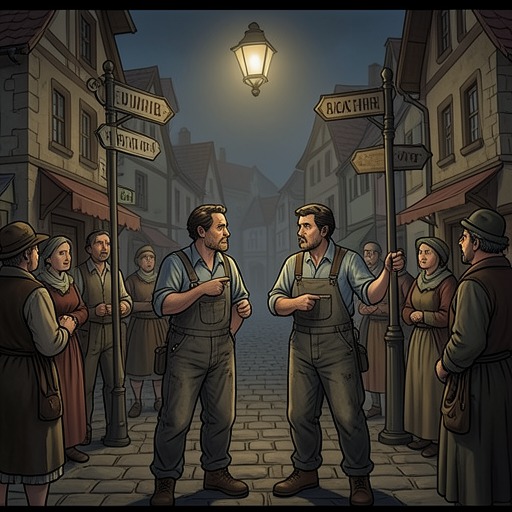
Sergeyich acts on the question at night, when daylight might expose him to observation from the horizon. Carrying tools in a backpack, he walks to the village entrance and uses a claw hammer to remove the blue-and-white LENIN STREET sign. He proceeds along the road, checking fences and houses for further signs; one, fastened directly to a house with long nails, takes him about five minutes to prise free and bends slightly in the process.
He then goes to Pashka’s street and removes six SHEVCHENKO signs. Their smaller number surprises him, though he explains it to himself by the unequal prominence the names had in Soviet times: Lenin was known around the world, while Shevchenko was known locally. He dismisses the distinction as beside the point, reasoning that poets are harmless in a way politicians are not, and decides that he will live on Shevchenko Street.
The new arrangement is not a simple removal of Soviet names. Sergeyich first nails a SHEVCHENKO sign to his own fence and replaces signs at the beginning and far end of the street. He then returns to the former Shevchenko Street and installs LENIN signs, including two on either side of Pashka’s gate, distributing the remaining ten along the road. The work is methodical and unilateral: the signs change places before any meeting, council decision, or consultation with the absent residents.
A local vote and its limits
In daylight, Sergeyich and Pashka discuss the newly exchanged street names. Pashka jokes that Sergeyich is now the local Leninist, then raises the possibility that residents might return and demand the old arrangement. Sergeyich insists they will not, pointing to renaming across the country and saying that residents’ agreement is the main requirement. He asks Pashka whether he agrees; Pashka says he does.
Sergeyich proposes taking a vote immediately so that they can call the decision unanimous. He raises his hand, and Pashka raises his in response. Sergeyich then reasons that anyone who did not attend the meeting bears responsibility for their absence, and that they can inform the government of their decision when it returns. The scene gives his nighttime act a makeshift procedural cover: two present residents become, for the moment, the electorate and the authority that validates the change. The exchange does not establish that the village has formally completed a legally recognized renaming.
War, absence, and the value of a name
The renamed streets stand in a village whose wartime emptiness shapes the apparent ease of Sergeyich and Pashka’s vote. Their claim to speak for residents who are not there rests partly on the fact of their absence; the deserted end of Pashka’s street leads toward the dilapidated buildings of the closed Iona Yakir collective farm. The renamed landscape therefore records not only a political argument over Soviet symbols, but also the thinning of the community that might ordinarily deliberate over them.
The episode’s irony lies in the mismatch between the scale of its procedure and the scale of its consequences. National policy and local council approval enter the conversation as formal stages, yet Sergeyich’s practical method is a hammer, a backpack, and a solitary nighttime walk. His improvised vote supplies consent only among the two neighbors present. Later, as Sergeyich prepares to leave the village with his hives, he dwells on the possibility that he may not return and wonders whether he would find everything as he left it. Against that uncertain homecoming, changing the street names becomes one fragile attempt to assert local agency over a place whose future remains unsettled.