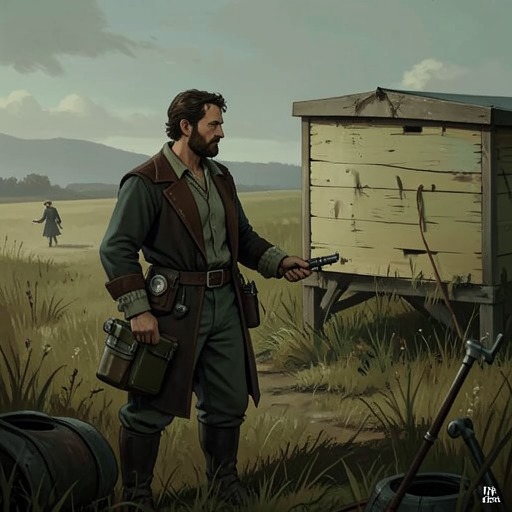
The March 3 bombardment of Little Starhorodivka
Grey BeesThe March 3 bombardment of Little Starhorodivka is the prolonged attack that turns Sergey Sergeyich’s wartime unease into departure. Lasting about four hours, it reaches him first as unexplained whistles, trembling walls, and distant flashes beyond the fields; afterward, he checks on Petro and sets about leaving with his bees. Its force lies not only in the immediate danger but in the change it compels: the home that had seemed to shelter him becomes a place he can no longer count on remaining in.
Background and approach
The date is March 3. With winter snow beginning to melt, Sergey Sergeyich has been watching the edge of his garden and the orchard beyond it. From there, he searches the windbreak running from the direction of Svitle toward Zhdanivka for a dead man he had previously seen in the field. The snow still covers the body, and the trees shield it from the morning sun. Sergey Sergeyich remains troubled by the man’s death, but his attention to the field has begun to fade; the day’s violence will soon redraw the boundary between distant danger and his own home.
That night, an explosion interrupts his thoughts while he is preparing food. The windows rattle in their frames. When he approaches one, he sees only darkness, and the glass trembles under his hand. He steps outside, but the rumbling has passed; only the ringing in his ears remains. The brief episode does not explain what is happening or where the fire is directed. Instead, it establishes a pattern of disturbance that returns more intensely later: a sound arrives before its source can be identified, and the ordinary house becomes an instrument registering violence beyond it.
The bombardment
In the middle of the night, Sergey Sergeyich dreams of fiery birds that whistle into view and fly away. Distant thunder follows, then further whistles and rumbles that seem to approach. As he wakes, he cannot at once determine whether the buzzing he hears belongs to the dream or the room. This uncertain threshold between sleep and waking makes the bombardment difficult to grasp as a single clear event: it reaches him in repeated sounds, in the trembling house, and in the effort to understand what is real.
The house shakes again, hard enough that Sergey Sergeyich shifts his footing to steady himself. He opens a window a crack; another whistle seems to come down from the sky and enter with the air. He closes the window, but the disturbance does not end. On the threshold, he is held still by the force of the whistles and rumbling. A sound passes overhead toward his garden, followed by more thunder. He considers whether the firing could be coming from Karuselino, then rejects the possibility because its shop is still open. He thinks instead of Melovannaya, where nobody remains. His guesses convey how little he can know from the sounds alone; no firing position is confirmed.
At some point, he realizes that he has begun walking toward the orchard without consciously deciding to go there. He stops at the garden’s edge. Across the field, beyond the ridge behind Zhdanivka, a red glow rises from the ground and sky, renewed by flashes and followed a second or two later by thunder. The bombardment is visible now as well as audible, but the scene still offers no clear account of the targets or participants. What Sergey Sergeyich can perceive is the sequence of light and sound, its apparent proximity, and the impossibility of controlling it.
He returns indoors and waits. The bombardment lasts about four hours, occupying the night with repeated whistles and rumbling rather than a single blow. At dawn, the immediate disturbance subsides and the surroundings return to calm, though the morning birds do not sing. The echo remains in Sergey Sergeyich’s ears. The contrast between apparent quiet and lingering sound marks the aftermath: calm arrives, but it does not restore the night to ordinary time.
Immediate aftermath and departure
Once the bombardment has stopped, Sergey Sergeyich takes his mobile phone from under his pillow and sends Petro a one-word message asking whether he is alive. Petro replies with the same word, without the question mark. The exchange confirms that both men have survived the night, but it does not settle what will happen next. Sergey Sergeyich’s relief is immediately followed by action: he gathers his belongings because it is time to go.
Preparing to leave proves slow and difficult, despite his experience packing for the road. This is not a routine journey to a sanatorium. He plans to attach the flatbed trailer, close the hive entrances so that the bees will not scatter, load the hives one by one, cover them with a tarpaulin against the rain, and secure them for travel. He also remembers to take jars of honey, which he regards as a form of money. The plan joins the practical requirements of moving the bees to the broader precariousness of wartime travel: the colony must be kept alive, while honey and provisions help make departure possible.
Before setting off, Sergey Sergeyich looks over the walls, trees, fences, gates, doors, and windows of his home. He had thought that he protected this small world; only as he prepares to leave does he recognize how it had also protected him. Rain begins as he drives out. Its appearance accompanies uncertainty about whether he will return and, if he does, whether he will find everything as he left it. The episode makes the bombardment consequential not simply as an attack endured overnight but as the rupture that sends him away from the place he had regarded as his refuge.
Consequences and narrative significance
The event changes the status of the home from a familiar shelter into a vulnerable place left behind. The immediate aftermath is neither a clear resolution nor a report of what has been struck: it is a departure organized around what Sergey Sergeyich can carry and protect. His bees are central to that choice. He prepares them carefully for the road, keeping the hives closed, covered, and secured, while the rain and cool conditions matter because excessive heat during travel could endanger them. The move therefore depends on attention to living creatures as much as on escape from the bombardment.
The later account of the bombardment’s role in his departure is paired with the larger pattern of survival and resettlement. Away from home, Sergey Sergeyich trades honey for food, including an exchange valued at seventy hryvnias per kilogram in a roadside village. At a later stop, Galya gives him a credit of five hundred and sixty hryvnias redeemable in groceries; her sales of his honey eventually bring cash, and she pays in advance. These later details show how a portable livelihood develops out of the departure: honey can be exchanged for immediate provisions or held as value, while the bees sustain his work and help him establish himself elsewhere.
The novel also places the event within a wider contrast between human violence and the bees’ ordinary rhythms. Sergey Sergeyich hears the bees’ wing-noise as evidence both of their health and of his own continued presence; their task remains gathering nectar and pollen while war interrupts human life. Elsewhere, he protects a swarm by misting it with water so its wings are too heavy for flight and collecting it into a trap. The account of the March bombardment makes such care consequential: leaving is not merely a human relocation but an attempt to carry a living apiary through a landscape made unstable by shelling. The attack’s lasting significance is measured in the home abandoned, the journey begun, and the fragile continuance of the bees under his care.