Ukraine
Grey BeesUkraine is the novel’s national setting and the political reality that presses into its most ordinary routines. Its revolution and the war Russia helped ignite divide the country and leave villages in the grey zone caught between forces; for Sergey Sergeyich, that history is experienced through power cuts, arguments about street names, postal isolation, military checkpoints, and the difficult journey home. Ukraine is not an abstraction in these episodes: it is the country whose changing borders of belonging are encountered at a kitchen table, in the lettering on a delivery van, and in the silence after a phone call.
Political setting and divided geography
The foreword locates the conflict in the upheaval that began with Euromaidan. After popular protests forced President Viktor Yanukovych and his pro-Russian political elites to flee Kyiv for Moscow, pro-European forces took power. Russia then captured Crimea and sent officers, volunteers, and activists to cities in eastern and southern Ukraine to foment anti-Kyiv revolts. The book presents the ensuing war as sustained rather than settled, and as a conflict whose unfinished, comparatively quiet front has been largely forgotten by the wider world.
That war’s geography is measured in the foreword as well as lived in the story: the line between Ukrainian troops and pro-Russian separatists in the breakaway republics of Donetsk and Luhansk stretches roughly 450 kilometres, with a grey zone of comparable length and a width ranging from hundreds of metres to several kilometres. Most people left the villages and towns within it, but a few remained. The village where Sergey Sergeyich lives belongs to this thinly populated, contested space. Ukraine is therefore both the country behind the front and the home that the front has made precarious.
Politics in everyday conversation
Ukraine reaches Sergey Sergeyich’s home through the people who visit it. When Petro talks about life in the government-held part of the country, he describes corruption, renamed streets and towns, and volunteers bringing lard; he also says people hope that after the war they will no longer need permission to travel abroad. Sergey Sergeyich answers with a bleak joke about surviving the war, then catches the implication and changes the subject. The exchange lets national politics surface as practical hopes and risks rather than distant commentary.
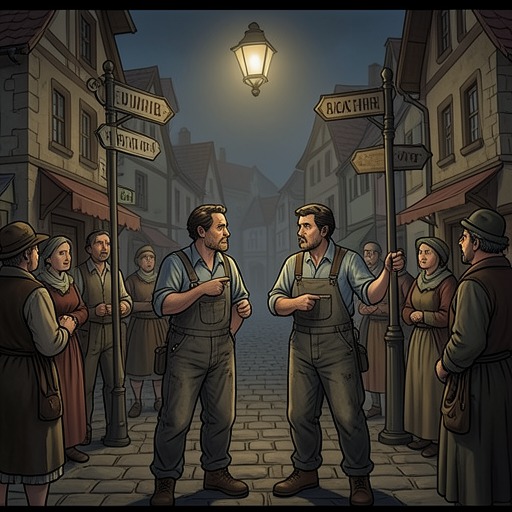
The renaming of streets becomes a recurring point of contact between the two men. Petro explains that streets named for Marx or Lenin are being renamed after Bandera or writers. Sergey Sergeyich says he would prefer a writer and notes that they are still on Lenin Street where he lives; Petro replies that it will be renamed when the war is over. Later, Petro complains that renaming streets and towns creates work when the country has more pressing concerns: some people refuse to remove signs, others want the flag reversed, and he would rename the country first. His tentative suggestion, the Ukrainian People’s Republic, makes the exchange a small but pointed encounter between national identity and the unsettled business of remaking public space.
Communication and the appearance of connection
The return of Ukrainian postal service gives the national setting a material presence. On the day called the Postal Ceasefire, Sergey Sergeyich rises early and prepares breakfast in a house still dependent on coal and a potbelly stove. As the weather begins to turn toward spring, warmth persists inside while the yard remains cold and damp. Against this modest domestic routine, the arrival of a van marked UKRPOSHTA becomes an event: Sergey Sergeyich fixes on the word with startled joy. The lettering signals that a public service has reached a village that has been isolated from ordinary communication.
A mobile phone offers a more intimate but less successful route back into connection. Sergey Sergeyich finds a number and presses the call button almost by accident. A familiar voice answers, but he cannot speak; the call ends without conversation, and he is left in tears. The contrast is sharp: a delivery van can announce the restoration of a link to the country, while a functioning phone cannot make a strained personal bond speak again. Ukraine’s infrastructure in these scenes is not mere backdrop; its intermittent presence shapes whether people can communicate, travel, and imagine life beyond the village.
Roads, checkpoints, and the meaning of home
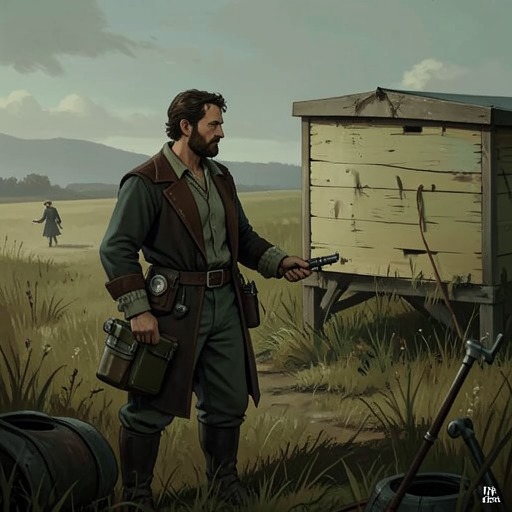
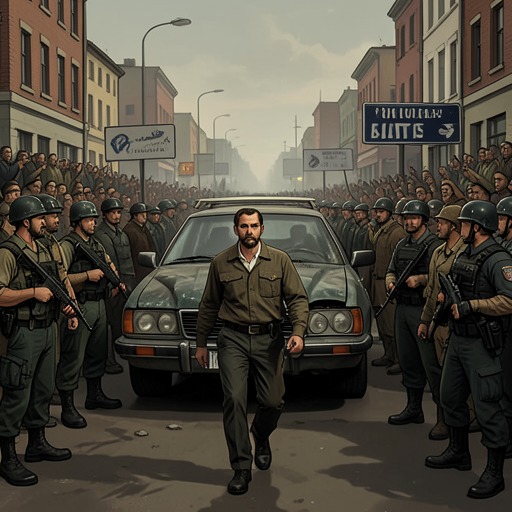
Movement through Ukraine is made tangible by the obstacles along the road. At a checkpoint, a soldier takes Sergey Sergeyich’s passport and phone to inspect them. While he waits, evening has fallen: yellow light shines through the windows of a military van, and the headlights of the queue form a chain stretching back into the distance. He listens at a nearby hive, whose buzzing seems exhausted, and watches anxiously for the soldier’s return. The soldier eventually hands back the documents and tells him to show a paper at the next checkpoint. Passage is possible, but it depends on inspection and permission.
The journey’s national and personal stakes converge when Sergey Sergeyich considers the grenade he has carried through Ukrainian and Russian customs and checkpoints. He fears that discovery could have meant life imprisonment, and knows he cannot take the grenade with him; he also cannot simply abandon it where children might find it. His road is thus not an uncomplicated passage across a country but a sequence of risky crossings, with the war’s material residue in the car.
Near Melitopol, a convoy of military vehicles comes toward him: two armoured personnel carriers, one towing a tank, followed by two Ural trucks and a green jeep. Reading the drivers’ faces, Sergey Sergeyich believes they are returning from the war, while he is going home. He insists to himself that his home is in the middle of the war but takes no part in it: nobody fires at the enemy from his yard, windows, or fence, so he thinks the house has no enemies. Its survival, despite three years of mines and shells falling on the village, becomes part of his understanding of home—not safety guaranteed by the country, but a place still standing within the conflict.
A country made strange and familiar
The journey also estranges Sergey Sergeyich from familiar measures of ordinary life. As he drives, he worries that he has left his alarm clock at home. Once it stops, he thinks, there will be no living time in the house until someone returns to wind it. He considers asking Pashka to do so, then doubts that Pashka would remember. The thought turns a domestic object into a measure of absence: time matters when someone is there to keep track of it, and the empty house seems to lose time along with its keeper.
Around him, the road passes churches, slag heaps, and fields; in the distance, the conflict’s infrastructure and landscape remain part of the same country. Ukraine is made unfamiliar not by becoming wholly foreign to Sergey Sergeyich, but by the way war interrupts familiar connections—between villages, between public institutions and residents, and between a man and the people he hopes to reach. His eventual direction is nevertheless homeward. That tension gives the country its decisive significance in the novel: Ukraine is both a nation reorganized by political upheaval and the lived terrain on which a fragile idea of belonging has to endure.