Ukrposhta
Grey BeesUkrposhta, Ukraine’s postal service, appears in the village through a delivery van whose arrival gives Little Starhorodivka a rare link to ordinary public services. The moment is charged with Sergeyich’s joyful recognition of the name on the van, but the connection does not last: the vehicle departs and never comes back, leaving the village without a postal route and Sergeyich’s greeting card unsent.
Arrival in Little Starhorodivka
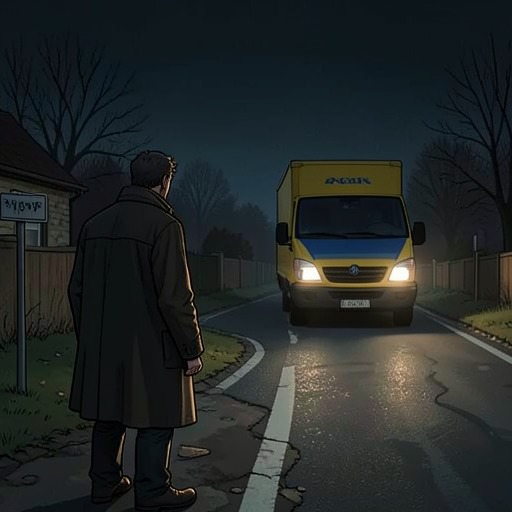
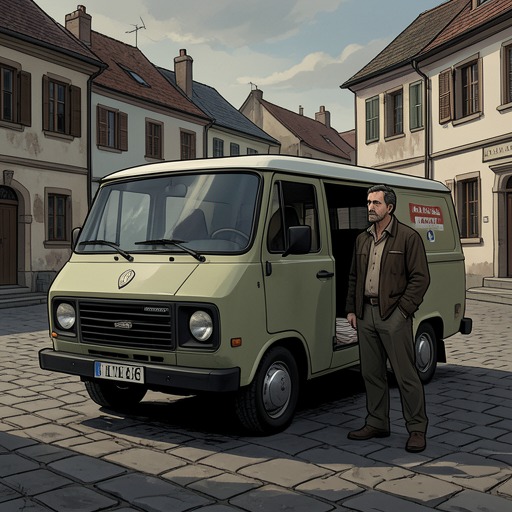
As the van approached, Sergeyich and Pashka could read UKRPOSHTA above its cab. Sergeyich fixed his eyes on the inscription, overcome by joyful surprise as though the word had hypnotized him. The van stopped, and its two frightened occupants asked whether they had reached Little Starhorodivka. After Pashka confirmed that they had, the driver opened the rear doors and showed them yellow waterproof bags. He identified one as the village’s mail and began pulling another toward the edge.
The delivery is presented not as a routine service but as an unexpected arrival in a place cut off by war. The care taken with the bags—the driver checking a tag and identifying the village’s own—makes the postal connection tangible. Sergeyich’s reaction gives the service its immediate significance: the name alone signals that a familiar civic network has reached the village.
A route that does not return
The visit does not establish regular delivery. The van left for Svitle and never returned, and its route seemed to run one way into the grey zone and out again. The village was left without postal service, even though working post offices and stamps were available beyond the front-line landscape. The van’s brief appearance therefore marks both a connection and its failure to endure.
The narrative describes the grey zone as nearly deserted and caught between two armed horizons, each firing through it at the other. Neither side, in this image, is concerned with the territory itself; it is the space between opposing lines. Against that larger condition, the postal route’s one-way passage becomes an everyday consequence of the conflict: a delivery can enter, but the village cannot count on the ordinary system continuing to serve it.
Sergeyich’s unsent greeting
The service’s disappearance becomes personal through Sergeyich’s envelope. A photo-card, signed and sealed, lay on his table until early evening. It lacked a stamp, but the more fundamental obstacle was that the village no longer had mail service. Sergeyich had not thought of sending congratulatory messages when the van was there; later, Vitalina’s three postcards prompted him to consider sending one himself.
He wonders how to get the envelope to the mainland, where post offices work and stamps are sold. The word carries an old association with a film about Soviet polar explorers, but now the mainland seems close: beyond the ridge and the horizon. Sergeyich considers asking Petro to post the envelope, believing he would do so. Ukrposhta’s short-lived visit thus remains present through what it cannot complete: the card’s passage out of the village must depend on personal help rather than a dependable postal route.