Vitalina
Grey BeesVitalina, Sergey Sergeyich’s estranged former wife and Angelica’s mother, is present through remembered scenes and messages sent from Vinnytsia. Her story is one of separation sustained by old disagreements, but not closed by them: the ant-pattern dress that Sergeyich associates with their rupture gives way, years later, to postcards, a worried telephone call, and her offer to help a young Crimean Tatar woman. Through that shift, the novel makes family connection tentative and practical—a matter of remembering, answering, and offering a place to stay.
Identity and Background
Vitalina lives in Vinnytsia with Angelica, the daughter she took with her when she left Sergey Sergeyich. Angelica was four at the time of the separation and is sixteen by the period in which Sergey Sergeyich has fled the war with his bees. The distance between them is therefore both geographical and temporal: the family Sergeyich remembers has continued to live elsewhere while he remains in a nearly emptied village and later relocates to Crimea.
Sergey Sergeyich first met Vitalina at a sanatorium in Sloviansk, where he had gone on a trade-union committee ticket. He was being treated with mud poultices, salt baths, and muddy hydromassage for ailments that did not include the silicosis for which the sanatorium was not equipped to treat him. A group of women approached him after supper, jokingly asking his name and introducing themselves over one another. When he heard Vitalina’s unusual name, he stared at her: he remembered her grey-green eyes, straight little nose, and arrow-like eyebrows. At the women’s joking suggestion that he should treat them to champagne, he went to the shop for two bottles of red Artemovsk sparkling wine. Later, by the salt lake, he concluded that Vitalina was the most interesting person there.
Their attraction did not prevent them from clashing over how to present themselves or what kind of life to make. Sergey Sergeyich remembered her as someone who loved beautiful things and had a forceful personality, qualities he found difficult to accommodate. Yet he also recalled that he loved her and married her for reasons more substantial than any disagreement over clothing. In his recollection, the intimacy of their earlier relationship is real, even as his account reveals how readily affection could coexist with embarrassment and irritation.
The Dress and the Marriage’s Fractures
After moving from Vinnytsia, Vitalina unpacked only part of the household before choosing her red-ant dress, ironing it, and setting out for the church at the end of the street. Its thick columns of red ants ran up and down powder-blue fabric. Sergey Sergeyich begged her to change, but she refused. He had expected to walk beside her; instead, embarrassed by the dress and the attention it would attract, he stopped at the gate. Vitalina went on alone, confidently passing neighbours who watched from their fences, windows, and gates. In a village then full of children and activity, she became the subject of gossip for several days.
Years later, Sergey Sergeyich finds that same dress hanging among empty hangers in his wardrobe. He understands it as a deliberate trace Vitalina left behind, a hint connected to her departure. The garment is not simply an old article of clothing: it compresses their contrasting attitudes toward public attention and his repeated inability to stand beside her without trying to restrain or disown some part of her self-presentation. At the same time, his memory insists that the dress was not why he fell in love with her; he says she was better without it, revealing a possessiveness that sits uneasily alongside his professed affection.
In a dream, the remembered promenade changes. Sergey Sergeyich walks beside Vitalina, holds her hand, and greets the neighbours while their eyes remain fixed on the ants. The dream carries the couple past the church to the cemetery, where he shows her the graves of his parents and other relatives. His actual memory of stopping at the gate is replaced by an imagined act of companionship and introduction: he brings her into the history of his family and the place where he has lived. The transformation makes the separation legible as a loss of the closeness he wishes he had been able to offer.
The conflict also reaches into the naming of their daughter. In another remembered scene, Vitalina is pregnant, with about six weeks remaining before the birth, and firmly rejects Sergey Sergeyich’s preferred names, Svetas and Mashas. She wants to call the child Angelica, partly because she considers the alternatives boring and does not want her daughter to become, in her words, a tram conductor. Sergey Sergeyich argues that there are no trams in their village and warns that the unfamiliar name will make the child a laughing stock. Vitalina replies that if people laugh, they will pack up and leave. The disagreement is about more than a name: it reveals different expectations for their daughter and different attitudes toward the village’s judgment. Sergey Sergeyich later identifies his angry response to the naming conflict as part of what drove the family apart.
Separation and Remembering
The memories of Vitalina carry a painful asymmetry. Sergey Sergeyich notices that she comes to mind more easily than Angelica, and wonders whether it is because the child was too young to form a strong bond with him. Angelica was only four when Vitalina took her away, leaving him alone. He turns the question against himself: perhaps he should have smiled more, stopped twisting his lips at Vitalina’s outfits, or spoken less. He speculates that women may be more willing to love or tolerate a man who plays the fool, then admits that he cannot know whether love or tolerance matters more in a family.
His reflections do not settle into a simple claim that the marriage could have been saved. He imagines that without his explosion after Angelica’s birth they might still have lived together, but immediately asks where such a household could have been: he would not have moved to Vinnytsia, while Vitalina would not have stayed in the village. Even before the war, he thinks, their incompatible plans made the separation likely. The tenderness of his regret therefore coexists with his recognition that reconciliation would have required more than correcting one argument.
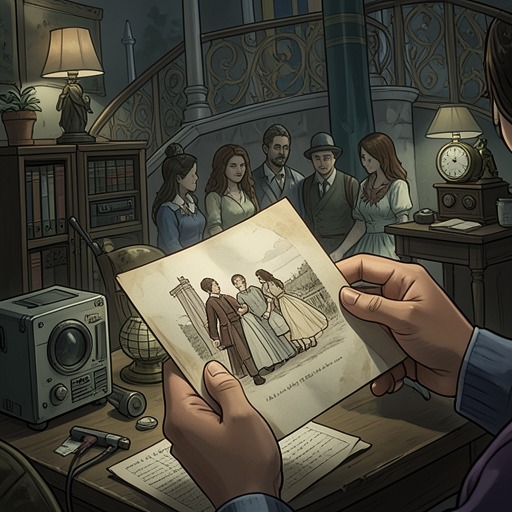
The postcards restore Vitalina and Angelica to his present in small, dated increments. After receiving mail that had been delayed, Sergey Sergeyich opens a New Year’s card addressed to “dear Sergey” and signed by both Vitalina and Angelica, wishing him wisdom, health, and peace. Its cancellation shows that it was sent from Vinnytsia on December 16, 2015. He finds two more cards from Vitalina: one for Defender of the Fatherland Day in 2016 and another with New Year’s wishes, including an invitation to come to them if anything happens. The dates show that the messages had been sent long before they reached him; their care arrives through a wartime delay rather than a direct, timely exchange.
He rereads all three cards, attending as much to Vitalina’s handwriting as to their brief messages. The old card’s rounded, even letters differ from his own restless script; the later handwriting leans to the right and looks hurried to him. He wonders whether a power cut forced her to write by candlelight. Studying the shapes of the letters, he delights in the possibility that relatives share not only noses and eyes but also handwriting. The cards become a physical sign of kinship he can inspect and keep close, even while the family remains far away.
Their arrival changes his intention. With the messages propped against a candle jar as he eats, he decides to write Vitalina a postcard for International Women’s Day, March 8. He wants to congratulate her and let her know he has not disappeared, that he is still alive. His attempt to find a suitable blank card among stored documents and old competition certificates makes the impulse concrete: after years in which he has not maintained ordinary contact, he is looking for a way to answer.
Renewed Contact and Aisha
When Sergey Sergeyich meets Aisylu in Crimea, he learns that she wants to send her daughter, Aisha, to Ukraine for an education. Aisylu has not left Crimea since returning from Uzbekistan as a girl, and says she has been too afraid to travel. Sergey Sergeyich initially mentions the fine places he knew before the war, including Horlivka and Donetsk, then draws a distinction between that past and the present. He recommends Vinnytsia, where Vitalina and Angelica live, and confirms that the city has a university.
After walking Aisha back to the road, he realizes that he has not yet called Vitalina about the young woman’s situation. He telephones and explains that Aisha is the daughter of a Tatar man he knew; her father is dead, her brother has been arrested, and her mother hopes to send her to Ukraine to study. The family has money, he says, but Aisha will need help getting to the university and finding her way around. He estimates that she is about sixteen or seventeen and says he could put her on a bus but would need someone to meet her in Vinnytsia.
Vitalina’s irony about whether he wants a beekeeping degree gives way to concern when she hears the request. She agrees readily to help and says Aisha can stay with them for a while if necessary. Sergey Sergeyich recognizes that Vitalina is genuinely worried, and that she has taken both the request and him seriously. The exchange moves their relationship beyond the distant, carefully preserved postcards: for the first time in these scenes, they coordinate a practical act of care, using the family connection to make a young woman’s journey possible.
Vitalina also invites Sergey Sergeyich to visit Vinnytsia. She describes the season as pretty and mentions the city’s musical fountains and lights. He says perhaps he will come, but retreats at once to the practical matter of returning home because the Baptists are bringing coal for the winter. Their conversation does not resolve the marriage or erase the years apart. It does, however, leave a future visit imaginable, and gives their renewed contact a purpose beyond remembering the past.
Family Connection and the Ending
After Aisha boards the train, Sergey Sergeyich is left alone on the platform, bitter and regretful, wiping his eyes as if he might be crying. He calls Vitalina with the arrival time and carriage number and describes Aisha again so she will recognize her. Vitalina hears the shakiness in his voice and asks whether he is crying. He says he is only tired, has not slept much, and had trouble at the border. Her worried question crosses the distance between Vinnytsia and the station; his silence follows hers, and neither seems to know what else to say.
Then Vitalina asks whether he will visit them too. Her voice sounds to him as it did in the early days around their wedding. Sergey Sergeyich answers yes, then becomes frightened by the answer and qualifies it: probably, but first he must go home. Before ending the call, he asks her to kiss Angelica for him. The request is simple and still mediated—he is not speaking directly to his daughter—but it acknowledges a bond he insists cannot be ended by distance or quarrel. Vitalina says goodbye, leaving their relationship not repaired but newly open: her help for Aisha has brought the separated family into conversation, and the possibility of a visit now hangs between them.