Vitya Samoylenko
Grey BeesVitya Samoylenko is a soldier killed in Donbas whose return to his village draws the community into a roadside ceremony of mourning. Sergeyich knows nothing about him beyond his death, yet the villagers’ decision to kneel as his body passes makes Vitya’s homecoming a defining encounter with wartime grief, public solidarity, and the cost of joining a communal ritual.
Identity and Death
Vitya is identified as a fallen soldier from the village. His death is announced to Sergeyich by Galya on a rainy morning: the village must be at the roadside by nine to greet him. The news supplies no account of Vitya’s life, service, or the circumstances in which he was killed; his public presence in the story is instead shaped by the community’s response to his death.
Galya explains the ceremony by referring to television coverage of people in western Ukraine kneeling along the road to greet their dead. She asks whether their village is any worse, then adds that the whole village is coming. The act is presented not as an established practice Sergeyich already understands, but as a form of collective recognition the villagers choose to undertake for Vitya.
The Roadside Welcome
Galya and Sergeyich reach the highway turnoff around half past eight, after a short ride in the rain. They wait beneath a tree to avoid getting soaked, then move to the edge of the tarmac, about fifty metres from the village turn. People gather in small groups under trees and umbrellas. As the expected vehicle approaches, they fold their umbrellas and gradually move out to the road.
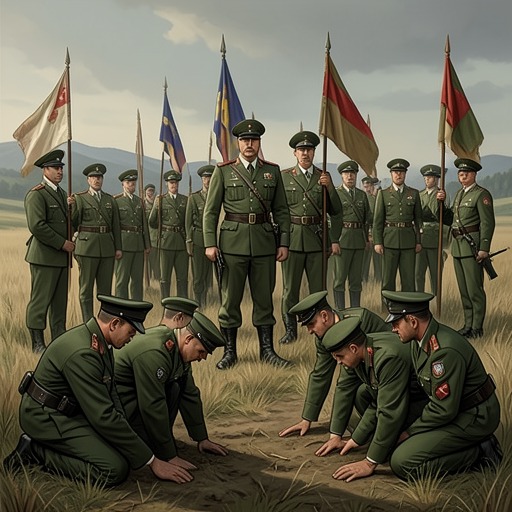
The kneeling does not happen all at once. People on the far side of the turning begin lowering themselves while others follow, unlike a church congregation responding together to a priest’s command. Galya kneels beside Sergeyich; a boy of about fifteen and the boy’s parents kneel on his other side. Sergeyich remains standing, uncertain why he should join them. His hesitation is sharpened by memories of having been made to kneel as a boy when punished for fighting at school, and by his belief that only the weak go down on their knees.
When Galya urgently calls to him, Sergeyich finally sinks down beside her. He notices the hostile attention of people across the road and the boy looking askance at him. The arrival of a green minivan shifts the gathering’s attention: everyone lowers their heads and looks at the tarmac, and Sergeyich follows. He experiences the gesture as a sudden loss of strength and pride, as if he had become nobody and lost his name. The roadside welcome thus asks more of him than a simple outward sign of respect; it makes his own sense of dignity collide with the community’s way of receiving a dead neighbour.
Memory, War, and Mourning
As he kneels, Sergeyich recalls a slogan written at a bus stop in Karuselino three years earlier: “No-one can bring Donbas to its knees!” The remembered declaration turns the ceremony into an uneasy image of defeat in his mind. He thinks that the enemy has finally brought them down, then recoils from the thought as alien and dangerous. His response does not settle into a political conclusion: the same posture can signify solidarity with Vitya and, to Sergeyich, a threat to the defiant identity expressed by the slogan.
Later, trying to grieve for Vitya, Sergeyich finds that his thoughts keep moving to other wartime deaths. He remembers a soldier called Petro, who had entered his home carrying a grenade; a soldier with an earring whose body lay in a field for half the winter because neither side retrieved it; and a sniper from Omsk killed in an explosion at a battle position near the Krupins’ garden. These memories give Vitya’s death a place within a wider landscape of loss, while also showing how difficult it is for Sergeyich to direct sorrow toward a man he never knew.
A memory of an earlier village funeral further complicates the roadside ritual. When a fellow villager’s body returned from the war in Afghanistan, the whole village attended, but the mourners remained standing. At the graveside, the dead man’s mother tried to fall onto the fresh grave, and relatives and friends held her upright and led her away; soldiers fired into the sky as wreaths covered the grave. Sergeyich merges that dead man in his thoughts with the soldier killed in Donetsk. The contrast between the earlier funeral and Vitya’s kneeling welcome marks a change in how the village publicly meets wartime death.
Ritual and the Limits of Knowing
After Vitya’s welcome, Galya tells Sergeyich that the village will go to the cemetery for the funeral service, burial, and wake. The ceremony therefore extends beyond the roadside greeting into the familiar sequence of funeral observances, even though Sergeyich has had to ask what comes next. Galya’s warm voice briefly reassures him; the gathering’s hostile looks and his discomfort at kneeling soon unsettle that reassurance.
At Akhtem’s funeral, Sergeyich encounters another community’s mourning customs. Akhtem’s body is carried on a stretcher wrapped in a green pall with golden Arabic script, and the men present wear fezzes. The imam leads prayers in a language Sergeyich does not understand. Sergeyich follows at the rear of the procession, feeling like a bee in an unfamiliar hive, neither a detached observer nor someone close to the deceased. This later scene echoes the distance he feels around Vitya’s funeral: he participates in acts of mourning without possessing the knowledge or intimacy that would make the dead fully known to him.
The distinction between these funerals is also visible in the treatment of a candle. At Akhtem’s home, the imam explains something about a burning candle, and Aisha blows out its flame; the imam approves. In Sergeyich’s later private remembrance of the fallen, by contrast, a candle burns beside an image of Nicholas the Wonderworker as he tries to focus on Vitya’s death. The two scenes place mourning within different religious practices rather than treating grief as a uniform ritual.
Narrative Significance
Vitya’s brief appearance in the story is defined by the actions of those who receive him, not by biographical detail. His death gathers the village at the road, draws Galya and Sergeyich into a public act, and prompts Sergeyich to revisit earlier funerals and the unattended dead of the war. The narrative delays the anticipated arrival with the rain-soaked wait, the gradual movement of the crowd, and Sergeyich’s struggle to decide whether to kneel, making a customary gesture newly strange and difficult to read.
Vitya remains, in Sergeyich’s words, a fallen soldier about whom he knows nothing except that he was killed in Donbas. That absence matters: the ceremony offers a public way to acknowledge a death even where personal knowledge is missing, but it does not erase the distance between the dead man and the beekeeper. By linking the roadside welcome to a remembered slogan, an older funeral, and other unburied or abruptly lost soldiers, the episode presents communal mourning as both an act of solidarity and a confrontation with the accumulated, unresolved deaths of war.