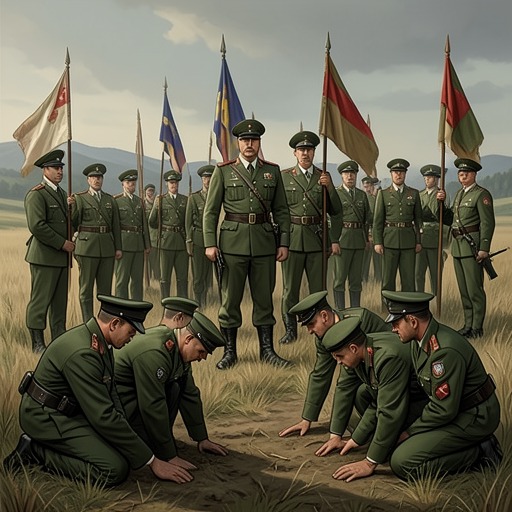
Vitya Samoylenko's funeral procession
Grey BeesVitya Samoylenko’s funeral procession is a roadside act of collective mourning in which villagers kneel as a vehicle carrying his body passes. The ceremony gathers people who share a home and history, while exposing Sergey Sergeyich’s uncertain place among them: he joins the mourners only after hesitating, and experiences the gesture as both solidarity with the bereaved and a threat to his pride.
The call to gather
On a rainy morning, Galya arrives at Sergeyich’s tent without the breakfast he expected. She tells him that Vitya Samoylenko has been killed in Donbas and that they must be at the roadside by nine to greet him. Sergeyich questions the word “greet,” since Vitya is dead. Galya explains that she has seen footage of Western Ukrainians lining the road on their knees to welcome their dead, and asks whether their own community is any worse. She says the whole village is coming. Sergeyich agrees to go.
They ride through the rain on Galya’s scooter and reach the highway turnoff at about half past eight. To avoid getting soaked again, they wait beneath an apricot tree. Dark, wind-fallen apricots lie in the wet grass; Sergeyich finds two intact fruits, wipes one, and offers it to Galya, who breaks it in half. The small exchange precedes the gathering’s public ceremony, where a familiar gesture of care gives way to the more difficult question of how a stranger should share other people’s grief.
The roadside ritual
Hundreds of people assemble, connected by long residence and companionship and united by their knowledge of Vitya. Sergeyich, who has spent years in near-isolation in an abandoned village with Pashka, feels alien among them. He worries that his presence might intrude on their grief and wonders what use he could be to these people. When the crowd begins to move, Galya tugs his sleeve and urges him forward.
The people do not kneel all at once at a command. Those near the village turn toward the road and gradually lower themselves. Sergeyich and Galya stop at the edge of the tarmac, about fifty metres from the turnoff, opposite a row of people with wet, sombre faces. Galya kneels beside him; a boy of about fifteen and the boy’s parents kneel on his other side. Sergeyich remains standing.
His reluctance is rooted in memory and conviction. As a boy, he had been forced to kneel when his father punished him for fighting at school; he had also knelt in church, where he understood the gesture as humility before God, though he disliked it there too. The thought that only the weak kneel makes the communal ritual feel less like a simple sign of respect than a surrender of self. Galya pulls at his trouser leg and calls to him tensely.
Sergeyich finally sighs and lowers himself beside her. He notices hostile looks from across the road and a grim sideways glance from the boy beside him. When a green minivan carrying the dead man arrives, the watchers lower their heads toward the tarmac. Sergeyich follows them, and the act overwhelms him: he feels his strength leave him, as if he has fallen and lost his name and pride. The passage links the bodily posture of mourning to his fear of being made insignificant, even as he participates in honouring the dead.
The minivan continues toward the village while the assembled men, women, and children remain kneeling along the road, motionless and heads bowed. The rain stops, but the clouds remain. Only after the vehicle has passed do people begin to rise, walk toward the village, retrieve bicycles and scooters, or return to cars. Sergeyich helps Galya up. She looks at him with compassion but says nothing. On the way back to their scooter, he offers her another intact apricot; she declines, and he eats it himself.
Pride, grief, and an older funeral
Afterward, Sergeyich remembers a slogan written at a bus stop in Karuselino three years earlier: “No-one can bring Donbas to its knees!” Kneeling at Vitya’s funeral makes the slogan return in a newly personal form. He privately connects the ceremony with the fear that the people who once made the claim have now been brought to their knees. The thought immediately frightens him; he rejects it as alien and dangerous, reminding himself that the people around him are grieving. His reflection in a puddle appears cloudy and dark, matching the unsettled quality of the day and of his response.
That night, as he prepares to sleep, the roadside scene returns to him: the long rows of people, Galya, and himself among them. He questions the occasion’s scale, thinking Vitya is not a hero or a cosmonaut. The memory then opens onto an earlier funeral, when the body of a fellow villager killed in the War in Afghanistan was brought home. The whole village attended, but everyone remained standing. The dead man’s mother tried to fall onto the fresh grave, and friends and relatives held her upright and led her away; soldiers fired into the sky while wreaths covered the grave.
Sergeyich’s memory brings the soldier from that earlier war and Vitya together in thought. He considers the Lord to be with both of them, making the two deaths part of one inward reflection even though their funerals are marked by different gestures: one remembered through a mother restrained from the grave, the other through a whole community kneeling along the road. The procession thus continues beyond the moment when the minivan passes. It leaves Sergeyich with a conflict between communal mourning and personal dignity, and with a sense that joining a ritual can make an outsider feel more exposed rather than more securely at home.
Significance in the wider story
The procession is a public display of the village’s cohesion, but its scale sharpens Sergeyich’s estrangement. The hundreds of mourners know one another and the man being returned to his native soil; he does not share that history. His hesitation, his eventual kneeling, and his troubled recollection of the Donbas slogan trace a movement from standing apart to participating without resolving whether participation is a freely chosen act of solidarity or a painful compromise with his pride.
The book later returns to mourning through the funeral of Akhtem Mustafayev, whose body is carried by men in a procession and buried according to Crimean Tatar practice. Sergeyich again occupies an in-between position: he follows behind the bearers and stands at the cemetery neither as a close relative nor as a wholly detached observer. Read alongside that later funeral, Vitya’s roadside farewell establishes a recurring tension between witnessing another community’s grief and belonging to it. The ceremonies differ in form, but each makes Sergeyich confront what it means to stand, kneel, or follow when death brings a community together.