Zhdanivka
Grey BeesZhdanivka is a nearby settlement repeatedly invoked as a place just beyond sight, yet central to how Sergey Sergeyich understands the wartime landscape around his garden. Hidden behind a rise, it lies toward the Ukrainian positions and along a road abandoned since the conflict began; its unseen presence makes the open field feel less like empty countryside than a boundary exposed to military observation and fire.
Setting and Visibility
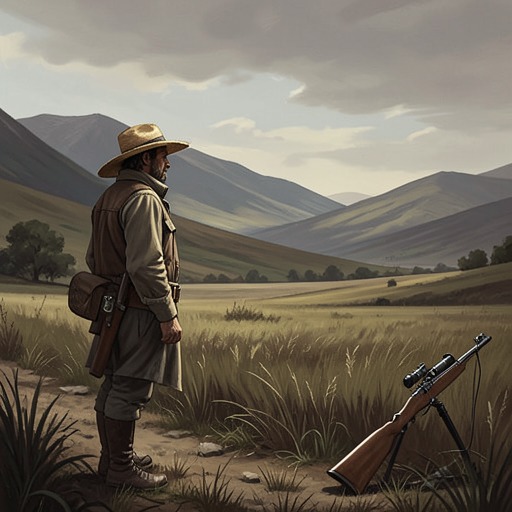
From Sergeyich’s garden, the ground falls toward a field and then rises gradually toward Zhdanivka. The settlement itself is concealed behind the intervening hump, so he cannot see it. What he can sometimes hear is the Ukrainian army, entrenched in dugouts and trenches in the rise between his garden and the settlement. Even when there is no sound, he remains aware of the troops’ presence. The landscape thus makes Zhdanivka a point of orientation rather than a visible place: its position is established by the slope, the military line, and what lies beyond the horizon.
The snowy view repeats that arrangement. Sergeyich stands at the edge of his garden facing a white field that descends and then climbs toward the hidden Ukrainian fortifications. A windbreak runs alongside the dirt road, which has been covered in snow and unused since the fighting began. Before the spring of 2014, that road continued as far as Svitle or Kalynivka. The remembered route and its present abandonment mark the change from ordinary local travel to a landscape organized by frontline conditions.
A Landscape Divided by the Front
Zhdanivka helps fix Sergeyich’s place within a village hemmed in by opposing forces. The Ukrainian army occupies the dugouts and trenches on the rise toward Zhdanivka, while local fighters and Russian military personnel have dug in beyond Pashka Khmelenko’s street, on the opposite side of the village. Between them are fields deprived of their workers, including the land between Sergeyich’s garden and the rise. A terrain once crossed by tractors and lorries has become part of a military division that residents can sense even when they cannot see its positions.
The settlement also figures in the differing outlooks of Sergeyich and Pashka. When they observe a dead man lying in the field, Pashka uses the direction of the body to speculate whether the soldier had been crawling toward or away from one side, and so whether he belonged to the Ukrainian troops or to their opponents. The body lies sideways, however, giving no reliable answer. His reasoning turns the orientation of a person in the snow into a question of allegiance; the nearby front, with Zhdanivka as one of its geographical markers, makes even the direction of a crawl seem politically consequential.
Exposure and Imagined Fire
The field toward Zhdanivka is not only a route of military orientation but also an exposed space Sergeyich must cross. After leaving a note for Pashka explaining that he is going to the corpse and asking him to retrieve him if he is killed, Sergeyich goes out with a sapper shovel. He descends across the snow, becomes increasingly frightened, and eventually crawls toward the body. The darkening sky and his dark clothes make him think that he is as visible to snipers as the dead man. The invisible positions beyond the rise turn the open ground into a place where an ordinary act of tending to a corpse carries immediate danger.
Later, Sergeyich recalls that a soldier had mentioned a sniper firing toward Ukrainian troops from the direction of the church. Standing above the sniper’s position, he imagines the likely response: artillery could come from the direction of Zhdanivka. His mind gives the imagined shell a destination, his own house. Nothing in this moment confirms that a shell has been fired at him; the force of the scene lies in the sudden connection between a hidden firing position, a possible counterattack, and the home he fears could be struck.
Narrative Significance
Zhdanivka remains unseen, but the narrative makes that absence active. It is a horizon toward which the ground rises, a direction from which troops can be heard, and the imagined origin of artillery. The road that once connected nearby settlements and the field Sergeyich must cross are both made newly strange by the front: familiar features now direct attention to military positions, exposure, and possible retaliation. Through this recurring geography, Zhdanivka measures how war reaches into civilian space without needing to appear in view.