grey zone
Grey BeesThe grey zone is the contested, sparsely populated territory between Ukrainian forces and pro-Russian separatists in Donbas, a place where the front line is not simply a distant military boundary but a condition of ordinary life. Its inhabitants endure shuttered services, uncertain safety, and shifting rules of passage; even the village in which they live can become difficult to place on an official map. For Sergey Sergeyich, the grey zone is both the home he refuses to abandon and a landscape that makes him, in his own words, neither securely within the separatist-held territory nor the country: “grey zones have no capitals . . .”
A shifting territorial margin
The front line between Ukrainian troops and pro-Russian separatists in the breakaway Donetsk and Luhansk people’s republics extends for about 450 kilometres. The grey zone between the forces is described as similarly long, but its width varies from several hundred metres to several kilometres according to the intensity of fighting and the terrain. It is therefore not a uniform band with a stable edge: the space between the sides changes along its length and with the course of hostilities.
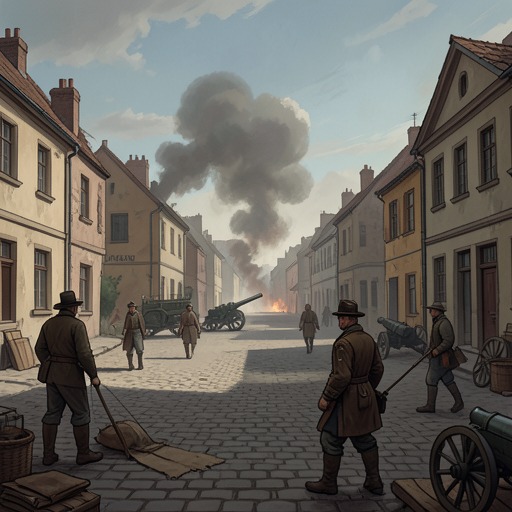
At the war’s beginning, most people in the grey-zone settlements left their homes, orchards, and farms. Some fled to Russia, some moved to parts of Ukraine beyond the fighting, and others joined the separatists. A smaller number stayed. They continued to inhabit villages that had once been densely populated but were now largely emptied, with shops, post offices, and police stations closed. Shells passed overhead; shrapnel sometimes had to be swept from yards. Some of the holdouts were killed, while others persisted in an environment whose danger had become inseparable from the routines of staying alive.
The number of people still living in the grey zone is uncertain. Their visitors are principally Ukrainian soldiers and separatist fighters, arriving to look for opponents or to see whether anyone remains. Residents respond to both sides with careful diplomacy and humble friendliness, a practical way of living among armed forces without making themselves conspicuous. The novel’s attention falls on these civilians rather than on military operations or heroic soldiers: the grey zone is made legible through the people who continue to call it home.
Little Starhorodivka: home without services
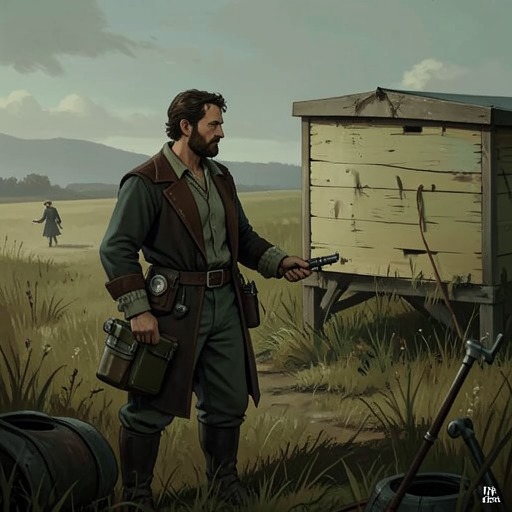
Little Starhorodivka lies in this landscape of exposed roads and diminished infrastructure. In its third winter of war, Sergey Sergeyich and his neighbour Pashka are among the few who have remained. They believe that if everyone leaves, nobody will return; keeping the village inhabited preserves the possibility of a future in which the fighting stops, the mines are cleared, and people come back. Their persistence is not confidence that the war is over, but a refusal to make departure permanent by leaving no one behind.
The village’s isolation is concrete. Sergey Sergeyich tells an older woman that repair workers did not come because only two residents remained, and those two lived on different streets; if a dozen or so returned, the calculation might change. He distinguishes his village from places closer to the guns: it is eight kilometres from the Russian side and five from the Ukrainian side, while near Gnutivka the grey zone narrows and the opposing forces are close together. There, she says, the shooting continues through the day. In Little Starhorodivka, the church, a couple of yards, and the collective-farm administration building have been hit, but nearly all the houses still stand. The contrast is not between war and peace, but between different degrees of exposure within the same disputed region.
With ordinary public services interrupted, residents improvise ways to meet basic needs. The Baptists bring aid occasionally, but cannot bring Sergey Sergeyich’s pension. In a neighbouring community, a postwoman’s son arranges pension withdrawals through a friend in Toretsk: he sends the pension cards and their access codes, and the friend returns money and cards in sealed envelopes, keeping a small fee. The arrangement makes clear how a missing service is replaced by personal connections, and how access to money depends on a route and a chain of trust that the official system no longer supplies locally.
Waiting, mail, and a day of quiet
The suspension of postal service becomes a measure of how war interrupts time as well as communication. After the local post offices stop working, mail accumulates in large quantities. Pashka tells Sergey Sergeyich that a one-day “postal ceasefire” has been arranged so deliveries can reach villages in the grey zone. The ceasefire is not a general settlement: it is a temporary pause tied to the practical task of delivering the backlog.
Sergey Sergeyich rises early for the delivery day, washes with water from a large milk can, and cooks two eggs for the occasion. He watches the pot as the stove warms the house against the damp March air. The attention to breakfast and fuel gives the promised pause its scale: people prepare for a rare, bounded interval of quiet, not for a lasting end to the conflict. When the Ukrposhta van finally appears, the word on its cab holds Sergey Sergeyich’s gaze, and he is overcome with joyful surprise. The national postal service’s arrival is more than a delivery; it briefly reconnects the village to a wider civic network from which the closures had cut it off.
That quiet remains precarious. Pashka reminds him that shelling has continued nearby, including a mortar attack on Melkobrodovka the previous morning. The scheduled pause does not mean that the region has become safe; it marks how exceptional even a day set aside for mail has become. War’s interruptions are registered in the contrast between a calm household morning and the nearby evidence that fighting can resume.
The grey zone on the map and at the checkpoint
The territory’s uncertain status follows Sergey Sergeyich beyond his village. During his later journey, a soldier checks his passport and asks over a radio whether Little Starhorodivka is in the Donetsk People’s Republic. Sergey Sergeyich identifies himself as being from the grey zone, near Karuselino, and explains that Petro advised him to enter by a particular route because it was safer. The soldiers’ question turns a lived home into a problem of classification: a person may know exactly where he lives while an armed authority still has to determine which jurisdiction claims it.
At another checkpoint, his phone and passport are taken for inspection after he explains that Petro visits him in the grey zone. The inspection makes the relationship, the phone, and the border crossing matters of scrutiny. At the Russian checkpoint on the route toward Crimea, the road funnels travellers beneath a canopy marked for the Dzhankoy crossing. Sergey Sergeyich remembers a sign near Chonhar declaring the distance to the Russian occupiers. The short interval between one sign and the next official post reveals how quickly a journey passes from one political account of the same space to another.
Border procedures continue to shape movement on his return. A Russian guard tells Sergey Sergeyich that he will not receive asylum and that his stay is limited to ninety days; the warning gives legal form to his vulnerability as a Ukrainian visitor. At the later inspection, he is told that the Lada’s undercarriage needs repair. When he explains that he comes from the grey zone, the customs officers, a dog handler, and even the German shepherd turn their attention toward him and the hives on his trailer. Afterward, he drives slowly through the buffer zone, watching the pedestrians and looking for Aisha, who has already gone ahead toward the Ukrainian border. The same space is encountered as village, route, checkpoint, buffer, and border crossing, each with different permissions and risks.
A home without a capital
For Sergey Sergeyich, the grey zone frustrates the ordinary markers of belonging. Recalling a beekeepers’ gathering, he remembers friends from Crimea and Bila Tserkva and considers getting in touch after the war. But his possible place in a beekeepers’ society is itself unsettled: the society might belong to the Ukrainian-controlled part of the region or to the separatist “republic,” while he lives in neither political centre. He concludes that he is in the grey zone, “and grey zones have no capitals . . .” The line is not an abstract description of disputed sovereignty; it comes from the practical question of which association, address, or community can claim him.
The zone’s status can shift even when the residents’ homes do not. Pashka later brings news that the separatists and Ukrainian army have agreed to move their artillery farther from Little Starhorodivka, widening the grey zone to include Karuselino, Zhdanivka, and other villages. For nearly a month, no shells explode, even at night. Sergey Sergeyich regains enough confidence to sleep in his orchard, while the bees fly freely in the fields. The lull enables a fragile return to ordinary rhythms, but it does not resolve the political or military uncertainty; the area’s boundaries and safety remain contingent on agreements that residents do not control.
The grey zone is therefore both a geographic interval and a lived condition produced by war, abandoned infrastructure, and competing systems of authority. Its residents’ continued presence keeps open the possibility of return, yet their homes can be neglected by repair services, tested by shelling, and questioned at checkpoints. Sergey Sergeyich’s life makes the contradiction plain: he insists that he can defend himself and stay where he belongs, while every journey reminds him that the territory around that home is classified, inspected, and governed as uncertain.