Alpine nature and freedom
HeidiAlpine nature and freedom are joined in Heidi as both a lived environment and a measure of well-being. The mountain offers Heidi room to move, a daily world rich in sensory discovery, and a sustaining sense of home; its weather and steep terrain also impose real limits. Against this open, changeable landscape, Frankfurt’s walls and windows make freedom visible through its absence.
The Mountain as a Lived World
The ascent from Mayenfeld passes through green, shaded meadows toward increasingly wild country. As the path steepens, the fragrance of short grass and sturdy mountain plants accompanies the climb. The setting is not an ornamental view set apart from daily life: it is encountered through movement, breath, weather, and the effort of getting uphill.
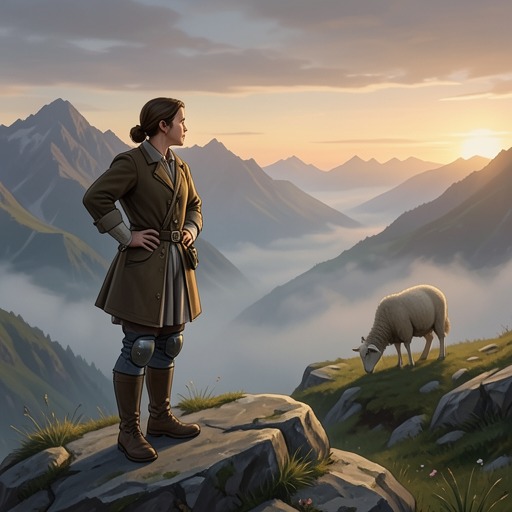
On the high meadows, Heidi’s attention ranges freely. She runs between patches of red primroses, blue gentians, and golden cistus, gathering flowers in her apron so she can make her bedroom resemble the meadows. When she stops at Peter’s pasture, the scene opens from the valley far below to a snow-field, towering rocks, and bare peaks beneath a dark-blue sky. A light breeze stirs the flowers; Peter sleeps, and the goats climb among the bushes. Heidi feels so content that she wishes to remain there. The great bird circling overhead adds a recurring presence to this expansive world, linking her early mountain days with later visits to the same resting place.
Freedom Within Mountain Rhythms
Heidi’s freedom takes the form of ordinary, repeated access to the outdoors. She climbs with Peter and the Goats day after day, growing brown from the sun and so strong and healthy that nothing ails her. Her pleasure is not limited to the high meadows: when weather keeps her home, she takes interest in Alm-Uncle’s hammering, sawing, and carpentry, watches him make goat’s-milk cheese, and listens beneath the old fir trees as wind makes them sway and roar.
The mountain does not mean unrestricted or effortless liberty. In autumn, stronger gusts make Alm-Uncle keep Heidi at home because a child her size could be blown from the rocks into the valley. The same landscape that affords open movement therefore demands attention to danger and season. Its weather changes the children’s routines, and the goats’ liveliness and the steep ground give Peter’s work its practical difficulty. Freedom here is a relation to a particular place, not escape from its conditions.
Frankfurt and the Loss of Open Space
In Frankfurt, Heidi wakes in a high bed in a large room and searches the tall-curtained windows for sky and country. She can see only walls and other windows; the sashes will not open, and she cannot reach the view she wants. The narration likens her to a bird testing the bars of a cage. Her distress arises from a concrete contrast: she is accustomed to going outside early to see whether the sky is blue, the sun has risen above the mountains, the fir trees are moving, and the flowers have opened.
The limits extend beyond the bedroom. Heidi is not free to run outdoors as she did on the mountain, must spend hours alone in her room, and is forbidden to converse with Sebastian in the dining room. She imagines the green growth, flowers, snow, rocks, and valley at home, while the rare outings with Clara reach only streets, large houses, and crowds. The landscape she misses is not merely a pleasant memory; it is the setting of her accustomed movement and daily life.
As autumn and winter pass, the city gives Heidi no changing view to mark the seasons. Even sunlight on the white walls opposite her room recalls what she cannot reach: Peter going out with the Goats and the cistus glowing on the mountain at sunset. She sometimes hides her eyes from the sun on the wall and sits still, struggling with homesickness. The contrast makes the mountain’s freedom legible as access to an open, changing world, while urban enclosure leaves her longing without an outlet.
The Mountain as a Measure of Restoration
When Heidi later brings The doctor to her favorite resting place, the familiar landscape is presented anew: autumn light lies over the green valley, the snow-field sparkles, the rocky peaks stand against the blue sky, and the remaining bluebells nod in the breeze. The great bird circles silently overhead. Heidi looks from feature to feature with delight, then turns to see whether her companion also appreciates the scene.
The doctor asks how a sad heart can be healed enough to rejoice in such beauty. The exchange places the mountain’s significance in human terms without reducing it to scenery: its beauty is an experience Heidi knows intimately and offers to share. Across the novel’s contrasts, alpine nature means sensory abundance, health, mobility, and belonging, but also weather, labor, and risk. Its freedom is compelling precisely because it is rooted in a real landscape with rhythms and limits of its own.