Cats
HeidiCats in Heidi are both inhabitants of an old church tower and unexpected visitors to Clara Sesemann’s Frankfurt home. A grey mother cat guards her kittens, and the litter becomes the focus of Heidi’s joy, Clara’s affection, and Fraulein Rottenmeier’s alarm. Their movement from tower to household makes them more than a charming distraction: they expose the difference between the girls’ delight in spontaneous companionship and the strict domestic order Fraulein Rottenmeier tries to maintain.
The Tower Cat and Her Kittens
The first encounter takes place after Heidi has looked out from the church tower and been disappointed by the view. On the way down, she notices a large basket on the landing beside the steep roof. A big grey cat sits in front of it, snarling at passers-by as if to warn them away from her family. The old tower contains armies of mice, and the cat catches several a day, so she has a practical role in this unusual home as well as a fiercely protective one.
The cat’s warning does not keep Heidi away for long. The old man reassures her that the animal will not hurt her while he is nearby and invites her to look at the kittens. Heidi is immediately absorbed by their tumbling play: seven or eight little animals scramble, roll, and fall over one another, and she moves around the basket to follow them. The scene sets two responses alongside each other: the mother cat’s wary defense of her young and Heidi’s unguarded fascination with them.
Seeing Heidi’s pleasure, the old man offers her one kitten, then says she may take more, even the whole litter if she has room. Heidi asks whether one can be hers to keep and imagines how delighted Clara will be to see the animals in the large house. Her first thought is not simply possession: she wants to share the discovery with Clara. Yet the mother cat springs fiercely when Heidi tries to pick up the kittens, and Heidi draws back in fear. The old man quiets his longtime companion by stroking her and offers to carry the animals himself.
From the Tower to Clara’s House
Heidi identifies the destination by its distinctive gold dog’s head on the door: Herr Sesemann’s house. Although she initially wonders whether she might take one kitten for herself and another for Clara, she cannot separate herself from the spectacle long enough to leave. The old man cautiously draws the mother cat into his room and gives her food, then returns and lets Heidi choose two. She places a white kitten in one pocket and a white-and-yellow striped kitten in the other before going downstairs.
The kittens’ arrival at the house is first registered by sound. During dinner, Fraulein Rottenmeier hears miawing and demands to know why Heidi keeps making the noise. Heidi explains that the sound comes from the kittens. Fraulein Rottenmeier cries out for Sebastian and Tinette to find the animals and take them away, then flees into the study and locks the door. To her, the kittens are creatures to fear; to Heidi and Clara, they are a source of pleasure.
Sebastian has already glimpsed a kitten’s head peering from Heidi’s pocket and guesses what is about to happen. The lady’s cries make him laugh so much that he cannot immediately return to the dining room. When he does, the disturbance has given way to a scene of companionship: Clara has the kittens on her lap, while Heidi kneels beside her, and both girls laugh and play with them. Clara asks Sebastian to find a place where the kittens can stay out of Fraulein Rottenmeier’s sight, because the girls want to keep them and bring them out when they are alone.
The Basket and the Household Uproar
The attempt to keep the kittens discreetly does not prevent a larger delivery. During lessons, Sebastian announces that a large basket has arrived with instructions that it be given to Clara at once. Clara wants to see what is inside, but Fraulein Rottenmeier insists that lessons should be finished first. The tutor begins to weigh the arguments for and against a look inside; before he can finish, the loose cover gives way and kittens spill onto the floor.
The animals race through the room, jump over the tutor’s boots, bite at his trousers, climb Fraulein Rottenmeier’s dress, and scramble around Clara’s couch. Their quick movement transforms a formal lesson into a scene no one can control. Clara delights in their antics and calls Heidi’s attention from one kitten to another, while Heidi runs after them from corner to corner. The tutor stands by the table, repeatedly lifting one foot and then the other to avoid the scratching animals. Fraulein Rottenmeier is so horrified that at first she cannot speak, and she fears rising from her chair lest the kittens jump on her.
At last she summons Tinette and Sebastian. They gather the kittens gradually, return them to the basket, and carry them away to be put with the other two. The sequence turns the kittens’ arrival into a comic reversal: an object that Clara has longed to inspect interrupts the lesson before she can finish asking permission, and the orderly room fills with movement and noise. The animals do not act as if they belong to the rules governing the people around them; their play itself is enough to unsettle those rules.
Conflict and Significance
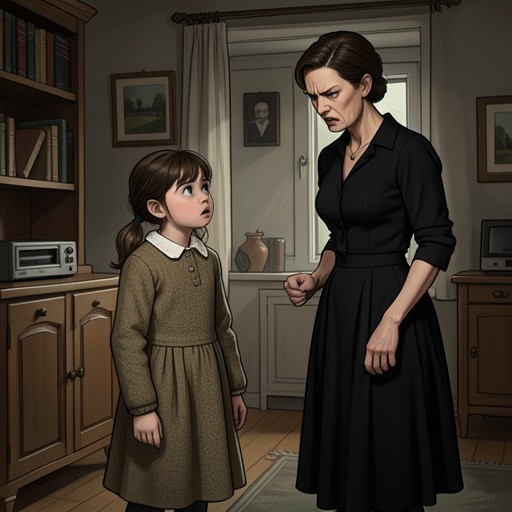
Later that evening, once she has recovered from the morning’s excitement, Fraulein Rottenmeier questions the servants and learns that Heidi’s excursion the previous day set the events in motion. She concludes that Heidi is responsible and turns on her with indignation. Heidi stands by Clara’s couch, unable to understand what sin she has committed, while Fraulein Rottenmeier threatens to punish her by putting her in a dark cellar with rats and black beetles.
The episode gives the cats a sharply divided place in the household. Clara and Heidi want them near, and their shared amusement briefly makes the girls’ room a place of ease; Fraulein Rottenmeier sees them as a threat to order and responds with fear, removal, and punishment. The grey cat’s defense of her litter in the tower also contrasts with the girls’ wish to handle and keep the kittens: the animals have their own protective bonds, even as human affection draws them into a new setting. Their presence therefore links Heidi’s open delight in living creatures to the conflict over who may decide what belongs in Clara’s home and how its inhabitants are expected to behave.