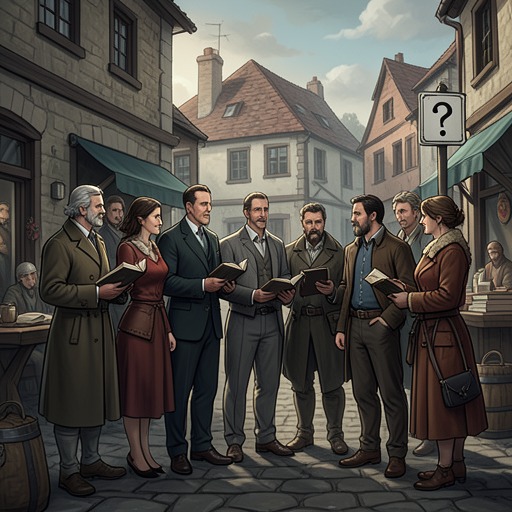
Dorfli school-attendance requirement
HeidiThe Dorfli school-attendance requirement is the village schoolmaster’s insistence that Heidi begin formal lessons despite Alm-Uncle’s refusal to send her down the mountain. The dispute turns on more than a missed school term: it pits an expectation of regular education against Alm-Uncle’s conviction that Heidi’s health and happiness are better protected among the goats and birds.
The schoolmaster’s demand
Twice during the winter, Peter carries a message from the schoolmaster at Dorfli to Alm-Uncle. The schoolmaster says Heidi is already over the usual age for starting school and should have attended the previous winter. Alm-Uncle replies that the schoolmaster may come to see him if he has something to say, but makes clear that he does not intend to send Heidi. Peter faithfully delivers both messages, so the refusal is direct and repeated rather than the result of a message never reaching its recipient.
When the pastor visits in March, he restates the problem more urgently: Heidi ought to have been at school a year earlier and certainly during the winter just passed. He asks what Alm-Uncle intends to do with her. The old man answers plainly that he intends not to send her. The pastor’s proposed timetable allows time for discussion and arrangements during the summer, but sets a firm boundary: the coming winter must be the last in which Heidi is allowed to run wild, and afterward she must attend school every day.
Alm-Uncle’s objections
Alm-Uncle defends his choice as a judgment about Heidi’s well-being. He wants her to grow up happy among the goats and birds, whose company he considers safe and free of evil influence. The pastor counters that Heidi is a human child, not an animal, and that a life without harmful companions would still leave her learning nothing. In his view, protection cannot substitute for education; Heidi needs to begin lessons.
The argument also concerns the practical demands of the journey. Alm-Uncle imagines a young child travelling several miles down the mountain on icy mornings through storms and snow, then returning at night in dangerous wind. He argues that the route could expose her to serious physical risk. He adds that Heidi’s mother, Adelaide, was a sleepwalker who suffered fits, and wonders whether exertion might bring on similar troubles in her daughter. The pastor’s call for regular attendance and Alm-Uncle’s concern about weather, distance, and inherited vulnerability are thus presented as competing claims about what care requires.
Refusal and its immediate effect
Alm-Uncle rejects the pastor’s proposed arrangement with calm determination, declaring that Heidi will not go to school. As the pastor presses him to reconsider, the exchange grows sharper: the pastor criticizes what he sees as obstinacy, while Alm-Uncle responds with irritation and threatens to take the matter before the country’s courts if anyone tries to force him. The confrontation establishes that the schoolmaster’s request and the pastor’s appeal have not secured his agreement.
After the pastor leaves, Alm-Uncle remains out of humor. When Heidi asks to visit Peter’s Grandmother, he first says they will not go that day, then postpones the decision again the next morning. The immediate consequence of the dispute is therefore visible in his mood and in the interruption of a familiar visit, even though he does not explain the change to Heidi.
The rule in the wider story
The requirement is conveyed as a village schoolmaster’s expectation and the pastor’s firm demand for attendance; the evidence does not establish a specific legal penalty or show that a court compels Alm-Uncle. Indeed, his threat to appeal to the courts underscores that compulsion remains contested. The school’s timetable is clear, but its authority over Heidi’s mountain household is not settled by the confrontation.
The disagreement also exposes how uncertain Heidi’s age and educational standing can become when adults speak for her. At the Frankfurt household, Dete claims she is about ten, but Heidi corrects her, saying Alm-Uncle told her she was eight. Fraulein Rottenmeier separately notes that Clara is over twelve and that she had wanted a companion of Clara’s age to share lessons and other activities. These exchanges do not resolve the Dorfli dispute, but they show how Heidi’s actual age matters both to the schoolmaster’s concern that she is overdue and to the expectations adults make of her as a learner.