Little Swan
HeidiLittle Swan is a goat in Alm-Uncle’s herd whose milk, choice of pasture, and care connect the mountain’s animals to Clara Sesemann’s recovery. She is not merely part of the background flock: Alm-Uncle gives her special attention, trusts her instinct for good grazing, and encourages Clara to remember her with a gift when she leaves. Through these specific relationships, the novel makes animal care part of the practical and emotional life of the mountain household.
Identity and Place
Little Swan belongs to the herd that gathers around Heidi. When Clara arrives on the mountain, Heidi introduces her to the goats by name, and Little Swan is among the animals Clara has long wished to meet. The introduction places her within a community of individually recognized animals: Clara is not simply presented with a flock but brought into Heidi’s familiar world, where each goat has a name and a place.
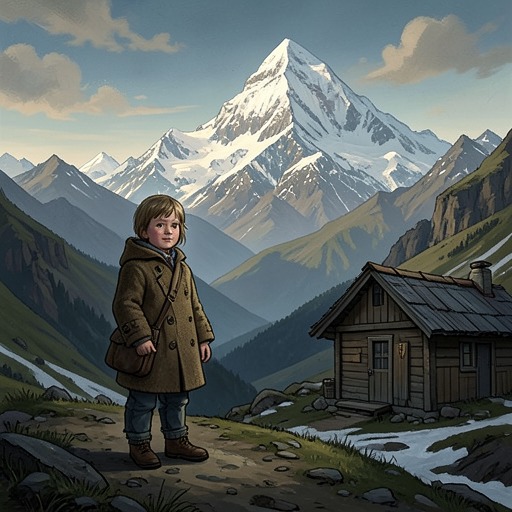
That world is shaped by a sharply particular landscape. Heidi’s days with Peter and the goats unfold among open slopes, flowers, rocks, and high pasture; at a favorite resting place the valley lies below, with a snowfield and rocky peaks above. The mountain is therefore both grazing ground and a lived environment, not a decorative view. Little Swan’s later importance depends on this terrain: her appetite and movement toward higher ground are treated as meaningful parts of the household’s care for her.
Milk and Clara’s Recovery
Alm-Uncle brings Clara and Heidi bowls of fresh goat’s milk, identifying Clara’s portion as milk from Little Swan and saying it will make the girl strong. Clara has never tasted goat’s milk. She hesitates, smells it, then follows Heidi’s example and drinks the bowl to the last drop, finding it delicious. Alm-Uncle responds by proposing that she drink two bowls the next day, pleased that she has taken to it.
The milk gives Little Swan a direct place in Clara’s mountain routine. Clara’s first response is sensory and immediate: she tries an unfamiliar food, likes it, and finishes it. The scene does not establish that the milk alone causes her recovery, but it does show Alm-Uncle deliberately incorporating the goat’s produce into his care of her. Later, when Clara must leave, she recalls Little Swan as having helped make her strong. Her gratitude gives the earlier bowl a lasting emotional meaning without turning the goat into a miraculous cure.
Special Care and Grazing
Alm-Uncle also changes the way Peter manages the herd. He instructs him to let Little Swan go wherever she likes and to follow if she climbs higher. Peter is not to bring her back: Alm-Uncle trusts that she has an instinct for finding the best food and believes that the extra climbing will not harm Peter or the other goats. He wants Little Swan to give particularly fine milk.
The order recognizes the goat’s own orientation to the landscape. Rather than treating Peter’s usual route as fixed, Alm-Uncle makes her choice of pasture the guide and requires the herder to adapt. Peter obeys, although the account notes a turn of his head and a look that suggest he has thoughts he keeps to himself. The immediate arrangement is practical—better feeding for Little Swan—but it also makes her movement consequential to the people who care for the herd.
Alm-Uncle’s attention continues in the food he brings back for her. He climbs higher each afternoon and returns with a large bunch of fragrant leaves, whose scent carries notes of carnations and thyme. Although the goats are eager to reach the leaves, his purpose is to feed Little Swan alone, so that she will give especially fine milk. The narrative links this extra feeding to her increasingly frolicsome behavior and the bright glow of her eye. Her care is thus shown through repeated labor and observed changes, not only through Alm-Uncle’s words.
Farewell and Significance
When Clara is to leave, she asks Heidi to say goodbye to Peter and the goats, especially Little Swan. She wishes she could give the goat a present because she believes Little Swan helped her grow strong. Heidi suggests salt, something Little Swan likes to lick from Alm-Uncle’s hand when she comes home in the evening. Clara is delighted by the idea and plans to send a hundred pounds from Frankfurt as a remembrance.
The proposed gift gathers the relationship into an ordinary, specific exchange: Clara’s farewell takes the form of food suited to the goat, and Heidi knows what Little Swan enjoys from the repeated familiarity of home. Little Swan has no human speech or independent narrated account, but the text gives her consequential appetites, a recognizable temperament, and a place in Clara’s memory. Her role joins the novel’s attention to animal care with its account of recovery: the goat is valued both for what she provides and as an individual whom Clara wishes to thank.