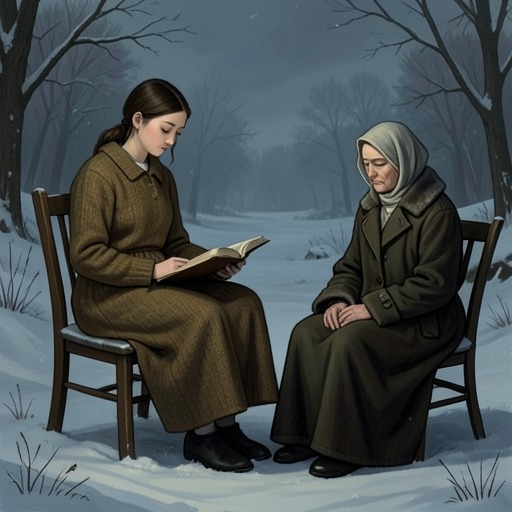
Peter's Grandmother
HeidiPeter's Grandmother is a blind, elderly woman living in a poor, deteriorating cottage with Peter and Brigitta. Her life is shaped by physical darkness, cold, and fear that the house may collapse, but Heidi's regular visits transform her days: conversation gives her something to anticipate, and practical care makes her home safer. Her story does not restore her sight; instead, it shows how companionship, material help, and religious consolation can change the conditions in which she lives.
Identity and Circumstances
Peter's Grandmother sits spinning in the corner of the cottage when Heidi first comes to visit. The rooms are small, narrow, and shabby, with a few dishes on a wooden shelf and a table near the door. Brigitta is mending Peter's waistcoat. The cottage is not like Alm-Uncle's hut, with its large ground-floor room and hayloft; its cramped interior reflects the family's poverty and the grandmother's constrained life within it.
She identifies Heidi by touch, passing her hand over the child's outstretched hand before asking whether she is the child who lives with Alm-Uncle. Her blindness is complete. When Heidi points out a loose shutter and wonders whether fixing it might let more light in, Peter's Grandmother explains that she can see nothing, even when the shutter is open. She knows the mountain and its yellow flowers only as things she will never again see in the light of day. This is not a temporary difficulty that can be solved by repairing the room: the shutter can be mended, but her sight cannot be restored.
The house itself adds a separate danger to her disability. Wind enters through cracks and holes; the place rattles and creaks, and she lies awake at night afraid that it will give way and kill its occupants. Peter, she says, does not understand how to mend it, and there is no one else to do the work. Her distress therefore arises not only from blindness but from living in a fragile building without the help needed to make it secure.
Heidi's Visits and Their Effect
When Heidi understands that no one can make Peter's Grandmother see again, she breaks into prolonged sobbing. The older woman tries to comfort her, then explains that a kind word and the sound of Heidi talking are especially precious when sight is gone. She asks Heidi to sit beside her and describe life with Alm-Uncle, whom she knew in earlier years but has heard little about lately except through Peter, who says little.
Heidi's stories turn the visit into a source of pleasure for both of them. She describes her days on the mountain with the goats and the winter she spends with Alm-Uncle, including the things he makes from wood: seats and stools, mangers for Little Swan and Little Bear, a milk-bowl and spoon, and a large water-tub for her summer bath. She tells Peter's Grandmother how she watches him work and hopes to learn to make such things herself. Her lively account gives the older woman company and brings Alm-Uncle, formerly distant from her daily life, into their conversations.
The visits become a repeated winter routine. On fine days, Alm-Uncle takes Heidi down the mountain in a sleigh; he carries her safely back up afterward, and brings his hammer and other tools so that he can work on the cottage. Over time he makes it sound and tight, so it no longer groans and rattles through the night. Peter's Grandmother, who had gone many winters without sleeping peacefully, is grateful for the repairs as well as for Heidi's company.
The change is especially clear in the rhythm of her days. She listens for Heidi's quick footsteps from morning onward and gives thanks when the child arrives. Absorbed in Heidi's talk, she no longer repeatedly asks whether the day is over; when Heidi leaves, the afternoon seems to have passed quickly. She also asks Brigitta whether Heidi looks strong and healthy. The visit has become something she awaits, and the loss of that companionship is a fear that shadows the happiness it brings.
Separation and Fear of Losing Heidi
That fear becomes immediate when Dete takes Heidi away. Hearing Peter explain what is happening, Peter's Grandmother rises and opens the window with trembling hands, calling after Dete not to take the child from them. Heidi hears her and struggles to return, saying she must go to her grandmother, but Dete holds her hand more firmly and hurries her onward. The scene makes plain that Heidi's visits have created a deep attachment: the older woman pleads from the window, while Heidi tries to break away from the person leading her down the mountain.
Later, the prospect of a visit from Frankfurt revives the same anxiety. In May, Peter's Grandmother is no longer confined to bed and has returned to her spinning-wheel, but Peter's angry report of the visitors leaves her awake through the night, afraid Heidi will be taken away again. When Heidi comes to tell her the news, she notices the older woman's distress. Peter's Grandmother tries to reassure her, but admits that Heidi's leaving would be almost more than she could bear, even while acknowledging that it might be best for the child.
Her effort to conceal her sorrow is an act of care. She does not want Heidi to refuse to leave on her account, and asks instead to hear a hymn that will steady her thoughts. The request turns religious reading into a form of comfort shared between them: Heidi can answer the older woman's fear not by promising an outcome she cannot control, but by reading words that place their troubles within a larger hope.
Practical Care and Renewed Security
During the visit of the Frankfurt party, Heidi rushes into the cottage and announces that her bed will be sent from Frankfurt with all three pillows and a thick coverlet, arriving in two days. The gift is a concrete answer to the cold and discomfort that have marked the grandmother's circumstances. Yet Peter's Grandmother initially takes the news as part of a farewell: she believes the visitors are taking Heidi away and says she will not outlive the separation.
Frau Sesemann follows Heidi into the room and corrects that fear directly. Heidi is to stay with Peter's Grandmother; the visitors hope to come to the Alm every year and will visit her when they do. The older woman's face brightens, and she presses Frau Sesemann's hand, unable at first to speak her thanks. Heidi links the promised bed and the other kindnesses to the hymn she had read. Peter's Grandmother receives the help as evidence that many people are willing to trouble themselves for a poor old woman, and that such human kindness supports her belief in a heavenly Father who does not forget even the least of his creatures.
The attention she receives is not limited to a single gift. Heidi knows the details of her life in winter, including how cold she is and what she does and does not have to eat, and recounts these circumstances to Frau Sesemann as the party walks past the cottage. The narrative thus connects the older woman's improved prospects to close observation: Heidi's familiarity with her daily needs allows them to be spoken of, while the visitors' response brings assistance and reassurance.
Character and Narrative Significance
Peter's Grandmother also shows compassion toward Peter. After he returns home frightened, refuses his potatoes, and hides under the bedclothes groaning, Brigitta guesses that sorrel has made him ill. Peter's Grandmother responds by asking that he be given more bread to take with him the following day, including some of hers. The moment presents her not only as someone receiving care but as a member of the household who remains attentive to another's need, even when she does not know the cause of his distress.
At the close of the story, after the events of the summer have brought the family and their visitors together again, Peter's Grandmother asks Heidi to read one of the hymns. She says that for the rest of her life she can do nothing but thank the Father in Heaven for the mercies shown to them. Her ending preserves the fact of her blindness while changing the emotional and practical world around it: the cottage has been repaired, she has a prospect of greater comfort, Heidi remains with her, and the relationships formed through the child's visits have widened into a circle of care. Her gratitude gathers these distinct gifts without suggesting that her original loss has disappeared.