Winter in Dorfli
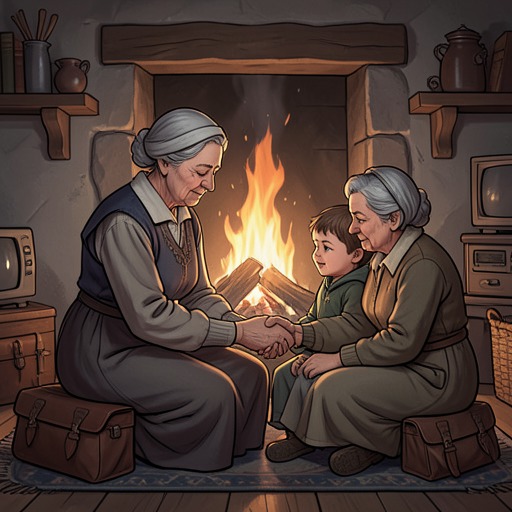
HeidiWinter in Dorfli is a season of physical confinement and altered routines that draws Alm-Uncle and Heidi down from the mountain while bringing education, friendship, and care for Peter's Grandmother into closer reach. Snow first makes travel dangerous, then hardens into a vast sled run; meanwhile, Heidi attends school and helps Peter learn to read so he can visit and read hymns to his grandmother. The season's practical demands and small achievements are closely linked: the winter changes where the household lives, how the children move between home and school, and who can offer the grandmother companionship.
The Move from the Mountain
As the first snow begins to fall, Alm-Uncle keeps his promise not to spend the winter in his old home on the mountain. He closes the hut and its outbuildings and takes Heidi and the Goats down to Dorfli. In the middle of October, they settle into an old, neglected building that Alm-Uncle has rented and repaired during the autumn. Its history is a contrast to its present condition: a distinguished soldier once built it with wealth gathered in Spain, intending to live quietly in Dorfli, but the noise and bustle of the world had suited him better, and he left again without returning. After his death was presumed, a distant relative inherited the property but did not rebuild it. It was eventually let cheaply to poor tenants, and its decay continued for years.
The building had stood empty because it was difficult to make habitable. Wind, rain, and snow entered through its gaps; in winter, the conditions could make it impossible to keep a candle alight and dangerous for anyone living there. Alm-Uncle knows how to mend the structure and makes it sound enough for the season. The remains still show how much work the place requires: from the back, the approach passes an open space bounded by walls, one partly ruined, beneath an ivy-covered arch and the remains of what appears to have been a chapel. Beyond it is a roof-damaged hall open to the square. Alm-Uncle puts up a wooden partition there and covers the floor with straw to make a shelter for the Goats. Passages lead through the damaged building to a sturdy oak door and an intact room. The family’s winter home is therefore not simply a change of address: it is a repaired refuge within a ruin, adapted to shelter both people and animals.
Snow, School, and the Sled Road
The snow makes life at Peter's family home a daily struggle. It rises so high that the windows appear level with the ground, while the door disappears beneath it. Each morning Peter climbs out through the sitting-room window because it is the only opening large enough for him to squeeze through. When the snow has not frozen hard overnight, he sinks almost to his shoulders and has to struggle free. His mother hands him a large broom, and he clears a path to the door, taking care not to let the loose snow fall inside or freeze into a barrier against the house. When the snow does freeze solid, the conditions turn into an opportunity: his mother passes his little sleigh through the window, and the mountain becomes a broad, unbroken run down to Dorfli.
Heidi’s winter routine is more regular. She goes to school in Dorfli every morning and afternoon and applies herself eagerly to what she is taught. Peter, by contrast, is usually absent. The teacher excuses his nonattendance by pointing to the deep snow and the difficulty of getting down from the mountain. Yet Peter can often make his way to Dorfli in the evening, when he visits Heidi. The difference between school and friendship becomes especially clear when the snow freezes. After a bright day and a clear night under the moon, Peter finds the mountain hard as iron. His usual exit through the window sends him sliding downhill before he can stop. He tests the ice by stamping and digging in his heels, then realizes Heidi can now make the journey up to see her grandmother.
Peter tries to go to school, but his sleigh carries him through Dorfli and onward past Maienfeld before it stops on level ground. By then, lessons have begun, and the walk back would take about an hour, so he returns to Dorfli later instead. At dinner, Alm-Uncle questions his conduct and warns him about letting the sleigh carry him past school when he should be in class. Peter understands the comparison to unruly Goats and looks apprehensively toward the corner. Alm-Uncle then changes the encounter into an invitation: Peter may eat, go with Heidi to visit his grandmother, and return that evening for supper. Heidi is too excited to finish the potatoes and toasted cheese on her plate, and Peter eats the food she pushes toward him while Alm-Uncle fills his plate as well. She puts on the warm cloak Clara Sesemann sent her, its hood drawn over her head, and sets off as soon as Peter has finished.
Visits and Lessons
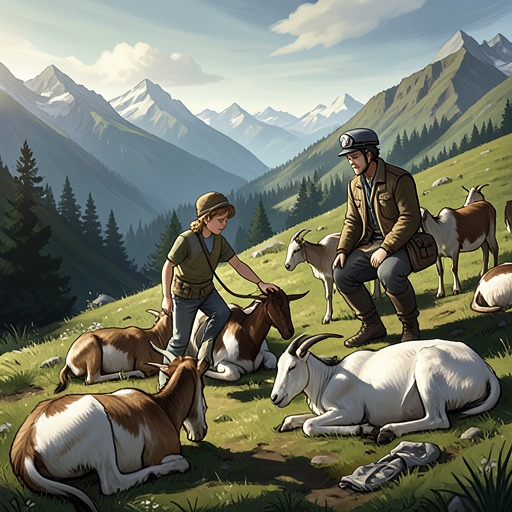
On the walk, Heidi tells Peter that two of the Goats were unhappy when they first came down from the mountain. They refused food and stood with their heads hanging. Alm-Uncle had explained that the animals were experiencing something like Heidi’s own distress when she first left the mountain for Frankfurt: they had never before come down. Heidi stresses that Peter cannot understand the feeling unless he has experienced it himself. The comparison connects the animals’ adjustment to the children’s changing lives, while the journey through the snow makes the grandmother’s home a destination reached through shared effort.
Heidi’s visits are constrained by the weather. When the frost gives way, the snow softens and fresh snow continues to fall; about three weeks pass before she can go to Peter's Grandmother again. She uses the enforced separation to work more determinedly with Peter, hoping that he will be able to read hymns to the old woman in her absence. Their lessons continue from day to day. Peter makes progress, and one evening announces at home that he can read. The next day he arrives at school punctually, bringing his dinner as children who live at a distance do: they sit on the tables, brace their feet on the benches, and spread their food across their knees during the midday break. After lessons, he goes to Alm-Uncle’s to see Heidi.
The teacher tests Peter’s new ability and becomes increasingly surprised as he reads. He asks Peter to try again, and Peter reads another three lines without a mistake. The teacher then goes to the pastor to report that Peter can read and to credit Heidi and Alm-Uncle’s combined efforts. The achievement changes Peter’s place in the winter routine: the boy whom the teacher had repeatedly noted as absent can now demonstrate a skill acquired through sustained teaching outside school.
Hymns and the Limits of Progress
Once Peter can read, he reads one hymn aloud every evening, as Heidi had asked. He will not read a second, but Peter's Grandmother never requests one. Brigitta is astonished and pleased by her son’s attainment, imagining that learning to read may open further possibilities for him. His grandmother is grateful that he has learned, but she still longs for Heidi’s return. The hymns do not reach her in the same way when Peter reads them, because words seem to be missing and she loses their sense while trying to supply what is absent.
The omission is deliberate, though Peter treats it as a harmless shortcut. Whenever he encounters a word he considers too long or difficult, he leaves it out, reasoning that a word or two cannot matter in a verse containing so many. In practice, many of the hymns’ principal words disappear. The winter’s educational success is therefore real but incomplete: Peter has learned to read, yet his grandmother’s experience of the hymns exposes the difference between decoding a text and conveying its meaning. Heidi’s lessons have enabled Peter to help, but the winter also makes clear why the grandmother still values Heidi’s own reading and presence.