
The Superior Man Watches His Own Course
I ChingThis flow traces self-examination as the means by which a person avoids confusing reputation, ceremony, or confidence with genuine character.
increasing Bearing strength in each event
 decreasing
Bearing strength in each eventdecreasingA Worshipper Pauses Before Offering

Sincerity Before Public Action
Hands washed, offerings withheld
Contemplation compares its subject to a worshipper who has washed his hands but has not yet presented the offering. Legge reads the pause as a moment of sincerity and dignity.
The action is not complete, but its seriousness is visible.
Conduct invites attention
A ruler's behavior becomes something others observe. The opening makes public leadership depend on a credible personal example.
Self-examination begins before action is displayed.
A Lad Sees Only the Surface

Shallow Attention
A limited view
The first line presents the looking of a boy. Legge says this may be tolerable for people of low standing but is regrettable in those with greater responsibility.
The subject's perspective is too narrow for his position.
Observation requires maturity
A person who must guide others cannot rely on superficial impressions. The line turns the act of looking into a measure of judgment.
The flow begins by distinguishing seeing from understanding.
The Ruler Examines His Own Course
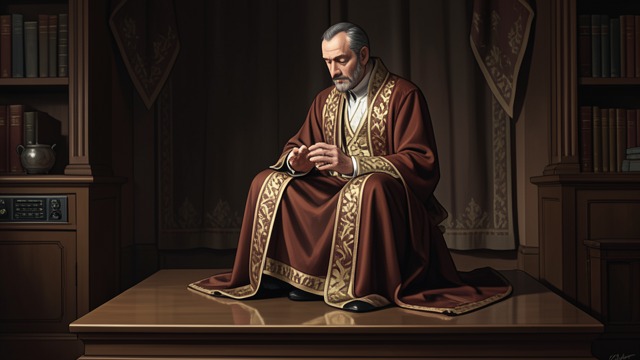
Authority Turns Inward
A leader considers his life
The fifth line shows a ruler contemplating his own course. Legge says that even a superior man must examine himself to avoid error.
Status does not remove the need for reflection.
Public example begins privately
The ruler's conduct becomes the object others judge, but its quality depends on inward scrutiny. A trustworthy example is made before it is displayed.
Self-examination links private character to public influence.
The Final Test Is Character

Looking Beyond Reputation
A superior man tests himself
The final line asks its subject to contemplate his character and determine whether it truly belongs to a superior man. Legge says the process prevents error.
The question is not how others describe him, but what his conduct shows.
A completed examination
The line's position is at the edge of the hexagram, yet the subject remains committed to its idea. Reflection continues beyond the ordinary work of the figure.
The flow resolves in character as something examined rather than assumed.
The Journey Is Judged Step by Step

Conduct Leaves a Record
A course is reviewed
Treading ends by telling the reader to look at the whole course taken and examine its presage. Legge calls the advice a truism but affirms its importance.
No single confident step can establish the goodness of an entire life.
Correctness accumulates
If every step has been appropriate, the outcome is favorable. The figure makes self-examination retrospective as well as prospective.
The theme closes with a practical test: a person's character is visible in the course he has actually followed.
At the opening of Contemplation
At the first line of Contemplation
At the fifth line of Contemplation
At the topmost line of Contemplation
At the final line of Treading
