
The Book's Changing Relation to God
I ChingThis flow traces Legge's account of divine language in the appendixes and his defense of how he translates it.
increasing Bearing strength in each event
 decreasing
Bearing strength in each eventdecreasingGod Appears in Seasonal Language
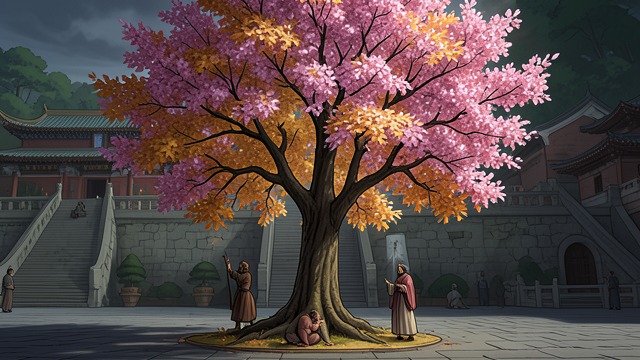
A Divine Presence in Nature
Seasonal work is attributed to God
One appendix says God comes forth through one trigram, acts through the seasons, and completes the year through another. Legge reads the passage as a direct account of divine activity in nature.
The cycle is not described as impersonal mechanism alone.
God is known through effects
Legge quotes later scholars who argue that God is not seen directly but is seen in the things produced. The seasonal world becomes evidence of a divine presence.
The theme gives natural change a theological dimension.
Spirit Is Defined as Operation

Presence at Work in Things
Legge Defends His Translation

A Word Choice Becomes a Dispute
The title at issue
Legge explains that he translates Di as God and Shang Di as Supreme God. Critics had urged alternatives such as ruler or emperor on high.
The disagreement concerns how much English readers should hear in the ancient title.
Translation as declared judgment
Legge insists that his choice is translation rather than private interpretation. He presents it as a conclusion reached after long study, not as a claim made for controversy.
The public dispute forces the translator to account for his religious vocabulary.
Different Traditions Meet in the Text

Theology Has a History
Older text and later ideas
Legge separates the core text from appendixes that discuss cosmic generation, spiritual agency, and natural correspondences. He argues that some concepts belong to later phases of Chinese thought.
A theological statement in an appendix cannot automatically be attributed to the earliest authors.
Criticism without erasure
Legge can value the appendix's account of God in nature while challenging other parts as speculative or trivial. Historical analysis allows for mixed judgments.
The theme becomes one of distinguishing theological insight from later projection.
A Translation Leaves the Question Open

Belief and Evidence Remain Together
A sincere translation choice
Legge says he uses God because he believes it to be the nearest analogue for the Chinese term. He also acknowledges that readers may disagree with his judgment.
The translation is offered as an argued position rather than a neutral escape from interpretation.
The classic exceeds its translator
The book contains layers of religious language and philosophical development that cannot be reduced to one English equivalent. Legge's choice is a way of making its significance visible to his readers.
The flow resolves as an invitation to judge the evidence and the translator's reasoning.
In the appendix on the trigrams
In the same appendix's discussion of Spirit
In the preface dated 1882
During Legge's comparison of appendixes
At the conclusion of the preface
