1143–1142 BC
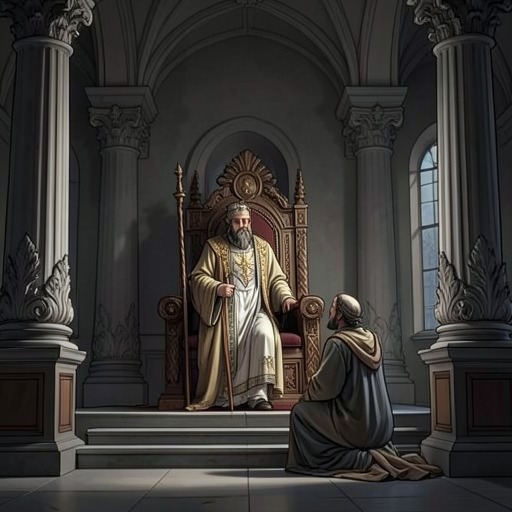
I Ching1143–1142 BC is the date the translator assigns to the portion of the I Ching attributed to King Wen, a proposed origin story that places the book’s composition inside a political crisis. Imprisoned at Youli by the last ruler of Shang, King Wen is portrayed studying the sixty-four figures and attaching to them interpretations that turn divination toward warnings about conduct, danger, and the condition of the state.
Political Crisis and Imprisonment
By 1143 BC, King Wen’s principality of Kâu had become influential across much of the kingdom. The translator describes its lord as distinguished in peace and war, and as a model of wisdom and restraint. Though princes and people would have welcomed an attack on the tyrant, King Wen held back rather than risk appearing disloyal. That restraint did not protect him from suspicion: the Shang ruler had him imprisoned at Youli, and an order for his death might arrive at any moment.
The account places the imprisonment amid a wider breakdown of rule. The Shang monarch is accused of contempt for virtue, cruelty, neglect of sacrifices and law, and favoring the wicked while driving away his instructors. Against this picture of failing authority, King Wen’s position was precarious: he was powerful enough to alarm the ruler, yet careful not to present himself as a rebel. The translator dates the height of their conflict to 1143 BC and says King Wen was released the following year after his friends appeased the ruler’s jealousy.
Composition and Divinatory Practice
The translator places King Wen’s work on the I Ching in this confinement. The linear figures were not new: trigrams had long been used in divination, and the translator cites early references to consulting tortoise shell and stalks. King Wen, familiar with divination as an institution, could have found the study of the figures an activity that would not alarm his keepers. The suggestion that this also helped lull suspicion is explicitly conjectural; the account presents it as a possibility, not a recorded motive.
In the translator’s imaginative reconstruction, the sixty-four figures lay before King Wen in prison. He gave each a name expressing an idea, drew lessons from nature, human society, and the kingdom’s condition, and shaped those lessons as exhortations or warnings. This interpretation recasts divination as a disciplined attempt to limit its follies: the figures still belong to a divinatory system, but their explanations direct attention toward judgment and conduct rather than unbounded prediction.
The proposed date is correspondingly cautious. The translator says King Wen’s portion may have been composed in 1143 or 1142 BC, perhaps begun in the first year and completed in the second. He distinguishes that contribution from the larger share attributed to King Wen’s son, the Duke of Zhou, whose work includes references to King Wu and events in the early years of the succeeding reign. The date therefore applies to one layer of the I Ching, not to the completed book as a whole.
What Divination Could Establish
The translator distinguishes consultation from certain foreknowledge. In his account, the purpose was not to discover future events absolutely, but to judge whether plans and contemplated circumstances were likely to turn out favorably or unfavorably. That limitation matters to the interpretation of King Wen’s work: the figures offer a way to assess a situation and receive counsel, rather than a guarantee that every future event can be known in advance.
The stalk-divination procedure described elsewhere in the book uses forty-nine stalks. They are manipulated three times for each line, requiring eighteen manipulations to form a hexagram. Odd numbers produce undivided lines and even numbers divided lines; the resulting figure is interpreted through King Wen’s judgments and the Duke of Zhou’s line statements. These procedural details belong to the later account of how divination worked, not to a claim that King Wen invented the practice while imprisoned.
Later Textual Layers and Reception
The date also helps separate the I Ching’s older Text from its Appendixes. The translator argues that the Appendixes are much later than King Wen’s material, placing them in the Confucian period, probably between 450 and 350 BC, and rejecting the assumption that the two parts form a single work in the proper sense. He objects in particular to editions that print some Appendixes alongside the Text, because the resulting mixture can blur the differences between their ideas and historical periods.
The book’s subsequent history, as the translator recounts it, shows how its uses and authority changed over time. In 213 BC the I Ching escaped Qin Shi Huang’s book burning because divination books were exempted. A catalogue prepared by Liu Xin near the beginning of the Common Era listed works on the I Ching and its Appendixes from thirteen authors or schools, divided into 294 portions. The imperial edition of 1715 quoted 218 scholars, and printed the Text and Appendixes separately. Against that long history of preservation and interpretation, 1143–1142 BC remains a proposed date for King Wen’s contribution, not a date for every layer of the received book.