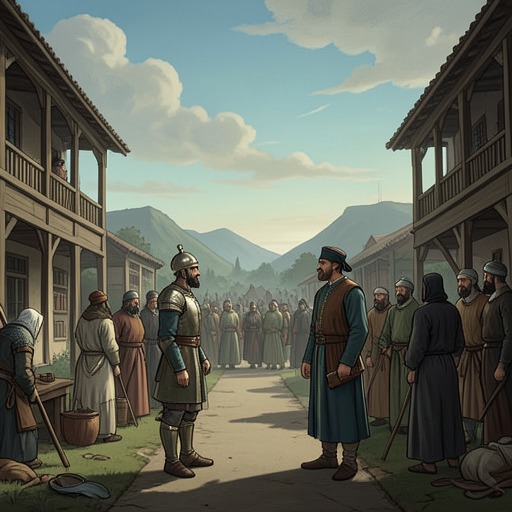
Abundance
I ChingAbundance, called Făng and numbered Hexagram 55, presents prosperity not as a secure possession but as a condition that must be actively sustained. Its decisive image is the sun at noon: at the height of its power, a ruler should remain a source of light and encouragement rather than assume that present success will preserve itself.
Definition and Political Lesson
Făng signifies largeness and abundance, and its judgment associates the condition with progress and development. The counsel is not to become anxious merely because circumstances may change. Instead, the ruler is to attend to the work of maintaining the prosperity of the state and its people, emulating the meridian sun that cheers and enlightens all.
The image carries a warning within its brightness. Prosperity in human affairs can give way to its opposite, so abundance is also a test of government: success calls for continued care, not complacency. The hexagram’s component trigrams combine intelligence with motive force, with the latter directed by the former. In the commentary’s account, that union equips a ruler to preserve both crown and prosperity.
Cooperation and the Ruler’s Work
The first line portrays its subject meeting a mate. Although the two are of the same character, their association is not an error; advancing together earns approval. The accompanying commentary identifies the unusual pairing as a departure from the usual doctrine of line correspondence, which would normally regard two undivided lines as an unsuitable match. Here, however, the text treats the fourth line as the first line’s mate. The exception gives the image a political force: mutual assistance matters more than a rigid application of the ordinary rule, and the first line is encouraged to advance.
The fifth line places a weak figure in the ruler’s position and makes him lord of the trigram of movement. He cannot accomplish much without help. His task is therefore to bring the talents of the first, third, and fourth lines—and even those of the second, his correlate—into his service. The commentary makes the consequence explicit: cooperation between ruler and able ministers is what most consolidates a country’s prosperity. Abundance is maintained through coordinated work, not through the ruler’s strength alone.
Obscured Light and the Risk of Isolation
The second line depicts a subject hidden behind screens so thick that, at midday, the constellation of the Bushel is visible through them. If he goes to enlighten the ruler represented by this obstruction, he risks suspicion and dislike. The counsel is to preserve sincere devotion, allowing that inward constancy to move the ruler’s mind; under those conditions, the line promises good fortune. The image turns the noon brightness into a measure of its opposite: a court can be so screened from illumination that even daylight offers no clarity.
At the other extreme, the topmost line shows a house enlarged until it serves only as a screen for its household. Its door remains still and unattended, and for three years nobody is seen there; the outcome is evil. The commentary attributes this failure to the subject’s complete lack of helpers and prolonged isolation. The hexagram thus sets collaborative abundance against a prosperity that has become enclosure: where assistance and contact disappear, apparent largeness cannot prevent decline.