Confucius's late-life study of the I Ching
I ChingConfucius's late-life study of the I Ching marked a renewed engagement with an ancient book he had earlier neglected, and became a key piece of evidence for the classic's existence before his time. Accounts cited in the book place his intense attention to it in the closing years of his life, after his return to Lu; tradition also connects him with interpretive Appendixes that later readers treated as part of the work, though the translator insists that the older Text and those later writings must be distinguished.
Return to the I Ching
The account begins with a reported saying that Confucius would devote fifty years to studying the I Ching if his life were extended, in the hope of avoiding serious errors. The author regards the saying as evidence that the book was known in Confucius's lifetime, not as a reliable indication that he literally expected to live another half-century. By then, Confucius was nearly seventy and had returned to his native Lu after long and painful wanderings among the states. The text treats his renewed study as especially striking because, in the prime of his life, he had given more attention to History, Poetry, and Rites and Ceremonies, the ancient books he had discussed with his disciples.
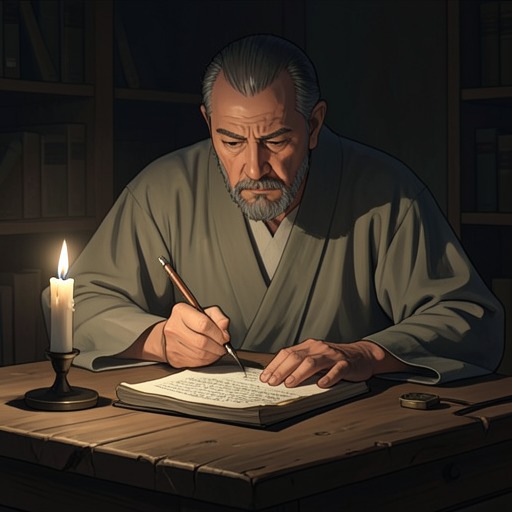
A related biographical report gives the late-life interest a physical image: Confucius read his copy so frequently that the leather thongs binding its tablets wore out three times. In this account he says that several more years would make him master of the I Ching. The repeated binding failures convey sustained study, while the wish for additional years underscores that mastery remained an aspiration rather than a completed achievement.
The Appendixes and the older Text
The historical account says that Confucius wrote various Appendixes to the I Ching, identifying nearly all of the treatises grouped under the traditional name of the Ten Appendixes. These writings were published with the older Text, which itself explains lineal figures based on still older forms. Most Chinese readers and foreign scholars received the Appendixes as an integral part of the classic, but the translator separates the two bodies of writing rather than treating them as a single work by one author.
That distinction rests partly on chronology. The book dates the Text's composition to King Wen in 1143 BC and to his son, the Duke of Zhou, roughly thirty to forty years later. Even if the Appendixes were Confucius's work, they could not have begun before 483 BC: at least six centuries separate them from the portion attributed to King Wen, and nearly 630 years separate them from the Duke of Zhou's contribution. The translator argues that ideas about the method and meaning of the I Ching could change over so long an interval, making it misleading to merge the later explanations with the older material.
A disputed attribution and its afterlife
The association between Confucius and the Appendixes shaped how later readers understood the classic. The translator notes that the Appendixes were generally attributed to the sage, with only limited dissent, and that native critics often defended the unity of the two parts and the attribution of all the Appendixes to him. In his account, questioning their consistency or authorship could seem to challenge Confucius's infallibility and expose the critic to accusations of heterodoxy.
The book also describes how editorial arrangement reinforced the fusion. Under the first Han dynasty, Pi Ji began a practice of interleaving five Appendixes with the Text in common editions. The translator considers this mixture a major obstacle to understanding: passages from writings of different periods and intellectual character appeared side by side, encouraging readers to treat them as one homogeneous composition. The Kangxi imperial edition of 1715 printed the two portions separately, though the broader habit of attributing the Appendixes to Confucius remained powerful.
Study, interpretation, and transmission
Confucius's reported late-life reading belongs to a longer history of interpretation, not simply to private study. The I Ching escaped the book-burning order of 213 BC because it was classed as a work of divination, among the kinds of books exempted from destruction. By the beginning of the Christian era, a catalogue of the imperial library listed works on the classic and its Appendixes from thirteen authors or schools, comprising 294 portions. The later Kangxi edition quoted 218 scholars, spanning from the second century BC to the seventeenth century, and the translator observes that these represented only a fraction of those who had tried to interpret the book.
The tradition of Confucius's study therefore carries two related kinds of significance in the account. It supports the claim that the older I Ching preceded him, while also explaining why a later body of commentary came to bear his authority. The book's transmission preserves both the evidence of a long interpretive history and the problem that history creates: reverence for the sage could make readers reluctant to distinguish his attributed writings from the much older Text.