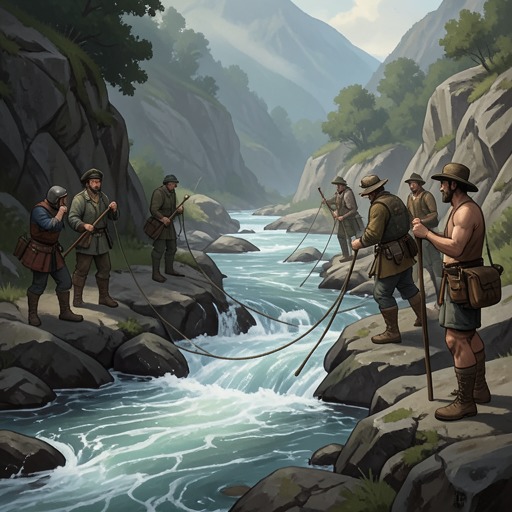
Fox
I ChingThe Fox is a symbolic figure in the I Ching’s closing hexagrams, where its tail at the water’s edge marks the precarious boundary between success and failure. In Completion, the image counsels stillness after an undertaking has been achieved; in Not Yet Completed, the young Fox’s nearly finished crossing fails through want of caution. The contrast makes the animal an instrument for thinking about timing: a crossing is not secure merely because its end is near, and a completed passage is not a warrant for further movement.
The Fox at the Threshold
In the account of Completion, the first line presents a driver drawing back his wheel, or a Fox whose tail has become wet. The two images converge on restraint: the enterprise has succeeded, but the moment calls for rest rather than another attempt at the stream. The Fox’s wet tail is therefore not simply a sign of mishap. It makes caution visible, giving an animal image to the decision not to risk a second crossing immediately after the first has been accomplished.
The commentary explains that the kingdom’s vessel has been brought safely across a great and dangerous stream: its distress has been relieved and its disorders repressed. Yet the new government still needs consolidation. The first line belongs to the time immediately after this achievement, when movement should be hushed for a season. The Fox that has wet its tail will not tempt the stream again. Its small, unfinished detail—a tail already in the water—carries the larger warning that success requires a pause if it is to endure.
Completion and the Cost of Moving Too Soon
The closing lines of Completion sharpen the distinction between achievement and lasting order. The hexagram intimates progress and success in small matters, while warning that good fortune at the beginning may give way to disorder at the end. Its figure has every line in a correct place, and each line has a proper correlate; the commentary treats this formal order as consonant with the prospect of success. But correctness does not remove the need for restraint. The ruler must continue to perfect what has been accomplished, firmly and correctly, while remembering how unstable human affairs remain.
Other line images develop the same pause from different angles. A woman whose carriage-screen is lost is told not to pursue it: after seven days, she will find it. The commentary reads this interval as the exhaustion of Completion’s six-line period and the beginning of a new time when action becomes proper. The advice is not that action must never resume, but that its timing matters. Against this pattern of waiting, the Fox’s wet tail gives the warning a bodily, memorable form: do not return to the stream simply because the crossing is familiar or the undertaking has gone well once.
Not Yet Completed: The Failed Crossing
In Not Yet Completed, the Fox is young and nearly across the stream when its tail gets immersed. The hexagram’s opening judgment associates this image with no advantage, and the first line repeats the immersed tail as an occasion for regret. The earlier image’s quiet refusal to tempt the stream again has become a failed attempt to finish a crossing that is still in progress. The difference is one of circumstance, not merely of animal: in Completion, the Fox’s wet tail accompanies a timely halt after success; here, a nearly finished crossing ends in trouble.
The commentary makes the Fox an emblem of insufficient caution among those trying to remedy prevailing disorders. Their attempt does not succeed; instead, they get themselves into danger, and whatever can be done must be undertaken in another way. The line’s position helps explain the reading: it is weak, at the bottom of the trigram of peril, and responds to a strong fourth line that is not in its proper place. Its subject tries to act but finds cause to regret the course. The image thus joins a concrete failure at the water to a broader failure of judgment under peril.
The remaining lines show that the Fox’s warning is part of a wider problem of choosing when to advance. The second line’s subject drags back the carriage-wheel and, with firmness and correctness, has good fortune. The third describes advancing while conditions remain unremedied, which leads to evil, while also preserving the possibility of advantage in attempting to cross the great stream; the commentary notes that critics have disputed whether a negative may have dropped out of this difficult line. At the fourth line, sustained and vigorous effort may bring progress and success, with the long expedition of Wu Ding offered as a comparison. The Fox does not prescribe simple immobility: it marks the danger of proceeding without the caution and changed approach the situation requires.
A Recurrent Image, Read in Context
The Fox’s meaning depends on how each image sits within its hexagram and line. The book’s explanation of the text describes its judgments as interpretations of whole figures, while line texts supply separate emblematic readings; the meaning of a line varies with the hexagram’s name and the state it denotes. The Fox therefore does not operate as a fixed omen detached from its setting. Its wet tail can signal prudent withdrawal after an accomplishment or regret when an incomplete crossing is pushed toward a premature end.
That contextual method also reflects the translator’s account of how the book should be rendered. He rejects a merely literal transfer of Chinese characters, arguing that a translator must apprehend the author’s thought and express its meaning as exactly and concisely as possible. The Fox’s recurrence illustrates why image and circumstance must be read together: a repeated animal and a repeated wet tail do not yield a single interchangeable lesson. Their force comes from the contrasting temporal states around them—one passage completed but in need of consolidation, another still unfinished and endangered by overhasty action.