Fuxi's invention of the trigrams
I ChingFuxi's invention of the trigrams is the Great Treatise’s account of how observation of heaven, earth, living creatures, and human experience became a system of symbolic figures. The account makes the trigrams instruments for discerning the qualities of the world, though the translator stresses that the tradition does not establish their historical origin with certainty and that their later divinatory use must be distinguished from the interpretations attached to them in the Text.
The account of observation
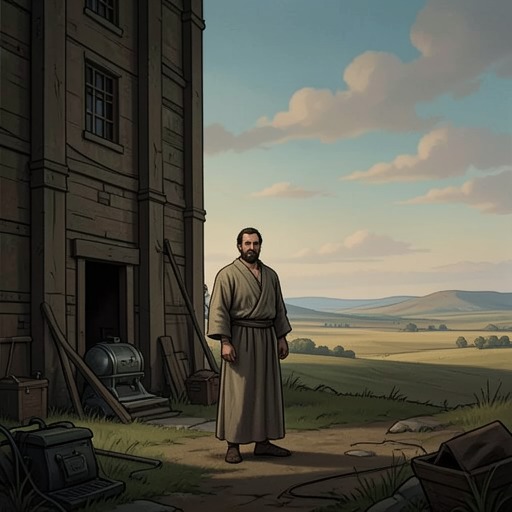
The Great Treatise describes Pâo-hsî, identified by the translator as another name for Fû-hsî, surveying the world in two directions: upward toward the forms of the sky, and downward toward the patterns of the earth. He notices the markings of birds and beasts and the differing suitability of soils. He also considers what is near at hand in his own person and what lies at a distance among things generally. From these observations, the account says, he devised eight three-line figures, intended to display nature’s subtle operations and classify the qualities of the myriad things.
The passage supplies a broad method rather than a step-by-step account of invention. Observation ranges from celestial forms to terrestrial patterns, from animal markings to land, and from the self to the distant world; the resulting figures condense this varied field into a scheme of classification. Yet the explanation remains general: it does not specify exactly how any one observation produced a particular figure, or how the inventor moved from perceived patterns to the eight forms.
The eight figures and their referents
The translator names the eight figures as khien, tui, lî, kăn, sun, khân, kăn, and khwăn, and associates them respectively with heaven or sky; water as a marsh or lake; fire, the sun, or lightning; thunder; wind and wood; water in the forms of rain, clouds, springs, streams in defiles, and the moon; a hill or mountain; and earth. The list makes clear that the figures do not merely stand for eight isolated objects: some encompass several related natural manifestations, while others designate broad features of the physical world.
Each figure is also assigned an attribute or quality suggested by the natural object it represents. The translator postpones discussion of those attributes, so the account establishes the classificatory principle without fully elaborating its interpretive consequences. The trigrams thus provide a compact symbolic vocabulary, but their meanings depend on the natural and conceptual qualities brought to bear on them.
From trigrams to the hexagram Text
The trigrams are not themselves the complete structure of the Text as the translator describes it. The work consists of sixty-four short, symbolically expressed essays, each based on a six-line figure formed from whole and divided lines. In the translator’s account, King Wen takes up the hexagrams in an order shaped by contrasts between successive figures and gives each one an overall significance, sometimes indicating what action its circumstances call for and whether that action is fortunate. The Duke of Zhou then interprets the lines individually, beginning at the bottom, through emblematic illustrations and related judgments of fortune. The interpretation of a whole hexagram is presented as harmonizing with the combined significance of its six lines.
This distinction matters to the invention story: the Great Treatise’s account of how the trigrams were formed does not, by itself, explain the later meanings of every hexagram or line. The figures are interpreted through the Text’s named authors and through rules concerning line qualities, positions, and relations. The significance of a line varies with the hexagram’s name and the subject it denotes; a figure’s meaning is therefore not reducible to its graphic form alone.
Divination and historical uncertainty
The translator cautions that the Great Treatise’s origin story is one account among several. He notes that another account describes the formation of the trigrams and hexagrams differently, and says that he considers that second account more likely. Whatever the first framer’s source for the whole and divided lines, he argues, manipulating those two forms by the described procedure can generate the figures. He also questions the account that derives them from a diagram associated with the Dragon-Horse of the Yellow River, suggesting that it may have been intended to give the trigrams a supernatural character and inspire religious veneration.
The trigrams were used in divination, but the translator distinguishes that practice from an absolute forecast of future events. In his account, divination tested whether a contemplated scheme or set of circumstances would prove fortunate or unfortunate. The stalks used in the procedure were treated in the Great Treatise as spirit-like and specially suited to divination; the practical operation, as he describes it, used forty-nine stalks, manipulated three times for each line, requiring eighteen manipulations to form a hexagram. Odd and even numbers determined strong, undivided and weak, divided lines, with the numbers associated with the emblematic symbols helping to produce the figure. The trigrams’ place in this ritual practice is therefore distinct from the account of their original formation through observation.
The translator also rejects reading the trigrams as proof that an elaborate theory of primordial matter or cosmological creation already existed when the relevant appendix was written. He argues that the author’s subject is the changing phenomena of nature and experience, not a fully developed cosmogony, which he says took shape much later. In this reading, Fuxi’s invention is best understood as the traditional account of a symbolic classification of the changing world—not as secure historical documentation of who first made the figures or as evidence that the later philosophical systems were present from the beginning.