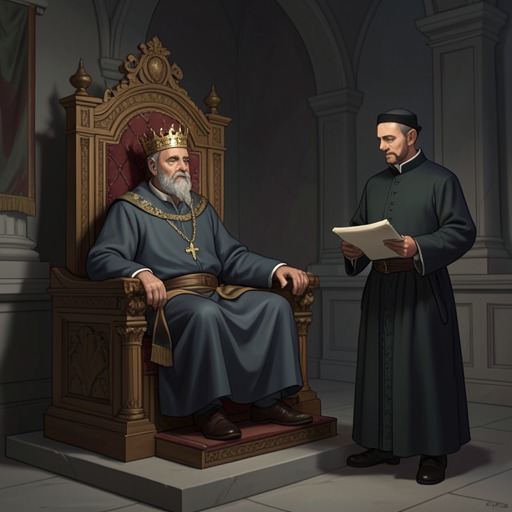
Gathering Together (Ȝhui)
I ChingGathering Together (Ȝhui), Hexagram XLV, treats collective unity as a political and ritual achievement, not simply a gathering of people: the king’s ancestral observances and the guidance of a great man sustain a bond between ruler and ministers, high and low. Its lines make that ideal humanly uneven, moving from a frustrated appeal that becomes joy to the lonely lament of one who remains outside the union.
The Kingdom in Union
The hexagram’s judgment presents a kingdom in a state of happy union between sovereign and ministers, and between those above and those below. Yet cohesion is not self-preserving. The judgment directs the king to repair to the ancestral temple, recommends meeting the great man, and conditions progress and success on firm correctness. Great victims are auspicious, and movement in any direction is advantageous, but the accompanying explanation makes the qualification decisive: the king’s actions succeed insofar as they are correct and right.
The ancestral temple gives this political picture a ritual center. The commentary describes the king meeting there in spirit with the spirits of his ancestors; the sacrifices are to be distinguished by dignity and splendor, with the best obtainable victims and other offerings in harmony with them. Ritual therefore figures as one means by which the united kingdom is maintained, alongside the influence of the great man, understood here as a sage on the throne.
Lines of Appeal and Support
The first line begins with a sincere desire for union that its subject cannot yet fulfill. Disorder enters the sphere of his association: though he has a proper correlate in the fourth line, two weak lines intervene, obstructing the connection. The line’s image registers the emotional cost of this separation, but also gives it a turn. If the subject calls to his correlate for help, tears give way suddenly to smiles; he need not be troubled by the temporary difficulty, and may go forward without error.
The second line offers a contrasting route into the union. Its subject is led forward by a correlate, and the result is good fortune and freedom from error. The line stresses complete sincerity: even the small offerings of the vernal sacrifice are acceptable in that condition. Set beside the judgment’s recommendation of great victims and splendid ancestral services, this detail distinguishes material scale from the inward quality that makes an offering meaningful.
The Unsettled Figure at the Summit
At the top, the divided line shows its subject sighing and weeping, but without error. The commentary explains the sadness through the structure of the figure: this weak line stands at the extremity, has no proper correlate, and finds everyone below united with the fifth line. Still anxious for union, the subject mourns his solitary position. His good feeling preserves him from error and blame, even though it does not bring him into the collective bond.
The ending thus refuses to make unity universal or effortless. The first line’s appeal receives an answer and turns grief into joy; the top line’s grief remains, because the relations that might support it are absent. The contrast gives the hexagram’s account of cohesion its limits: right intention matters, but position and connection also shape whether a person can participate in the larger union.
Divination and the Text’s Historical Frame
The book’s discussion places this hexagram within the older practice of divination by lineal figures. It describes the use of divining stalks alongside tortoise-shell divination, with the stalks manipulated to form a hexagram whose interpretation drew on the judgments associated with King Wen and the line statements associated with the Duke of Zhou. The translator distinguishes this consultation from absolute foreknowledge: divination was meant to assess whether contemplated schemes and conditions would turn out luckily or unluckily.
The translator also separates the older Text from the later Appendixes that explain it. He argues that their different historical periods and interpretive aims should not be collapsed into a single work, and notes that the common arrangement of printing some Appendixes alongside the Text could confuse readers. For Gathering Together, this distinction matters to how its political and ritual language is approached: the judgment and lines offer the hexagram’s own divinatory statements, while explanatory commentary develops their implications for royal worship, social cohesion, and the figure’s patterned relationships.