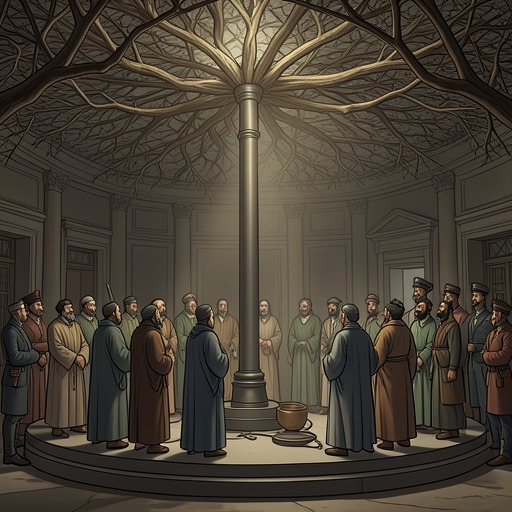
Gui-shen
I ChingGui-shen is not a single, stable supernatural category in the passages examined by the translator: the expression shifts between spiritual agents associated with natural change and a pair of constituents of human life. The distinction matters because later interpreters, in his account, made the term carry more elaborate cosmological meanings than its early contexts warrant.
Meanings Across the Appendixes
In one appendix, Gui-shen occurs in passages on the fifteenth hexagram, Khien, and the fifty-fifth, Făng. The translator distinguishes the two elements of the compound: kwei denotes the disembodied human spirit, while shăn refers to spirits whose seat is in heaven. In combination, he says, the words are best rendered as “spiritual beings or spiritual agents.” This is a deliberately cautious translation: it preserves the suggestion of agency without assigning the pair a later, fully elaborated metaphysical system.
The discussion of Făng connects the term to the changing interaction of Heaven and Earth. A question put to Zhu Xi asks why an account of seasonal growth and decline, already described as Heaven and Earth’s changing activity, needs also to mention Gui-shen. Zhu Xi answers that “heaven and earth” names the general result, while Gui-shen represents the effective traces of their interaction as though some personal agency brought them about. The translator considers this an explanation that largely explains away the wording, and points readers toward the later appendix for a clearer sense of the period’s ideas.
Elsewhere, the single character shăn describes Heaven’s spirit-like way, through which the four seasons proceed without error. Sages follow that way in establishing instruction, and people throughout the realm submit to them. This passage makes spiritual language part of a sequence joining regular natural change to human teaching and political authority; it does not, by itself, settle what sort of beings or powers the term names.
Human Life and the Two Souls
In another appendix, Gui-shen appears in a passage where the translator assigns each component a specifically human meaning: kwei is the animal soul or nature, and shăn the intellectual soul. Their union constitutes the living, rational person. He therefore translates the terms as “the anima and the animus,” distinguishing this usage from the earlier references to spiritual beings or agents.
The translator compares this reading with two competing renderings. Canon McClatchie translates the characters as “demons and gods.” Walter Henry Medhurst instead describes the kwei-shăn as expanding and contracting principles of human life: at death, in his account, shăn ascends and moves about in space, while kwei contracts and returns to earth and nonentity. The translator says Medhurst’s account is broadly close to his own, while declining to adopt its language of expansion and contraction. The disagreement illustrates why a fixed English equivalent can obscure the different work the same expression performs from passage to passage.
A second occurrence in that appendix is harder to interpret. Its passage assigns odd numbers to Heaven and even numbers to Earth, saying that changes and transformations are effected and spirit-like agencies kept in movement. The translator reads the numbers as enabling the formation of spirit-like lines that picture changing phenomena in nature, as though those phenomena were produced by spiritual agency. Medhurst follows Zhu Xi in explaining Gui-shen through the contracting and expanding, receding and approaching of the productive and completing powers represented by even and odd numbers. McClatchie, however, renders the term here as “the Demon-god (i.e. Shang Tî),” a markedly different interpretation from his “demons and gods” elsewhere.
Divination and the Work of the Term
Gui-shen belongs to a text that discusses divination as a practice with specific materials, operations, and limits. The translator traces divination by tortoise shell and stalks to early historical records, including a document in the Shû King said to date to the twenty-third century BC. By the time of the lineal figures, stalks of the plant Ptarmica Sibirica were used to generate hexagrams. The translator reports having seen the plant growing near Confucius’s grave.
The purpose of the consultation, as the translator construes it, was not to know the future absolutely. It was to test whether a contemplated scheme or condition of events would turn out luckily or unluckily. The appendix describes the stalks as spirit-like things produced by Heaven, and attributes to them an invisible virtue fitting them for divination. The translator regards that claim as evidence of the appendix writer’s belief in the stalks’ special efficacy, not as proof that the procedure revealed future events.
The procedure itself made numbers instrumental in constructing the figure. Forty-nine stalks were used; each line required three manipulations, and a hexagram therefore took eighteen. Odd numbers produced strong, undivided lines and even numbers weak, divided ones, with the emblematic values nine, eight, seven, and six helping to combine lines into the hexagram. Once the figure had been formed, its interpretation turned to the judgments attributed to King Wen and the line statements attributed to the Duke of Zhou. In the translator’s account, numbers served as aids to divination by making the figure; they were not treated as the underlying substance or cause of all things.
This account also clarifies the relation between the language of spiritual agency and the mechanics of divination. The figures were used to represent changing phenomena, while Gui-shen could describe their effective interaction as if some agency were at work. The translator contrasts that account with a claim that the signs made every possible occurrence in nature knowable beforehand. He argues that such a reading misstates the practice: the question was whether an envisaged course of action was auspicious, not whether every future event could be foretold.
Interpretation and Historical Limits
The translator resists reading later cosmology backward into the appendixes. He argues that the developed doctrine of an ethereal primary matter, alternately expanding as active yang and contracting as inactive yin, took more than a thousand years to form within the Confucian tradition and was not fully developed until the eleventh and twelfth centuries, during the Song dynasty. In his view, the appendix’s subject is the changing phenomena of nature and experience, not a comprehensive account of creation or the universe’s first substance. The multiple uses of Gui-shen should therefore be read in their immediate contexts rather than forced into that later system.
The history of the text complicates interpretation further. The translator distinguishes the older core text from its appendixes, which he places in the Confucian period, probably between 450 and 350 BC, and rejects treating the two parts as one homogeneous work. The Qin book burning in 213 BC spared the I Ching because it was classed among works on divination. Later, the imperial library catalogue prepared by Liu Xin recorded thirteen authors or schools on the I Ching and its appendixes, comprising 294 portions; the Kangxi imperial edition of 1715 quoted 218 scholars. These layers of preservation and commentary shaped how readers understood the term, but, for the translator, they do not erase the differences between its early uses or justify importing later metaphysics into them.