Kâu dynasty
I ChingKâu dynasty is presented both as a principality whose rulers became central to the political history of ancient China and as the house associated with the foundational layers of the I Ching. Its lord King Wen is credited with interpreting the hexagrams, while his son, the Duke of Zhou, is associated with the line texts. The dynasty’s legacy therefore joins political authority to an enduring textual tradition, though the book distinguishes these early texts from later appendixes and interpretations.
The principality and its rulers
The principality of Kâu lay in the west of the kingdom, in a region corresponding to part of what is now Shen-hsî. Its lords had long been distinguished for ability and virtue. The chief known as King Wen, then called Khang, succeeded his father in 1185 BC and came to exercise a kind of viceroyal authority over much of the kingdom. His reputation rested on conduct in both peace and war, as well as on wisdom and self-restraint.
King Wen’s standing had political consequences. Princes and common people, the account says, would have rejoiced to follow him against the tyrant Shâu, but King Wen held back rather than risk being accused of disloyalty. Shâu’s suspicion nevertheless grew, and in 1143 BC King Wen was imprisoned at Yû-lî, with the threat of execution hanging over him. The Kâu ruler’s restraint and vulnerability form the political setting for the book’s account of his work on the hexagrams.
The I Ching and the Kâu house
The book attributes the I Ching’s older Text to King Wen and the Duke of Zhou, placing King Wen’s portion in 1143 BC and his son’s work thirty to forty years later. In the account of King Wen’s imprisonment, divination with trigrams and stalks was already an established practice. The narrative suggests that study of the figures might have appeared harmless to his captors, while also allowing him to turn inherited divinatory materials toward a more reasoned interpretation.
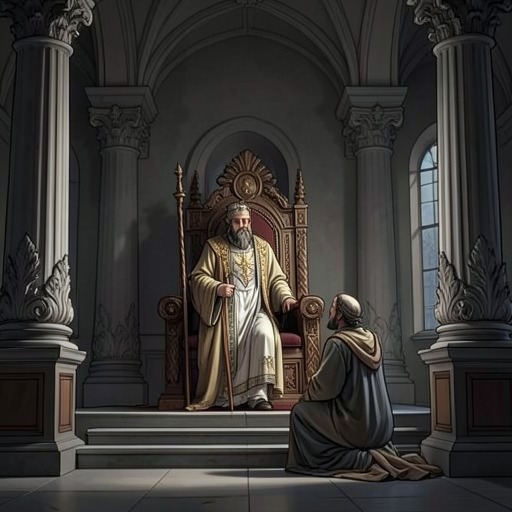
The translator imagines King Wen in Yû-lî with all sixty-four figures arranged before him. In this reconstruction, he attached to each hexagram a name expressing its governing idea, drawing meanings from nature, human society, and the condition or possible future of the kingdom. He then framed those ideas as exhortation or warning. The account understands this work as an effort to restrain the follies of divination by giving the figures an ethical and political interpretive compass; it is the translator’s reconstruction of the tradition, not a claim that the surviving evidence establishes every detail of King Wen’s process.
The Duke of Zhou, King Wen’s son, is credited with the line texts, which supplied a further layer of interpretation for the figures. The distinction matters to the book’s account of authorship: King Wen’s hexagram judgments and the Duke’s line statements belong to the ancient Text, whereas the Appendixes are later writings and should not simply be treated as part of the same original work.
Text, appendixes, and historical memory
The book dates the Appendixes far later than the Text. Even on the assumption that Confucius composed them, their writing could not have begun before 483 BC—roughly six centuries after King Wen’s contribution and nearly 630 years after the Duke of Zhou’s. The translator therefore rejects treating Text and Appendixes as one homogeneous work. He argues that their combination, especially when five Appendixes were broken up and printed beside the Text in common editions, obscured differences in date and interpretation.
The Khang-hsî imperial edition, first published in 1715, printed the two parts separately. Its discussions also show the scale of later scholarship: the edition quoted 218 commentators, covering a span from the second century BC to the seventeenth century. Earlier, a catalogue of the imperial library prepared by Liû Hin near the beginning of the common era listed works on the I Ching and its Appendixes by thirteen authors or schools, comprising 294 portions. These records show that the Kâu house’s association with the Text became the starting point for a long history of commentary, classification, and debate rather than a fixed, untouched body of writing.
Preservation and continuing authority
The I Ching survived Qin Shi Huang’s book burning in 213 BC because it was classified as a work of divination, a category exempted from the destruction of old books. The exception preserved a text traditionally tied to King Wen and the Duke of Zhou even as much ancient Chinese literature was lost. Its survival helped sustain the Kâu dynasty’s place in the history of the classic, but did not settle questions about how the work should be read or who authored its later layers.
The book also describes a persistent tension in the tradition’s reception. Native scholars recognized the chronological distance between Text and Appendixes, and the Khang-hsî edition kept them distinct, yet few critics openly challenged the idea that they formed a unified whole or that Confucius wrote all the Appendixes. The translator values many native commentaries for clarifying the Text, while criticizing the pressure to defend the sage’s infallibility by reconciling every difficulty. Kâu dynasty thus remains central to the classic’s claimed beginnings, while the history of its preservation and interpretation reveals how later readers repeatedly reshaped the authority attached to those beginnings.