King Wen
I ChingKing Wen was the virtuous but politically constrained lord of Zhou whom the book credits with composing the sixty-four brief statements attached to the hexagrams of the I Ching. Its account places this work in the crisis of his imprisonment at Youli around 1143–1142 BC: faced with a hostile Shang ruler and the danger of death, he is said to have worked with the divinatory figures and turned them into a vehicle for admonition and reflection. The book distinguishes his contribution from the line texts attributed to his son, the Duke of Zhou, and from the Appendixes associated with a later age.
Identity and Political Setting
King Wen, originally known as Khang, succeeded his father as ruler of the western principality of Zhou in 1185 BC. Zhou’s lords had long been noted for ability and virtue, and King Wen himself had become more than a local ruler: he acted as a kind of viceroy over a large part of the kingdom. The account describes him as distinguished in both peace and war, and as a model of goodness, wisdom, and self-restraint.
That stature made his position politically fraught. Princes and people, the translator says, would have welcomed his leading an attack on the tyrannical Shang sovereign, but King Wen held back rather than expose himself to the charge of disloyalty. His caution was not a lack of capacity; it was a response to the political order in which rebellion against the reigning monarch could be cast as treason, even when that monarch’s conduct had alienated both Heaven and the people.
The crisis sharpened when the Shang ruler’s suspicion of him was aroused. King Wen was imprisoned in 1143 BC at Youli, identified in the book with a place in present-day Tangyin district, Henan. His confinement was brief: his friends managed to allay the ruler’s jealousy and secure his release the following year. The translator consequently dates the portion of the I Ching assigned to King Wen to 1143 or 1142 BC, allowing that it may have been begun in the first year and completed in the next.
Imprisonment and the Hexagrams
The book sets King Wen’s work against a larger political breakdown. It recounts the accusation that the Shang ruler despised virtue, alienated the people, neglected sacrifices, discarded laws, and indulged in cruelty. In the translator’s reconstruction, the prisoner at Youli thus faced more than personal danger: the kingdom itself was in a state of disorder, while King Wen remained constrained from openly taking up arms against its sovereign.
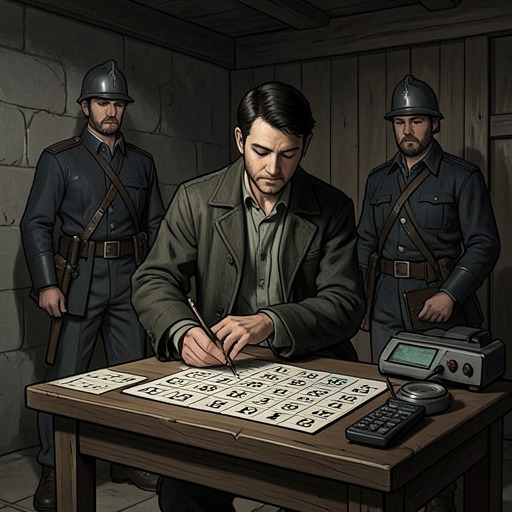
It was in this confinement, with an order for his death liable to arrive at any moment, that King Wen occupied himself with the lineal figures. Divination with figures and stalks was already an established practice. The book points to early references to divining stalks and to the use of tortoise shell and stalks to examine doubts, treating the method as part of the inherited culture in which King Wen would have been familiar with divination.
The translator imagines the sixty-four figures arranged before the imprisoned ruler. In this reconstruction, King Wen associated each hexagram with an idea about nature, human society, or the actual and possible condition of the kingdom. He named the figures with terms expressing those ideas and set them out in short statements that could exhort or warn. The scene is presented as an interpretation of how his contribution may have taken shape, not as a detailed eyewitness record of what occurred in the prison.
The translator suggests that attention to the figures may also have been a politically unobtrusive occupation: if the keepers noticed the work, they might take it for harmless divinatory study. This possible advantage is explicitly conjectural. The stronger claim is about the literary effect the translator ascribes to the hexagram statements: they attempted to confine divination within the bounds of reason, giving inherited figures moral and social significance rather than treating them merely as instruments for fortune-telling.
Contribution to the I Ching
King Wen’s attributed share is defined narrowly: it amounts to sixty-four short paragraphs, one for each hexagram. The translator contrasts these whole-hexagram statements with the larger portion of the book assigned to King Wen’s son, the Duke of Zhou. The Duke’s work treats the individual lines, turning each into an image or case of human experience from which consequences of good or bad conduct may be inferred. The distinction is one of scale and method: King Wen supplies the concise statement for the complete figure; the Duke extends interpretation to its six constituent lines.
The translator also connects King Wen with the names of the hexagrams and their sequence. The later Appendix called the Sequence of the Diagrams, he argues, discusses the names and order in a manner consistent with the idea that they express associated meanings. He treats that Appendix as explanatory testimony, not as the source of King Wen’s work. This distinction matters because the book separates the older Text from the later Appendixes rather than treating everything transmitted together as a single authorial composition.
The historical chronology reinforces that separation. The translator dates the hexagram statements attributed to King Wen to the middle of the twelfth century BC and the completion of the I Ching, including the Duke of Zhou’s contribution, to shortly before the Duke’s death in 1105 BC. The Appendixes, by contrast, are placed in the Confucian period, probably between 450 and 350 BC, and their attribution to Confucius is treated as uncertain. The resulting account does not make King Wen the author of the entire received book: it makes him the earliest of its principal contributors, whose concise statements were later supplemented and interpreted.
Attribution, Transmission, and Legacy
The book presents King Wen’s authorship as a historical attribution supported by a traditional account, rather than as something established without qualification. It reports the claim that the Changes began to flourish in the late age of Yin, when the virtue of Zhou had reached its height and conflict between King Wen and the Shang tyrant had brought anxiety and danger into view. The passage interprets the work’s warnings about peril and overthrow in relation to that crisis. The translator then uses King Wen’s imprisonment and release to propose a date for his contribution, while keeping the boundaries of that claim visible.
The difference between the Text and the Appendixes is central to the book’s treatment of his legacy. It argues that the older Text preceded the Appendixes by centuries and that printing the later material interleaved with the Text obscured the difference between them. The first Han scholar Pi Zhi is named in connection with that blending; common editions placed several Appendixes alongside the older material, producing what the translator regards as confusion between ideas from different periods. The imperial Kangxi edition of 1715, by contrast, printed the two portions separately.
That edition also represents the scale of the interpretive tradition built around the work associated in part with King Wen. It cites 218 scholars, while the translator observes that these were only a fraction of those who had tried to explain the book. He acknowledges the value of native commentaries but criticizes the pressure to defend the consistency and authority of every Appendix by attributing all of them to Confucius. His distinction between the ancient Text and later explanatory writings therefore shapes how King Wen is remembered: not as the unquestioned author of every received layer, but as the ruler to whom the book’s foundational hexagram statements are assigned.
The Changes also survived a later threat to ancient literature. In 213 BC, when the Qin premier Li Si advised that old books be burned, an exception was made for works on medicine, divination, and agriculture. Because the I Ching was classified as a divination book, it escaped the fires. Its preservation carried forward the text associated with King Wen, but also the historical problem that the article insists readers must keep in view: the received classic combines materials of different dates, functions, and degrees of certainty about authorship.