King Wen and the Duke of Zhou
I ChingKing Wen and the Duke of Zhou are presented as father and son whose complementary contributions shaped the early Text of the I Ching. King Wen interpreted the sixty-four hexagrams as wholes; his son Tan, known as the Duke of Zhou, supplied interpretations for their lines. The distinction matters: the book’s compact hexagram statements and its much larger body of line texts arise from different authors and circumstances, though both work through the symbolic, enigmatic idiom of divination.
Historical and textual relationship
The account places King Wen’s contribution in 1143 or 1142 BC, in the period of his conflict with the last ruler of Yin, and the Duke of Zhou’s work some thirty to forty years later. The Duke of Zhou’s line texts refer to King Wu, who succeeded King Wen and became the first sovereign of the Zhou dynasty, as well as to events in the early years of the next reign. The I Ching in the form described is therefore not the product of one moment: its Text had been completed a few years before the Duke of Zhou’s death in 1105 BC, in the last decade of the twelfth century BC.
The book’s discussion distinguishes this early Text from the Appendixes, traditionally attributed to Confucius. Even if that attribution is accepted, the Appendixes were written six to seven centuries after the Text began to take shape. The large chronological gap, and the differences between the two parts, lead the author to reject treating them as a homogeneous work. The father-and-son authorship is thus a claim about the Text, not a claim that they composed the later explanatory materials.
Two complementary kinds of interpretation
King Wen’s share amounts to sixty-four short paragraphs, one for each hexagram. He takes the figures in an order of his own, apparently guided by contrasts between successive pairs, names each figure, and explains its significance as a whole. His statements may also suggest what action suits the circumstances represented and whether that action is fortunate or unfortunate.
The Duke of Zhou’s contribution works at a smaller scale. Beginning with the bottom line of each hexagram, he gives each of its six lines a symbolic or emblematic interpretation, again indicating the likely fortune of acting in the situation it depicts. The account says that King Wen’s reading of a whole figure accords with the combined significance of its lines as interpreted by his son. Their methods differ in scale but are meant to converge: one establishes the hexagram’s general situation, the other unfolds that situation line by line.
The line readings depend on relationships among the figures, not simply on isolated images. A line’s meaning varies with the hexagram’s name and subject, while its position and its correspondence with other lines shape how it is read. In the discussion of a marriage image, for example, a divided second line faces difficulty in advancing but has a strong fifth line in the position of authority to serve; those circumstances lead the Duke of Zhou’s interpretation toward a young woman rejecting an unsuitable suitor and, after ten years, marrying a suitable match. The example shows how line symbolism turns structural relations into a human situation.
Divination, moral counsel, and interpretive limits
Both authors were familiar with divination, whose practice had existed in China for more than a thousand years. The account nevertheless distinguishes writing in the manner of diviners from divining for themselves: King Wen and the Duke of Zhou’s words later became oracles for readers who consulted the hexagrams to consider how events might go and whether to continue or abandon intended courses of action. The inherited form could therefore serve later divination while carrying political and moral reflections in its early composition.
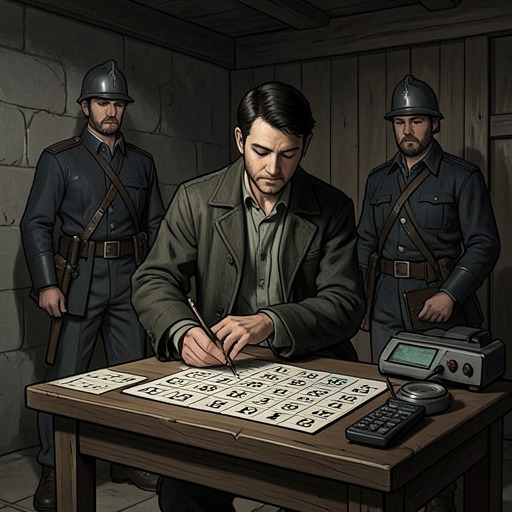
The author imagines King Wen in confinement at Youli with the sixty-four figures before him, assigning each a meaning drawn from nature, human society, or the condition and prospects of the kingdom. In this reading, naming and explaining the figures was an effort to bring the excesses of divination within the bounds of reason, sometimes through exhortation and sometimes through warning. This is presented as an interpretive reconstruction, not as a surviving record of what King Wen did in prison.
The two authors’ symbolic language also makes the Text difficult to translate. The translator’s first English version, made in 1854, attempted to match the Chinese concision and, he judged, became nearly unintelligible. He later argued that Chinese written characters function as symbols of ideas, not representations of words, so a literal rendering cannot reliably convey the author’s thought. A translator must grasp that thought and express it as accurately and concisely as possible, occasionally supplying words that the original leaves implicit. This account of translation reflects the structure of the father-and-son work itself: hexagram and line statements are compact, while their meaning depends on relations that a reader must reconstruct.
The author also resists reading later cosmological theories back into the early Text. Discussing the Appendixes’ treatment of yin and yang, he argues that a doctrine of primordial matter belongs to later intellectual development and should not be assumed to have been the authors’ subject. Their concern, in his view, was the changing phenomena of nature and human experience. The father and son’s significance thus lies not only in their attributed authorship, but in the distinct, successive layers through which their symbolic Text was made and later interpreted.