King Wu of Zhou
I ChingKing Wu of Zhou appears in this account as the son of King Wen, the ruler who succeeded his father and led the decisive campaign against the last Shang sovereign. His crossing of the Yellow River in 1122 BC is presented as the culmination of long waiting and one of the great deeds in Chinese history; it also anchors the book’s account of the transition from Shang to Zhou and the completion of the I Ching’s early texts.
Identity and Historical Setting
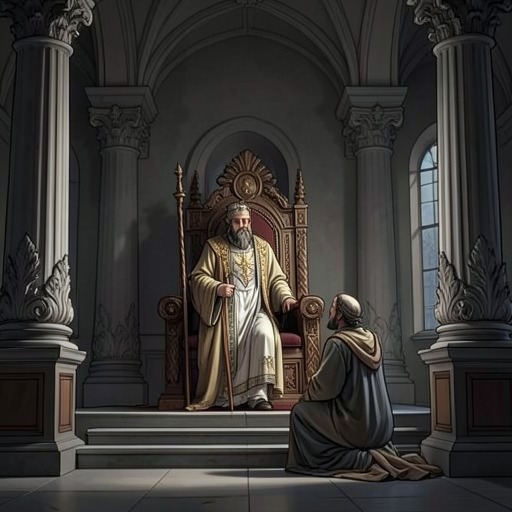
King Wu is identified as the son of King Wen and the first sovereign of the Zhou dynasty. The book distinguishes his role from his father’s: King Wen was a lord of Zhou who never occupied the throne, while King Wu succeeded him and obtained it through the campaign against the Shang ruler. In the account of the I Ching’s composition, this succession marks a change in historical perspective. King Wen’s contribution is associated with the crisis under the Shang, while the greater share of the text is attributed to King Wu’s brother, the Duke of Zhou, whose writings include allusions to the new king.
The setting for King Wu’s rise is a state described as disorganized and demoralized under the Shang. A declaration associated with the campaign accuses the Shang king of contempt for virtue, cruelty toward people, rewarding the wicked, driving away advisers, neglecting sacrifices, and abandoning law. The declaration presents the king’s conduct as a rupture not only with the people but with Heaven. The political indictment supplies the grounds on which King Wu’s advance is represented as more than an ordinary contest for power.
Campaign and Accession
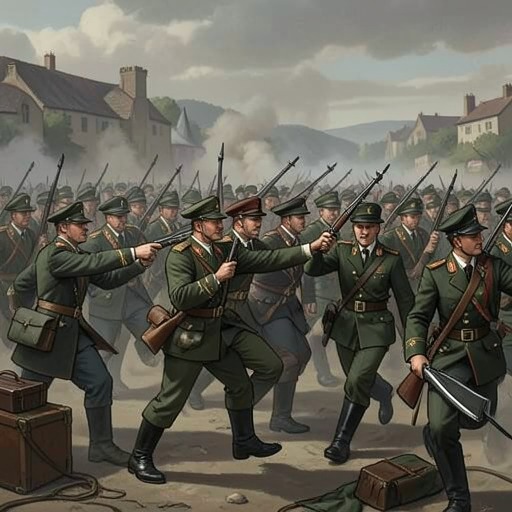
The narrative describes King Wu taking the field against the Shang tyrant and crossing the Yellow River in 1122 BC. The passage is treated as a decisive historical undertaking: the commentary identifies the river crossing with the revolutionary movement against the Shang and calls King Wu’s passage one of China’s greatest deeds. The event is not framed as a sudden exploit. It follows a period of waiting, during which the Zhou side held back until success seemed assured.
That emphasis on waiting connects the military episode to the hexagram teaching discussed in the book. Strength confronted by danger might be expected to rush forward, but the wiser course is to wait until the conditions for success are secure. The commentary reads the expression about crossing a great stream both as a general image for hazardous undertakings and, more particularly, as a reference to the Yellow River and King Wu’s campaign. The image thus joins a practical lesson about timing to a political memory of Zhou’s conquest.
The campaign is also explained as a response to the ruler’s breach of obligations. The charges preserved in the declaration include violence against people, rejection of instruction, disregard for legal rules, and the discontinuance of offerings to Heaven, Earth, and the ancestral temple. In this account, the overthrow of Shang follows a moral and political collapse: the declaration says that Heaven will no longer endure the king and is sending his ruin. King Wu’s action therefore stands within a narrative in which legitimate authority is measured by conduct toward both the people and the sacred order.
Family and Political Relationships
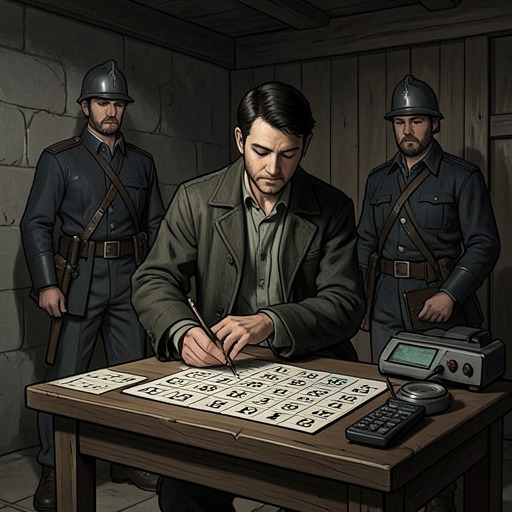
King Wu’s defining family relationship in the account is with King Wen, his father, and the Duke of Zhou, his brother. King Wen is portrayed as the earlier Zhou leader whose restraint kept him from attacking the tyrant while he feared the charge of disloyalty. His imprisonment at Youli brought him close to death, and during that confinement he occupied himself with the lineal figures. King Wu’s later campaign gives political consequence to the crisis in which his father’s work on those figures is situated.
The Duke of Zhou’s position as King Wu’s brother also shapes the book’s account of authorship. The Duke is credited with a larger share of the I Ching than King Wen, and his line texts refer to King Wu, who succeeded their father. The text further suggests that at least one symbolic passage attributed to the Duke may belong to the unsettled regency after King Wu’s accession and before his son, King Cheng, took power. King Wu is therefore present not only as a conqueror but as the hinge between King Wen’s political world and the next generation’s government.
Divination and the Book’s Early History
The book associates King Wu with the practice of divination, placing him in a family tradition rather than treating the practice as King Wen’s solitary innovation. It notes that King Wen’s grandfather divined and that King Wu did so as well. This evidence is used to establish that divination was familiar in Zhou well before the later explanations of the I Ching were assembled.
The account distinguishes divination from certain prediction of future events. Its stated purpose was to test whether a contemplated scheme or set of circumstances would prove fortunate or unfortunate, not to reveal the future absolutely. In the method described for the I Ching, forty-nine stalks are manipulated three times for each line; six lines require eighteen manipulations to form a hexagram. Odd numbers produce strong, undivided lines and even numbers weak, divided lines, while the resulting figure is interpreted through King Wen’s judgments and the Duke of Zhou’s line statements. King Wu’s recorded association with divination belongs to this broader history of practice, but the commentary’s account of the method does not attribute its detailed procedure to him.
The text also limits what can be inferred from numerical symbolism. Numbers help the operator form the line figure; they are not treated as the underlying substance or cause of all things. The commentary rejects the claim that the numbers of the I Ching make every possible natural event knowable in advance, emphasizing instead the distinction between constructing a hexagram and interpreting a contemplated course of action. King Wu’s place in the history of divination thus supports the practice’s antiquity without turning the book into a claim of absolute foreknowledge.
Political Symbolism and Legacy
Several discussions of hexagram imagery use marriage as an analogy for political service, not necessarily as a direct account of King Wu’s own household. One interpretation describes a young woman refusing an unsuitable strong suitor and, after ten years, marrying a suitable match; the pattern illustrates choosing the proper object of loyalty. Elsewhere, a discussion of a ruler and subordinate draws on a marriage arrangement in which a principal bride is accompanied by two women from her father’s household, including a half-sister of lower status. The commentary reads the subordinate woman’s service as an image for an able officer serving a ruler despite disadvantage. These passages help clarify the political world in which King Wu’s accession is discussed, but they do not establish personal events in his life.
King Wu’s lasting importance in the book rests on the convergence of political action and textual history. His victory supplies the historical endpoint to the conflict that frames King Wen’s contribution, while references to the new king help date the Duke of Zhou’s work and the completion of the received I Ching to the late twelfth century BC. The river crossing gives concrete form to a recurring tension in the text: strength must be joined to right timing, and action becomes legitimate when it answers a disordered rule. Through King Wu, the book connects the transition of dynasties to its larger concern with peril, restraint, and the conditions under which a threatened order can be remade.