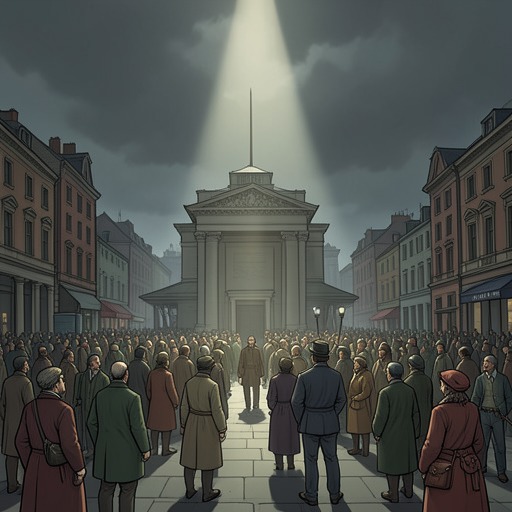
Legal Constraint and Union
I ChingLegal Constraint and Union, Hexagram 21 (Shih Ho), presents law as force applied to obstacles that prevent a community from coming together. The image of jaws closing after they have bitten through what lies between them makes punishment a means of restoring social connection: progress depends not on force for its own sake, but on removing what obstructs understanding between high and low.
Hexagram and Political Meaning
The hexagram’s judgment declares that progress is successful in the conditions it describes and that legal constraints will be advantageous. Its commentary explains the name Shih Ho as “Union by gnawing”: two strong lines occupy the first and last positions, while most of the lines between them are divided. The figure suggests jaws held apart by something in the mouth. Once that obstruction is gnawed through, the jaws can close; in political terms, removing impediments to union allows those above and below to reach a good understanding.
The commentary identifies force with the act of gnawing and specifies legal constraint as its political form. The auspice is favorable: properly directed coercion can succeed in clearing what prevents union. This account gives the hexagram a double emphasis. Law acts upon conflict through force, but its stated end is renewed association, not the perpetuation of punishment.
The Line Texts and Punishment
The line texts distinguish between people who receive punishment and those involved in imposing it. The first and sixth lines stand outside the central action represented by the figure and are interpreted as punished parties; the other lines represent parties inflicting punishment. The structure therefore does not treat every position in the hexagram as sharing the same agency or relation to law.
At the bottom, an undivided line depicts a person with his feet in the stocks and deprived of his toes, yet says there will be no error. The commentary identifies the stocks as punishment for a small offense, administered before crime has made much progress. It also notes a difficulty in the image: if the wording means that the toes are cut off rather than merely restrained, the punishment appears excessively severe to a Western reader. The line thus makes the reach and proportionality of legal force part of the interpretation, even as the judgment accepts restraint at an early stage.
The second line shifts from the punished person to the action of enforcement. Its subject bites through soft flesh and then bites off a nose, with no error. The commentary describes the line as weak, appropriately placed in an even position and centrally situated, and therefore capable of effective action. The soft flesh represents an easy initial obstruction; the strong offender immediately below it will not submit so readily. Punishment must consequently continue and increase until its purpose is secured. Together, these images present enforcement as graduated but potentially severe: the resistance encountered determines how far it must proceed.
At the opposite end, the sixth line depicts a person wearing the cangue and deprived of his ears, and declares the outcome evil. Set against the first line’s early restraint, this final image places punishment at the end of the sequence and marks a bad result. The contrast frames the hexagram’s concern with intervention and outcome: legal force may assist union, but the line texts do not make every use or consequence of punishment auspicious.
Divination, Interpretation, and Historical Context
The hexagram belongs to a text organized as sixty-four short, symbolically expressed essays on moral, social, and political themes, each based on a six-line figure. In the account presented by the translator, King Wen interprets each whole hexagram, indicating its significance and sometimes the action appropriate to the circumstances it symbolizes; the Duke of Zhou then treats the individual lines through emblematic illustrations and judgments of good or bad fortune. The whole-hexagram interpretation is understood to accord with the combined significance of its six lines.
The figures were already associated with divination. The translator points to the use of divining stalks and to an older practice in which doubts were examined by means of both tortoise shell and stalks. In his account, King Wen was familiar with divination as an institution, but the work’s ethical and political readings are not reducible to an oracle about the future. The authors’ words later became oracles for people consulting the hexagrams, while the text itself uses divinatory form to consider whether people should persist in or withdraw from intended courses of action.
The translator situates this interpretive possibility against a picture of political disintegration under the Shang rulers: law was violated by nobles and officers, robbery and treachery spread among the people, and criminals could not reliably be apprehended. In that setting, the idea that legal constraints might remove obstacles to union carries a broader political force. It addresses not simply an isolated offense but a disorder in which law has ceased to bind society together.
Symbolic Language and the Translator’s Method
The translator argues that the Yijing’s difficult style reflects its use of diviners’ language, and that a literal English rendering cannot reliably convey its meaning. He describes Chinese written characters as symbols of ideas rather than representations of spoken words, and treats translation as an effort to participate in the author’s thought and render its sense clearly, sometimes supplying a word needed to make an implied connection explicit. That approach helps explain why the image of gnawing is read at once as a physical arrangement of jaws, a model of legal enforcement, and a principle of political repair.
A related interpretation appears in the account of dense clouds over the western territory of Zhou. Rain that would nourish vegetation is understood as an emblem of blessings that good training and government might bring to the wider kingdom, but which remain restrained. This reading shows how the book’s natural images can carry political implications without stating them as plain historical report. In Legal Constraint and Union, the mouth and the obstructing morsel work similarly: a compact bodily image opens onto a claim about law, authority, and the conditions under which social unity can be restored.