Opposition (Khwei)
I ChingOpposition (Khwei), also called Disunion and numbered Hexagram XXXVIII, portrays a social condition of division and mutual estrangement. Its teaching is deliberately measured: small matters can still meet with success, and local acts of recognition and cooperation may prepare the way toward healing the whole community. The hexagram’s most striking image turns suspicion into kinship: a man raises his bow against what appears monstrous, then lowers it when he recognizes a relative, and the encounter ends in the auspicious rain of union.
Meaning and Scope
The judgment says that, notwithstanding the condition the hexagram denotes, there will be good success in small matters. The commentary explains the qualification: opposition is not overcome all at once. Limited remedies can heal particular breaches and clear a path toward curing the larger social system. The distinction between small success and comprehensive repair gives the hexagram its practical emphasis: division is real, but it need not make every effort futile.
The commentary distinguishes its account from interpretations that find a family theme in the text. Later appendices treat disunion as a consequence of the regulation of the family, but the commentary says that the text itself contains no allusion to family. Its reading instead starts from the hexagram’s represented social state and asks how the lines describe conduct within it.
Reading the Lines
The first line offers a modest image of trust surviving disruption. Its subject has lost his horses, but is told not to pursue them: they will return of their own accord. The commentary connects this return to the assistance of the line’s correlate and to the possibility that people who share a common virtue can help one another despite the prevailing division. The line also advises against shrinking from contact with bad people. Communication with them may be beneficial, both by allowing good to overcome evil and by silencing slander.
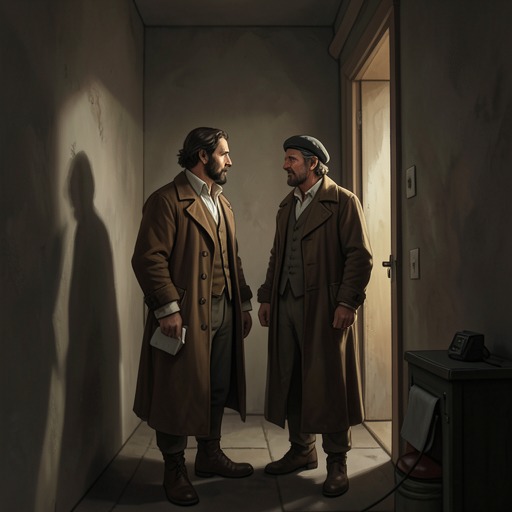
The topmost line brings opposition close to violence. Alone amid the prevailing disunion, its subject looks toward the figure represented by the third line and sees, or imagines, a filthy pig or a carriage laden with ghosts. He bends his bow against the apparent assailant, then unbends it when he discovers not an attacker but a near relative. The movement from hostile misperception to recognition is the line’s decisive change: he goes forward, meets rain, and receives good fortune.
The commentary explains the reversal through the lines’ relation. The strong top line is out of place, and it regards the weak third line through the hostile perspective of disunion, although the two are proper correlates. The grotesque pig and impossible carriage express how estrangement distorts what is seen. Once the supposed enemy is recognized as a friend, action becomes fortunate; the ensuing rain figures the happy union of yang and yin in nature. The image makes reconciliation more than an inward correction: recognition changes what action is possible and brings a favorable consequence.
Interpretation and Significance
The commentary reads the first and topmost lines together as evidence that people of the same class can support one another even when the general condition is divisive. At the beginning, help allows lost horses to return without pursuit; at the end, recognition prevents an attack and permits a meeting. In both instances, the apparent necessity of force or pursuit gives way to a relationship that can be recovered. The contrast gives the hexagram’s counsel its shape: do not assume that opposition has erased every bond, and do not let estrangement dictate the interpretation of every encounter.
The hexagram also illustrates how the book’s whole-figure judgment and individual line images are read in relation to each other. In its account of the text, the translator describes the judgment for the complete figure and the line interpretations as distinct but harmonious levels: the general significance should be understood alongside the combined meanings of its lines. He further stresses that a line’s application depends on the hexagram’s name and subject, and on the positions and relations among lines. In Opposition, the broad diagnosis of social alienation thus meets a sharply particular scene: the bow is drawn, recognition interrupts violence, and a small reconciliation points toward the possibility of a wider cure.
Translation and Limits of Interpretation
The translator presents the difficulty of rendering the Changes as a problem of thought as well as wording. In his account, Chinese written characters are symbols of ideas, and their composition reflects what an author thinks rather than simply reproducing what the author would say in another language. He therefore rejects literal translation as a sufficient method: the translator must first enter into relation with the author’s thought, then express its meaning as accurately and concisely as possible. At times, he says, a few words must be supplied to make explicit what the writer’s thought leaves implicit; he generally marks such additions with parentheses.
That interpretive method matters especially for a text whose imagery can resist easy explanation. The translator acknowledges that readers may find some discussions of the hexagrams disproportionate to their apparent content, while insisting that the difficulty belongs to the source rather than automatically to the translator. His treatment of Opposition displays the method in practice: it separates the judgment’s counsel about limited success from later explanations, distinguishes the text from appendix interpretations, and uses the relation between the hostile image and the eventual recognition to make the line’s movement intelligible without claiming that every image is transparent.