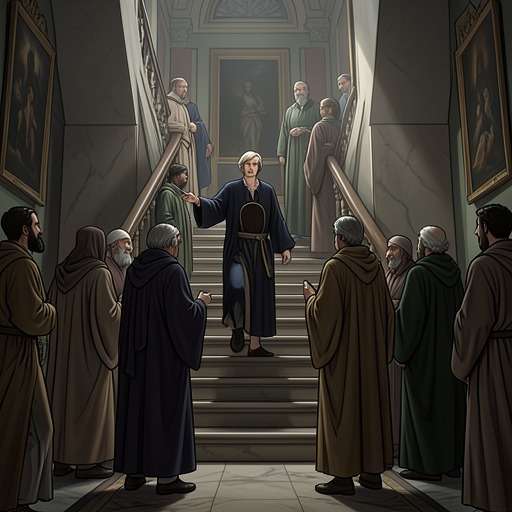
Pushing Upward (Shăng)
I ChingPushing Upward (Shăng), Hexagram XLVI, describes the ascent of a capable officer through a favorable political opening, while insisting that progress must remain governed by judgment. Its central tension is between advancement earned through modest strength and advancement pursued so blindly that even a person who has attained distinction risks losing the benefit of it.
Meaning and Conditions
The hexagram’s judgment promises great progress and success under its conditions. Its subject seeks an audience with a great man and is told to advance southward, an auspicious direction. The commentary reads this not simply as movement through space but as forward progress: the south is associated with brightness and warmth, making the direction an image of a joyful advance.
The opportunity depends on a balance between the advancing officer and the ruler who receives him. The second line, central in the lower trigram, represents the subject of the hexagram: a person combining modesty with force. The ruler’s seat, the fifth place, is occupied by a divided line, which signifies a ruler ready to welcome the officer’s rise. The officer has the qualities for advancement, and the political opening makes their exercise timely.
The Officer’s Ascent
The first line shows a humble and docile figure advancing upward with the welcome of those above; the result is great good fortune. The commentary also notes that this line is weak where strength would ordinarily be expected, treating that weakness as humility rather than a disqualification. Advancement begins not through a claim to power but through receptiveness, and the welcome it receives turns that modest approach into a favorable start.
At the second line, strength is tempered by its position, again conveying modesty joined to capability. The line’s subject is fit to rise, while the divided line in the ruler’s fifth position signals that the ruler will welcome him. The judgment’s promise of success thus follows from a relation between personal qualities and political recognition, not from ascent alone.
The fourth line places the advancing figure beside a ruler who trusts him and raises him to the highest distinction as a feudal prince. The commentary connects the mention of Mount Khî, near the capital of the lords of Kâu, with a historical reading: the king is the last sovereign of Shang, and the prince is King Wen. In this interpretation, the image of advancement reaches beyond an abstract career pattern toward a specific account of political elevation.
Success and Its Limit
The fifth line marks the highest point of dignity. The commentary says that firm correctness is especially necessary there: ascent may now be easy or ceremonious, but rank does not remove the need for restraint. The final line turns that caution into the hexagram’s decisive warning. Its subject keeps pressing upward after gaining all his wishes; the advance has become blind and foolish, and only the most exact correctness can avert the consequences.
This ending complicates the opening promise of progress and success. The hexagram does not treat upward movement as inherently virtuous or endlessly beneficial. Advancement is auspicious when ability meets a welcome and remains disciplined; once achievement becomes a reason to continue without judgment, the very motion that brought success threatens to undo it.
Place in the Book’s Interpretive Method
The book presents the sixty-four hexagrams as short, symbolically expressed essays on moral, social, and political subjects. King Wen interprets each figure as a whole, while the Duke of Zhou treats its lines individually; the line readings are intended to accord with the combined meaning of the figure. Pushing Upward exemplifies how this method turns line positions into a structured account of authority, opportunity, recognition, and restraint.
That account depends on relationships among the lines as well as on the hexagram’s name. The fifth position can represent the ruler, while the second can represent an able officer; their complementary relation helps explain why this hexagram’s upward movement is welcomed and successful. The interpretation is therefore not a general endorsement of ambition, but a conditional political model: advancement is good when the aspiring officer is fit, the ruler receives him, and continued progress remains subject to correctness.