Shangshu
I ChingThe Book of Documents is a major source in the account of how divination and political authority were understood in ancient China. Its references to tortoise-shell and stalk divination help establish that these practices predated the Yijing’s later interpretation; its political declarations, meanwhile, frame the disorder under Shang rule and the challenge to its sovereign. In this historical argument, the work is not merely a storehouse of old statements: it supplies evidence for the ritual setting and political language through which the Yijing is read.
Political Crisis and the Shang Court
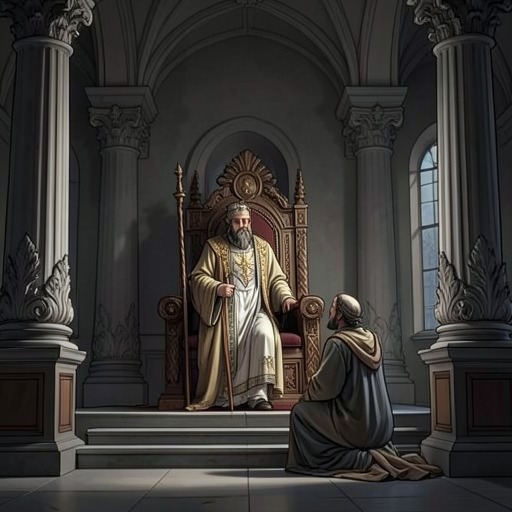
The text’s political voice appears in two sharply contrasting descriptions of Shang decline. One passage, presented as the words of a brother of the reigning king, depicts a realm in which the ruling house can no longer govern effectively. It attributes the loss of the founder’s virtue to addiction to drink, and describes lawbreaking among both officials and ordinary people, uncertainty about whether criminals will be apprehended, and violence among the populace. The dynasty is figured as a person attempting to cross a great stream without finding either ford or bank: the image makes political collapse a crisis of direction as well as authority.
A second declaration, issued by the son of King Wen of Zhou as he took the field against the Shang ruler, makes the crisis an indictment of the monarch himself. It accuses him of contempt for virtue, idleness and irreverence, and of setting himself against Heaven and the people. It also charges him with cruelty, favoring bad counsellors, driving away his instructors, disregarding laws, and neglecting sacrifices to Heaven and Earth and offerings in the ancestral temple. The paired accounts therefore connect the failure of government to the conduct of its ruler: disorder throughout the realm and moral dereliction at court reinforce one another.
The declaration also presents political legitimacy as more than possession of power. Its charges range from the treatment of the people and the administration of law to the performance of public rites. The sovereign’s abandonment of these responsibilities is represented as a breach with both Heaven and the community, making the anticipated fall of his rule a consequence of that breach rather than simply a contest between rival powers.
Divination in an Early Ritual Setting
The Book of Documents is cited as evidence that divination was an established practice long before the Yijing’s interpretive tradition. The account points to an early document associated with the Counsels of the Great Yu, where divining stalks are indicated, and to a section called the Great Plan, associated with the Xia period, which describes using both tortoise-shell and stalks to examine doubts. These references situate divination within a recognized practice of consultation, rather than treating it as an innovation of the hexagram text.
A further passage in the Great Plan sets a limit on what such consultation can authorize. When the tortoise-shell and stalks both oppose people’s views, it says, good fortune lies in stillness and active undertakings will be unlucky. The point is not that consultation supplies certain knowledge of everything to come. Instead, the practice bears on the prospects of a contemplated plan or set of circumstances, and its result can advise restraint rather than action.
The book’s references thus help distinguish the instruments and purpose of divination. Tortoise-shell and stalks are media for examining doubts; they do not, in the interpretation advanced here, make the future absolutely knowable. This qualification matters because descriptions of the Yijing’s divinatory use could otherwise be mistaken for a claim to foretell every future event.
From Stalks to Hexagrams
The account of the Yijing’s procedure gives the stalks a specific operational role. Forty-nine stalks are manipulated three times to determine each line, requiring eighteen manipulations to form a six-line hexagram. Numbers derived from the River Map distinguish strong, unbroken lines from weak, divided ones: odd numbers produce the former and even numbers the latter. The emblematic values 9, 8, 7, and 6 also take part in combining the lines. Once the figure is formed, the consulter turns to the judgments associated with King Wen and the line statements associated with the Duke of Zhou for interpretation.
Numbers in this process are therefore instruments of formation, not, in the author’s account, independent principles governing all existence. The text explicitly contrasts this practical function with the Pythagorean idea that Number is the beginning and cause of things. The analogy between the systems may invite comparison, but it does not erase their difference: in Yijing divination, numbers help produce a hexagram whose meaning is then sought in its received statements.
This procedural description also clarifies why the Book of Documents is relevant to the history of the Yijing. Its early notices of stalk consultation supply a precedent for the medium, while the later process joins that medium to the construction and interpretation of lineal figures. The ritual practice and the moral or political readings of the hexagrams are related, but they are not identical stages of the operation.
Reading Political Counsel through the Hexagrams
The book’s political language also helps contextualize the Yijing’s treatment of authority and military action. In the example of the seventh hexagram, Hosts, the interpretation takes the image of gathered multitudes as a question about how a campaign should be conducted. The commentary reads the image of harmful birds in the fields as plunderers or invaders who may rightly be destroyed, and presents the force as defensive or directed by rightful authority against rebellion and lawlessness.
That account assigns command carefully. The chief authority is represented as weak or humble and entrusts the execution of judgment to the commander-in-chief, identified with the oldest son; the younger men who might share that authority are associated with danger. The final line’s instruction about rewarding distinguished service and appointing rulers of states or chiefs of clans likewise makes military success a question of political settlement afterward. It warns against placing small men in those offices.
Read alongside the Book of Documents’ depiction of a failing Shang court, this hexagram commentary makes the question of legitimate force inseparable from the condition of government. The political passages describe a sovereign whose rule has lost moral and ritual foundations; the hexagram reading, by contrast, makes force defensible when it checks disorder under proper authority. Together, these materials show how divinatory language could be interpreted as counsel about the responsibilities and limits of political power.
Preservation and Historical Use
The Book of Documents is also part of the evidence for the Yijing’s early setting and later reception. The historical account associates divination by stalks and tortoise-shells with documents attributed to very early periods, while warning that such traditional dates do not by themselves settle the history of the practices. What the references establish in the argument is their presence within ancient textual memory and their relevance to the institutions in which the Yijing could be used.
The Yijing survived the Qin book burning of 213 BCE because the proscription exempted works on medicine, divination, and agriculture, and the Yijing was classified as a divination book. This episode does not concern the Book of Documents alone, but it underscores the importance of the ritual category that the earlier documents help illuminate: the text’s preservation depended in part on how its purpose was classified.
Later discussion also uses the Book of Documents to correct an overstatement about divination. A claim that combinations of the lines could provide advance knowledge of every possible occurrence is presented as a misreading; the Great Plan’s warning about stillness when both instruments oppose a proposed course supports the narrower understanding of consultation. The book consequently serves several functions at once: evidence for ancient divinatory practice, a record of political arguments about failed rule, and a check on expansive claims about what divination can reveal.