The Abyss and Danger (Khan)
I ChingThe Abyss and Danger (Khan), also identified as Hexagram XXIX and Repeated Danger, is formed by doubling the trigram Khan, whose image is water and whose name evokes a pit or perilous passage. The hexagram turns that repeated image into a study of danger: not simply the presence of a threat, but its effects on judgment, the different prospects of those caught within it, and the possibility of finding a way out.
Image and Governing Idea
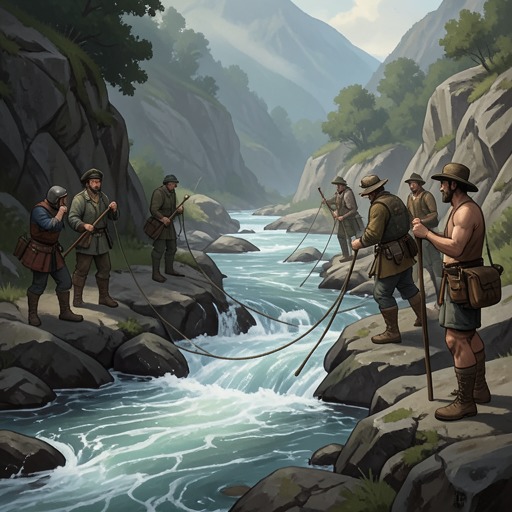
The doubled trigram makes danger the defining condition of the figure. Water flowing through a defile supplies the commentary’s concrete image for a hazard that a person must encounter rather than overlook. The hexagram’s general statement connects this situation with sincerity: inward honesty makes the mind penetrating, and action conducted in accordance with that quality is of high value. Danger thus becomes a test of discernment and conduct, not a promise that every subject will escape it.
The figure’s strong central line, held between divided lines, is read as sincere goodness sharpened through contact with danger. In the commentary’s account, this quality enables its subject to act in a manner worthy of his character; the general statement implies eventual exit from peril, though it does not make the course easy or automatic. The same dangerous setting yields sharply different outcomes for other line subjects, according to their position, strength, and access to help.
Unequal Prospects Within the Defile
At the bottom of the figure, the first line is weak and lacks a corresponding helper above it. Its subject is already in a double defile and enters a cavern within it, deepening rather than escaping the predicament. The commentary treats his case as hopeless: effort only involves him more deeply in danger. The image makes a precise distinction between action that is guided by sound character and movement that compounds exposure.
The second line, by contrast, is strong and occupies the central place within the lower trigram. Though still amid peril, its subject obtains a little of the deliverance sought. The contrast with the first line gives the hexagram’s counsel its conditional force: being in danger does not by itself settle the outcome, and limited relief is different from full release.
Help and position also shape the prospects of the fourth and fifth lines. The fourth line is weak and receives no assistance from its correlate in the first, so its subject cannot avert the danger threatening himself and others. Yet he is close to the ruler in the fifth place and cultivates that intimacy through unostentatious sincerity, represented by the appointments of a simple feast. He cautiously enlightens the ruler, and this relationship leaves him without error. The fifth line itself stands on the eve of deliverance: the waters are expected to find free vent, disappear, and leave the ground level and smooth. Its strength, proper position, and place of honour distinguish it from those still caught without effective support.
The Terminal Warning
The sixth line presents no comparable prospect of relief. Its subject is represented as bound and placed in a thicket of thorns; after three years, he still has not learned the course to pursue. The commentary interprets the thicket as a metaphor for a prison, while acknowledging that it cannot establish a history for the expression. With danger at its height, a weak line, and no proper correlate below, the subject’s case is judged hopeless. The ending therefore refuses a simple assurance of rescue: the figure’s central promise of insight and possible deliverance stands beside a final image of confinement prolonged by an inability to find the way.
Text, Interpretation, and Meaning
The commentary distinguishes the compact, symbolic language of the hexagram from the interpretive work required to make it intelligible. It argues that a translator cannot rely on literal rendering alone: the written characters serve as symbols of ideas, and translation must convey the thought they prompt, sometimes supplying words that the original leaves implicit. Parentheses mark such additions in the English version, while the translator insists that they express what he believes was present in the writer’s thought rather than license invention.
That interpretive method matters to this hexagram because its brief images do not explain themselves. The overall statement, line positions, and individual emblems must be read together: the doubled water establishes danger, while differences among the lines distinguish deepening peril, partial relief, sincere counsel, approaching release, and lasting confinement. The result is not a single prediction for everyone in danger, but a structured account of how character, position, and assistance shape what action can achieve.