The Well (Ȝing)
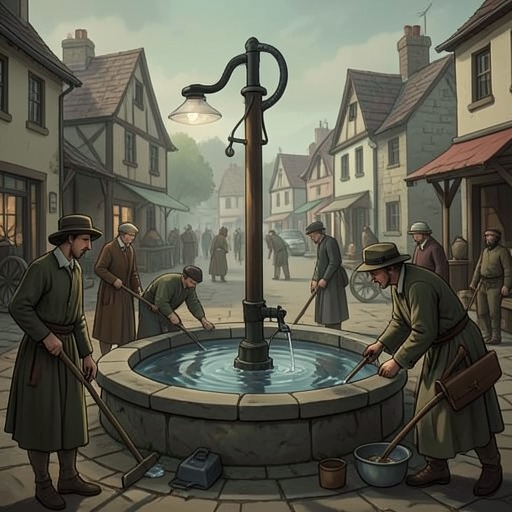
I ChingThe Well (Ȝing), Hexagram XLVIII, makes a durable source of water an argument about public government. Towns and social arrangements may change, but the well remains available to those who come and go; its value lies not merely in its existence, but in whether people can actually draw from it. The hexagram’s movement from a muddy or leaking well to water raised and left uncovered gives that political image a practical test: provision must be sound, accessible, and carried through to completion.
The Well as a Shared Institution
The name Ȝing means a well, and the character is described as pictorial: it represents a plot divided into nine parts, with a central section belonging to the government and cultivated jointly by the eight families occupying the other divisions. A well in the middle was shared property. The image therefore joins an essential resource to a social arrangement of common use, rather than presenting water as a private possession.
The hexagram’s judgment emphasizes continuity amid change. A town’s location or form can alter while its wells remain; the water neither disappears nor receives any great increase, and people arriving or departing can draw and benefit. The well is a dependable provision across changing circumstances. Its lesson for government is correspondingly institutional: inherited principles may remain useful through changes in society, but only if rulers put them into practice for the present.
Access, Maintenance, and Failure
The judgment’s final image sharply qualifies its promise. A person may have nearly completed the drawing of water, yet if the bucket breaks before the rope reaches it, the outcome is evil. Near-success is not successful provision. The resource must be reached and brought up intact; effort or proximity alone cannot deliver its benefit.
The line images trace different failures of that public function. At the bottom, a divided line shows a well so muddy that people will not drink, or an old well visited by neither birds nor other creatures. The commentary reads this as the counterpart of people in authority who are corrupt, useless, and disregarded. Another line presents water escaping through a hole or leaking from a broken basket: what should supply the well is wasted before it can serve those who need it. Against these failures, the topmost line shows water brought up and not covered, an image associated with sincerity and great good fortune. The sequence makes maintenance and openness as consequential as the presence of water itself.
The Political Reading
The commentary calls the hexagram a set of lessons about the good order and government of a country. What the well provides to its neighbors and, more broadly, to people in general, government should provide to a population. Rulers are urged to understand principles handed down from earlier good ages and apply them faithfully to present conditions; the people, and the rulers themselves, are said to benefit when that is done.
The commentary also insists that a well’s value depends on water actually being raised. In the same way, sound principles do not govern merely by being preserved or praised: they must be enacted. Its account of the well as a deep source from which a vessel is lowered and drawn up ties political effectiveness to the last, practical link between resource and recipient. The central image is thus not simply permanence, but useful continuity—public provision that survives change because it is actively administered.
The Well Within the I Ching
The book presents its sixty-four hexagrams as short, symbolically expressed treatments of important themes, mostly moral, social, and political, each grounded in a six-line figure. King Wen interprets the significance of each whole hexagram and may indicate a course of action and its fortune; the Duke of Zhou then interprets the individual lines, beginning at the bottom. The reading of The Well belongs to this layered method: its general image of enduring provision is elaborated through line-by-line contrasts between usable, wasted, neglected, and successfully raised water.
That interpretive structure also belongs to a history of divination. Divination in China used tortoise shells and stalks; the account of the stalk method describes forty-nine stalks manipulated three times for each line, making eighteen manipulations for a hexagram. Odd and even numbers determined strong and weak lines, and the resulting figure was interpreted through King Wen’s judgments and the Duke of Zhou’s emblematic line statements. The translator distinguishes this practical purpose from a claim to know the future absolutely: divination was meant to assess whether contemplated plans or circumstances would turn out fortunately or badly. In The Well, that framework gives a public image of water both an interpretive and a decision-making role.
Interpretation and Limits
The translator warns that the classical text’s compressed, symbolic style makes it exceptionally difficult to render intelligibly. His first translation, made in 1854, tried to match the original’s concision and became nearly as unintelligible as an earlier Latin version. He later argued that Chinese written characters function as symbols of ideas, not representations of spoken words, and that a translator must therefore render the author’s thought rather than mechanically reproduce a literal sequence. The aim, he stresses, is still to express the original meaning as exactly and concisely as possible; occasional added words clarify what the original leaves implicit.
That account matters to The Well because its political force is developed through interpretation: a shared source of water becomes a model for government, and the details of drawing, leaking, neglect, and access become judgments about administration. The commentary does not treat the image as abstract praise of permanence. It makes the well answer to a concrete standard—whether its benefit reaches the people—and turns the broken bucket into a warning that even a nearly completed undertaking can fail at the point of delivery.