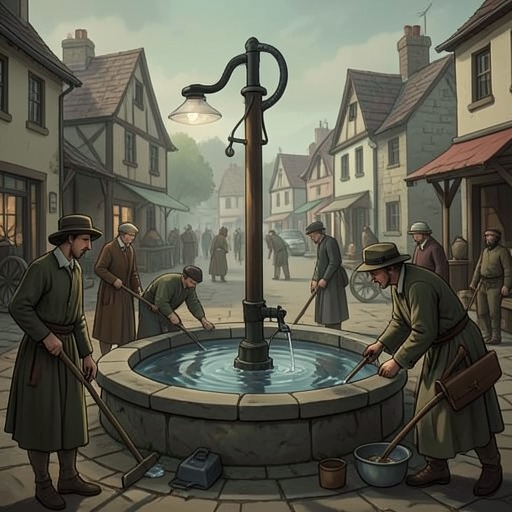
The Well Never Dries Up
I ChingThe Well Never Dries Up expresses a political lesson through the image of a shared well: enduring provision benefits a community only when it remains accessible and is actively put to use. In the interpretation of Hexagram 48, the well’s water persists through changes in the surrounding society, while government is measured by whether it reliably serves the people.
The Well as a Figure of Continuity
The hexagram’s central image distinguishes the well from the town around it. A town’s site may change, but the well does not; its water neither disappears nor receives any great increase. People coming and going can draw from it and share its benefit. Continuity here is not mere permanence for its own sake: the well matters because it remains a dependable resource amid change.
The image also marks the risk of failed access. Even when drawing the water is nearly complete, a bucket that breaks before the rope reaches it makes the outcome bad. The resource may endure, yet the effort to reach it can still fail. The expression thus holds together lasting capacity and the practical means required to make that capacity useful.
Government as Public Provision
The commentary explicitly likens the well to government: what a well is to the people living nearby, government is to a people. The comparison gives political responsibility a concrete measure. Rulers should understand sound principles handed down from earlier good ages and apply them faithfully to present conditions; doing so benefits rulers and their people alike.
The water must actually be raised from the well. Its value lies not simply in existing below ground, but in being drawn up for refreshment and for cultivating the land. In the same way, inherited principles of government cannot sustain a community as abstractions: they must be carried out. The image therefore links the continuity of public institutions to the everyday work of making their benefits available.
A Contrast with Disorder
The book’s wider political discussion gives this ideal a pointed contrast. Its account of the failing Yin state describes lawlessness, insecurity, and a breakdown of rule, while the denunciation of its sovereign associates that disorder with neglected duties and the abandonment of established rites. Against this picture of a political order unable to provide dependable direction, the well stands for a stable source of collective benefit.
Other hexagram interpretations likewise connect political and military authority to public order. In the example of Hosts, the commentary presents force as justified when directed against plunderers and invaders or used by rightful authority to suppress disorder, and warns against divided command. In Great Havings, the opening judgment promises progress and success under the circumstances of the hexagram. These examples do not replace the well’s specific lesson; they show the broader interpretive practice of reading hexagram images and judgments as guidance on the conditions of sound action and governance.
Image, Text, and Interpretation
The well’s political meaning emerges through the book’s symbolic method. Its short essays take moral, social, or political themes from figures made of six whole or divided lines. The interpretation of a whole hexagram is considered in relation to its lines, and the significance assigned to those lines depends in part on their positions and on the name and subject of the hexagram. The well is thus not merely a decorative comparison: it is an image read within a structured system of figures and judgments.
The translator describes the Chinese written characters as symbols of ideas rather than representations of spoken words, and argues that a literal version cannot adequately convey the author’s thought. Translation must render that thought intelligibly without claiming license to depart from it. The well’s lesson accordingly depends on interpretation, but its practical emphasis remains concrete: a resource may be durable, and principles may be inherited, yet their value is realized only when people can draw on them.