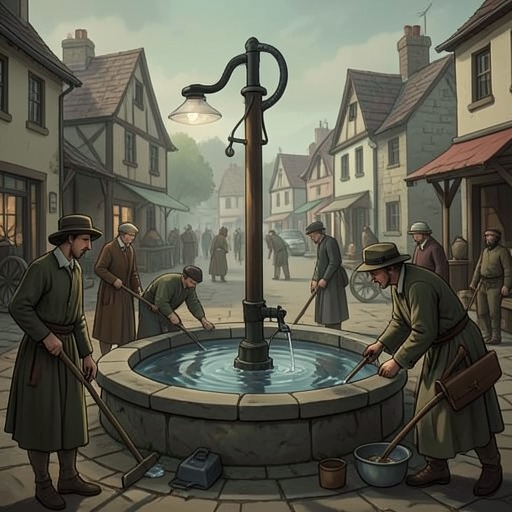
The Well as Public Provision
I ChingThe Well as Public Provision is the interpretation of the well in Hexagram 48 as a model of government: a community’s circumstances may change, but its shared source of sustenance must remain available and be actively maintained. The image’s promise of continuity is conditional. Water benefits people only when it can be drawn; correspondingly, inherited principles of good government matter only when rulers put them into practice.
The Well and the Common Good
The hexagram contrasts a changing town with wells that do not change in their essential character. The water neither disappears nor receives any great increase, while people arriving and departing can draw from it and enjoy its benefit. The well thus stands for a durable provision shared across generations and changing circumstances, not a resource reserved for one ruler or one moment.
Its original written form, as explained in the commentary, represents a tract of land divided into nine portions. The central portion belongs to the government and is cultivated through the joint labor of the eight families occupying the other divisions; a well in the center is the common property of all. The image therefore joins public provision to shared work and communal access. Its political force lies not merely in the existence of a resource but in the arrangement that makes it available to those who depend on it.
A Resource Must Be Made Usable
The commentary presents the well as a lesson for the good order and government of a country. Just as a well serves nearby people by supplying water, government serves a people through the principles it inherits and applies. Rulers who rightly understand those principles and faithfully regulate the present by them can bring benefit both to themselves and to the people.
That benefit depends on action, not on the continued existence of an ideal in the abstract. The well is described as substantially the same through many changes in society, a dependable source of refreshment and water for cultivating the ground. Yet the water’s value depends on its being raised from the depth in a vessel lowered from above. In parallel, sound principles of government must actually be carried out. Continuity without implementation is only a promise; provision becomes real through competent administration.
The hexagram’s warning about a bucket broken just before it reaches the water makes this condition especially sharp. A task nearly accomplished can still end in evil if the means of access fails at the last moment. The image measures public provision by whether people can obtain its benefit, not merely by whether the resource remains present.
Failures of Administration
The line images distinguish different ways a well can cease to serve. At the bottom of the figure, a weak line suggests a well so muddy that people will not drink, or an old well to which neither birds nor other creatures come. The commentary extends this image to people in authority who have become corrupt, useless, and unregarded: their position remains, but it no longer supplies what the community needs.
The second line offers the opposite potential and a different failure. It is strong and can suggest an active spring feeding the well, the ground, and its cultivators. But because it occupies an inappropriate position and has no proper correlate, its cool water cannot be brought to the top. The commentary draws a lesson about ministers: a country needs officials able and willing to administer government properly. Capacity that cannot be put to effective use is still a failure of provision.
At the upper end, the water is brought to the surface and the well is left uncovered. This image suggests sincerity and is associated with great good fortune. The contrast completes the hexagram’s practical argument: a public resource must not be rendered inaccessible, hidden, or wasted. Its beneficial character is fulfilled when it is brought within reach.
The Well’s Place in the Book’s Transmission
The well’s lesson appears within a text whose own history of preservation and interpretation illustrates the importance of access. The Yî survived the book burning of 213 BC because it was treated as a work of divination, an excluded category in the order to destroy old books. By the beginning of the common era, a catalogue of the imperial library listed works on the Yî and its appendixes by thirteen authors or schools, in 294 portions; the imperial edition of 1715 later quoted 218 commentators.
The account also insists that the older Text and the Appendixes be distinguished. The Text was attributed to King Wen and the Duke of Zhou, while the Appendixes were traditionally associated with Confucius and were considered much later. The two bodies of writing could therefore preserve different stages of interpretation rather than one undivided work. Their common editions had often interleaved five Appendixes with the Text, a layout the translator argued had confused readers by bringing incongruous ideas together. The imperial Kangxi edition printed the parts separately, although many scholars continued to defend their unity and the attribution of all the Appendixes to Confucius.
The commentary tradition is itself presented as a source of public and intellectual value. The imperial edition of 1715, identified as the Kâu Yî Keh Kung, gathered discussions and decisions on meaning that, in the translator’s view, helped raise interpretation of the Yî to a science. Like the well, the classic could persist through historical change; but its continuing usefulness depended on the work of preserving, distinguishing, and interpreting what it contained.