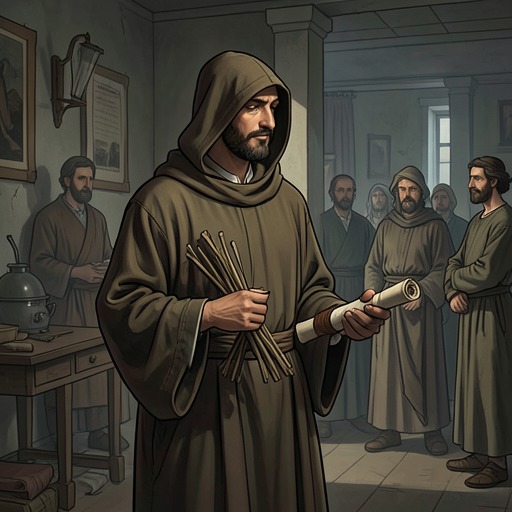
Yarrow-stalk divination procedure
I ChingThe Yarrow-stalk divination procedure is a rule-governed method for producing a hexagram and consulting its textual interpretations. It uses forty-nine stalks, manipulated eighteen times to form the six lines, with odd and even numbers determining strong and weak lines; the resulting figure is interpreted through the judgments associated with King Wen and the line statements of the Duke of Zhou. In the account presented here, divination’s proper question is whether a contemplated plan or set of circumstances is auspicious, not what the future must inevitably bring.
Historical Setting and Materials
Divination was already an established practice in early China. The account points to references to tortoise-shell divination in an early document of the Book of Documents and to the later use of plant stalks with lineal figures. It identifies the plant as Ptarmica Sibirica, said to have been cultivated around Confucius’s grave, where the translator reports seeing it grow. The method therefore belongs to a wider practice involving both stalks and tortoise-shell, rather than being an isolated technique invented solely for the hexagrams.
The historical narrative also places divination in the political crisis of the Shang state. A description attributed to a brother of the reigning king depicts a land afflicted by lawlessness, official misconduct, and the breakdown of rule; a later declaration denounces the ruler’s conduct and predicts the fall of his authority. Against this background, the account presents King Wen, imprisoned in Youli under suspicion, as familiar with divination and occupied with the lineal figures. The procedure’s setting is thus linked to a period when political disorder and questions of legitimate rule gave the hexagrams a social and political significance as well as a divinatory one.
Operations and Formation of the Hexagram
The procedure begins with forty-nine stalks. Each line is formed through three manipulations, and six lines require eighteen manipulations in all. This repeated handling converts the stalks into numerical results from which the line pattern is determined. The operations are described as demanding time and thought to master, so the method is not presented as an immediate or casual drawing of a symbol.
Odd numbers produce strong, undivided lines, while even numbers produce weak, divided lines. Four emblematic symbols, assigned the numbers 9, 8, 7, and 6, play a part in combining the line results into a hexagram. The account also connects the numbers with the River Map, while cautioning that the map’s later depiction makes the precise historical derivation uncertain. Whatever the uncertainty about that scheme, the practical role assigned to number is clear: it helps the operator form the figure.
Interpretation and Scope
Once the figure has been formed, its interpretation turns to the judgments of King Wen and the emblematic line statements of the Duke of Zhou. The procedure therefore has two distinguishable stages: numerical manipulation produces the hexagram, and the inherited texts provide the terms through which it is read. The numbers are not treated as an independent explanation of the material world. The account explicitly distinguishes this function from the Pythagorean idea that number is the underlying principle and cause of things.
The consultation is also limited in aim. It does not, in this account, disclose future events as fixed facts; it tests whether schemes under consideration, or conditions of events contemplated by the consulter, are likely to turn out well or badly. A cited passage on examining doubts makes the practical emphasis especially plain: when both the shell and the stalks oppose people’s views, stillness is fortunate and active undertakings are inauspicious. The result bears on a decision about action, not on an absolute forecast of everything to come.
Belief, Criticism, and Significance
The procedure’s ritual authority rests partly on a belief that the stalks possess a spirit-like quality suited to divination. The account reports that an appendix describes Heaven as producing such spirit-like things and includes the tortoise and plant among them. It also notes that later writers questioned what could be learned from an old shell and withered stalks, and cites a story in which a diviner dismisses them as mere objects and advises a petitioner to listen to himself. The contrast separates belief in the medium’s efficacy from the method’s mechanical description.
The translator is skeptical of divination’s truth claims and judges the method no less vain than other forms of divination. He nevertheless draws an important distinction between that criticism and the procedure’s stated function: numbers assist in making the hexagram, while the consultation concerns the auspiciousness of contemplated plans rather than certain foreknowledge. This distinction helps explain how the method can be both a practical ritual for forming and reading figures and, in the surrounding interpretation, a vehicle for reflections on conduct, political authority, and the consequences of action.